September 9, 2026 • Roxanne Flair • 11 min reading time • Prices verified June 4, 2026
The Yamaha MG10XU vs. FIFINE Mixer Decision: When You've Already Bought Wrong Once
The Yamaha MG10XU vs. FIFINE Mixer Decision: When You’ve Already Bought Wrong Once
A mixer — short for audio mixer or mixing board — is the hardware box that lets you combine multiple sound sources (microphones, instruments, playback devices) into one clean output signal sent to your speakers, recording software, or streaming platform. If you’re reading this, you’ve probably already owned one, and it probably disappointed you in some specific, maddening way. Maybe there was a hiss behind every recording. Maybe the controls ran out of room the moment you tried to add a second microphone. Maybe it stopped working six months in. This guide is for the person ready to buy more deliberately the second time — whether that means spending $200 on the Yamaha MG10XU or accepting that a purpose-built option like the FIFINE AM8 still covers everything you actually need.
Here’s the core decision frame: the Yamaha MG10XU is a small-format analog mixer built for reliability and signal quality across multiple inputs and real-world events, while the FIFINE AM8 is a compact USB-first mixer built specifically for streaming and gaming setups. They’re not really competitors in the traditional sense — they target different ceilings. The question is whether your ceiling has changed.
| EDITOR'S PICKYAMAHA MG10XU 10-Input Stereo M… | Mid-tierBoytone Dj Mixers 8 Channel Aud… | Budget pickPyle 5-Channel Rechargeable Min… | |
|---|---|---|---|
| Channels | 10 | 8 | 5 |
| Bluetooth | — | ✓ | — |
| 48V phantom power | — | ✓ | — |
| Rechargeable | — | — | ✓ |
| XLR input | — | — | ✓ |
| Price | $294.99 | $179.00 | $46.75 |
| See on Amazon → | See on Amazon → | See on Amazon → |
What “Buying Wrong Once” Actually Costs You
The most consistent pattern in long-run Yamaha MG10XU owner feedback is that buyers describe the purchase as a correction, not a first buy. The phrase “buy once, cry once” appears repeatedly, and the difference in noise floor — the background hiss a mixer adds to your signal even when nothing is playing — tends to be audible immediately after switching from a budget unit. That’s not a subtle audiophile distinction; it’s something podcast listeners and event clients can hear.
What goes wrong with cheap mixers breaks down into three predictable failure modes:
-
High noise floor. Budget preamps — the internal circuits that amplify your microphone signal — are often poorly shielded and introduce hiss. According to Yamaha Pro Audio’s published MG10XU product specifications, the MG series uses D-PRE preamps (discrete, Class-A circuitry), which represent a substantial step up from generic IC-based designs in the same price range.
-
Gain staging limitations. Gain staging means setting the right amplification levels at each step of the signal chain so your output is loud and clear without distortion. Cheap mixers often have coarse, imprecise gain knobs that make this guesswork. The MG10XU’s channel gain controls have enough range and resolution that owners running dual-duty home-and-live setups consistently report stable performance across both contexts.
-
Build failure. Pots (rotary knobs) and faders on budget units are frequently the first things to fail, introducing crackling or dropout. Sound On Sound’s coverage of the Yamaha MG series specifically notes construction quality as a standout differentiator at this price tier — a distinction that becomes obvious after a first mixer has physically degraded inside of a year.
The Four Mixers: Side-by-Side by Use Case
Rather than a flat feature list, the honest comparison here is use-case scoped. Each of these four products has a context where it’s the right answer and a context where it’s undersized or over-specified. The H3 sections below address each tier directly.
The FIFINE AM8: Right Tool for Single-Source Streaming
Pyle
$46.75
In stock on Amazon
Check price on AmazonThe FIFINE AM8 is a compact USB-C mixer designed for the most common modern content creation scenario: one microphone, one computer, one platform. Within that scope it delivers straightforward USB audio interface functionality, on-board muting, basic level controls, and plug-and-play operation without driver installation.
Wirecutter’s coverage of audio mixers for podcasters and streamers draws the line for budget USB mixers at channel count and gain control flexibility — criteria where the AM8 is explicitly scoped for minimal setups rather than multi-source production. That’s not a flaw. It’s an honest scope boundary.
Where it works: Single-mic home streaming, gaming commentary, solo podcast recording in a treated room.
Where it fails: The moment you add a second microphone, run a live panel, or need to manage independent mic levels for two hosts in real time, the AM8’s controls become a hard ceiling. It was not designed for multi-source live events, complex gain staging across dynamic and condenser microphones, or running a monitor mix alongside a house mix.
Decision rule: If your entire setup is one microphone into one computer for one platform, and you are not hosting live events, the FIFINE AM8 is not a compromise. It’s appropriately scoped. Upgrading to the Yamaha in that scenario means paying for capability you will never use.
Pyle
$46.75
In stock on Amazon
Check price on AmazonThe Boytone 8-Channel and Pyle Portable: Honest Placement for Budget Alternatives
Pyle
$46.75
In stock on Amazon
Check price on AmazonTwo other mixers appear consistently alongside these two in buyer searches. They deserve direct placement rather than a vague feature list.
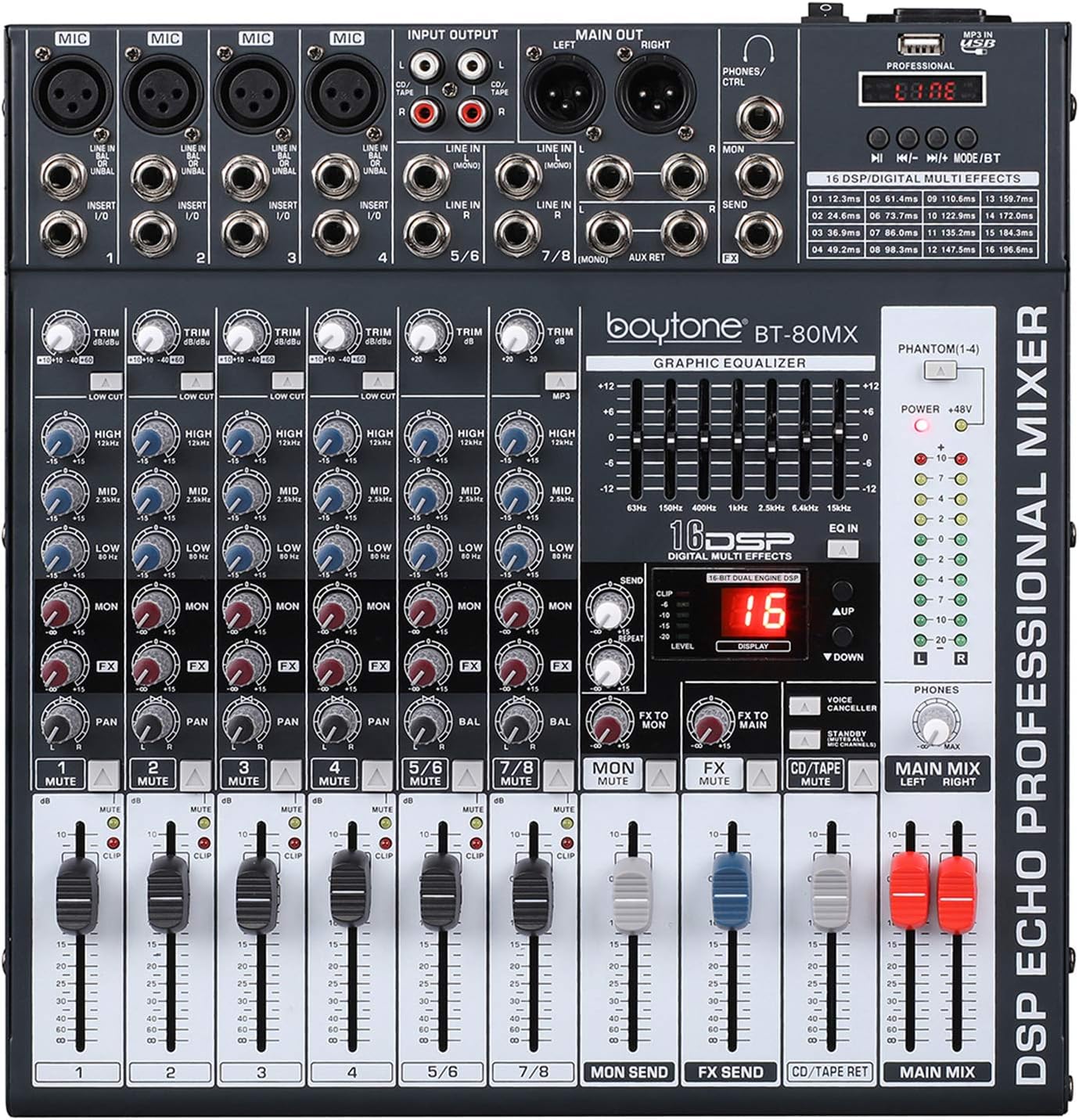
Boytone 8-Channel Mixer earns reasonable value marks for buyers who need channel count on a tight budget. The critical caveat, documented in owner reviews: the 16 DSP “effects” onboard are not 16 distinct effects. They are a single echo algorithm applied at 16 different time values. Buyers who credit Boytone for overall build quality still flag the effects feature list as marketing language rather than functional breadth. For anyone considering the Boytone for live DJ performance or event sound design where effects are part of the creative workflow, that distinction matters — you are getting one effect dressed up as sixteen. For basic multi-source mixing without effects as a performance tool, it’s a reasonable entry point.
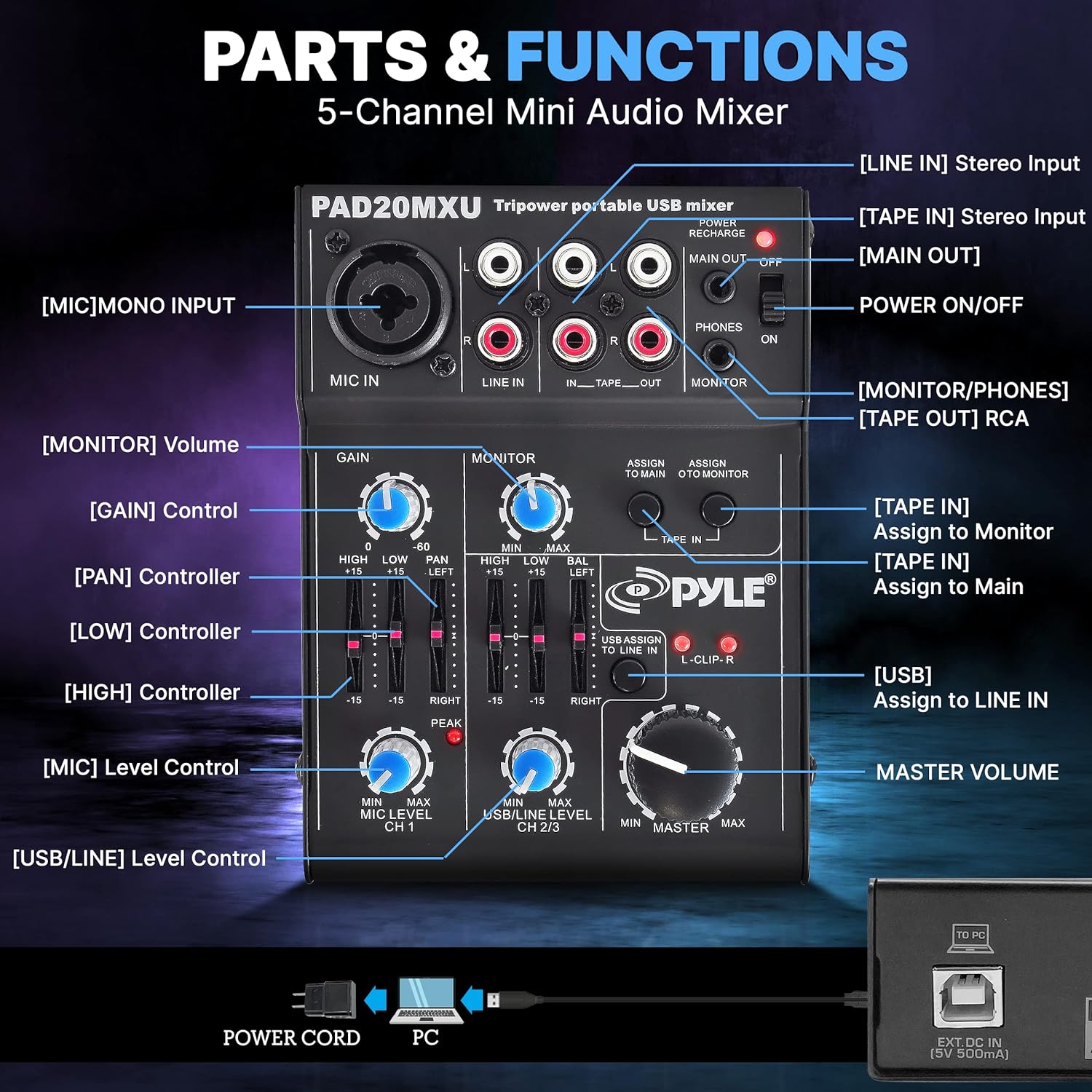
Pyle Portable Mixer occupies a genuinely specific position: it is, based on owner reports and verified product specs published by Pyle Audio, the only sub-$50 mixer with both battery power and USB connectivity that buyers consistently surface in searches for mobile setups. Fitness instructors and teleconference hosts who need a cord-optional, battery-backed USB mixer often find the Pyle almost by accident — it’s simply the only result that fits that narrow brief. Within that use case it earns strong marks. Outside it, preamp quality and limited controls follow the same ceiling pattern as the FIFINE.
Pyle
$46.75
In stock on Amazon
Check price on AmazonThe Yamaha MG10XU: When Your Workflow Has Outgrown the Budget Tier
Boytone
$179.00
In stock on Amazon
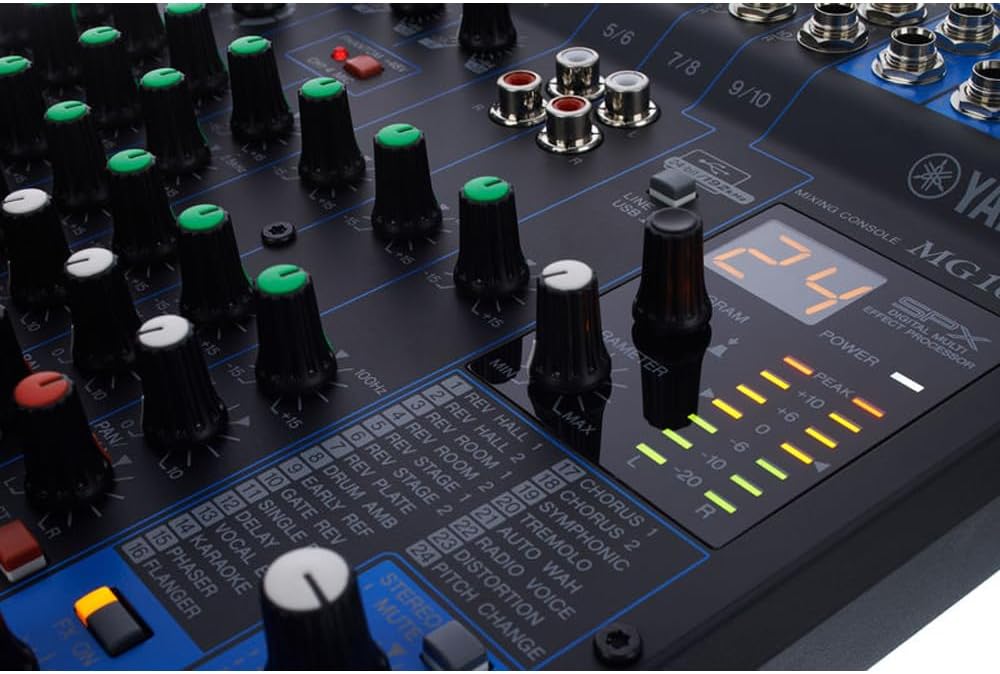
Check price on AmazonThe Yamaha MG10XU is the inflection point between consumer-grade mixers and professional small-format audio. It offers 10 channels (4 XLR mic inputs), 48V phantom power for condenser microphones, a built-in USB audio interface, and the D-PRE preamps that Yamaha Pro Audio’s published MG10XU specifications describe as discrete, Class-A designs — meaningfully different from the IC-based preamps found in budget units.
Sound On Sound’s review coverage of the Yamaha MG series identifies construction quality as a standout at this price point, which tracks with the long-run owner pattern: people who buy the MG10XU after a budget mixer has failed them physically describe the build as immediately noticeable. Knobs with resistance and precision, faders that move without crackling, channel strips that feel like they were designed for repeated use.
Wirecutter’s mixer coverage for podcasters and streamers consistently points to channel count and gain control resolution as the dividing line between mixers that scale and mixers that cap — and the MG10XU clears both criteria for setups that have grown beyond a single desk microphone.
Where it works: Multi-host podcast recording, small live events and venue acoustic sets, hosted Zoom panels requiring independent mic management, any setup where a condenser microphone needs phantom power, dual-duty home-studio-and-live workflows.
Where it may be over-specified: A solo home streamer with one USB-friendly dynamic mic and no plans to expand. The MG10XU’s capabilities won’t be used, and the FIFINE AM8 covers that use case at a third of the price.
Decision rule: If you’ve added a second microphone, run any live or semi-live event, need simultaneous recording and speaker output, or are miking anything that requires phantom power — the MG10XU is the appropriate tool and the alternatives are under-specified.
Boytone
$179.00
In stock on Amazon
Check price on AmazonBy the Numbers
| Mixer | Channels | Phantom Power | USB Interface | Battery Option | Approx. Street Price (2026) |
|---|---|---|---|---|---|
| Yamaha MG10XU | 10 (4 mic) | 48V included | Yes | No | ~$200 |
| FIFINE AM8 | 4 (1 mic) | No | Yes (USB-C) | No | ~$60–$80 |
| Boytone 8-Ch | 8 (2 mic) | Yes | No | No | ~$80–$100 |
| Pyle Portable | 4 (2 mic) | No | Yes | Yes | ~$40–$55 |
Prices reflect aggregated market listings as of May 2026 and are subject to change.
Frequently Asked Questions
Is the FIFINE mixer good enough for a semi-professional podcast, or only for gaming and streaming?
It depends entirely on what “semi-professional” means in your workflow. One host, one microphone, recorded at home and edited before publishing — the FIFINE AM8 is adequate. It delivers clean USB audio for spoken-word content in a treated room. Where it hits a wall is multi-host recording, live interview setups, or any scenario requiring two independent microphone levels managed in real time. Wirecutter’s coverage of audio mixers for podcasters draws the line at channel count and gain control flexibility — criteria where the Yamaha MG10XU leads at this price tier, per Sound On Sound’s MG series review.
What exactly is wrong with cheap budget mixers that makes people upgrade to the Yamaha?
Three things, in descending order of how often they appear in upgrade-motivated owner accounts: noise floor (audible hiss from low-quality preamps), gain control imprecision (coarse knobs that make clean levels hard to dial in), and physical durability (knobs and faders that crackle or fail under regular use). Yamaha Pro Audio’s published MG10XU specifications specifically document the D-PRE preamp design as addressing the first problem. The second and third follow from Yamaha’s MG series construction standards, which Sound On Sound identifies as a differentiator at this price point.
Does the Yamaha MG10XU require phantom power for condenser microphones, and is 48V included?
Yes and yes. Condenser microphones — the studio-style mics used in most home recording setups — require 48V phantom power, a small electrical charge sent through the microphone cable to power the mic’s internal circuitry. The MG10XU supplies 48V phantom power on its XLR channels via an onboard switch, per Yamaha Pro Audio’s published MG10XU product specifications. You do not need a separate phantom power supply. Dynamic microphones such as the Shure SM58 do not require phantom power and are unaffected when the switch is active.
Are the Boytone DSP effects actually usable for live performance or event DJing?
No — not in any meaningful creative sense. As documented in owner reviews and consistent with the product’s published feature descriptions, the 16 DSP effect slots on the Boytone are a single echo algorithm with 16 preset time values. There is no modulation, no pitch-based effect, no filtering, and no parameter customization beyond preset selection. For a DJ or live sound operator who expects effects as a performance tool, this is a significant functional limitation relative to what the feature count implies. The Boytone is a reasonable budget mixer for basic multi-source mixing; it is not a performance effects unit. For event DJing with effects in the signal chain, purpose-built DJ mixers with dedicated FX sections — reviewed regularly by DJ Mag and Mixmag — are the appropriate category.
Can the Pyle portable mixer run on USB power alone without the internal battery?
Based on Pyle Audio’s published product specifications and owner accounts, the Pyle portable mixer is designed to operate in multiple power modes including USB bus power from a laptop or power bank. Multiple owners confirm operation without the battery when connected via USB. Long-run owner reports note that output volume runs slightly lower in USB-only mode compared to battery operation — relevant for live fitness or PA contexts rather than desktop use.
The Verdict
If you’ve already bought a cheap mixer and felt its limits, you already know what you’re buying when you upgrade to the Yamaha MG10XU — you’re buying the thing that doesn’t fail the moment your workflow gets even slightly more complex. The “buy once, cry once” framing that appears repeatedly in owner accounts isn’t dramatic; it’s practical math. The Yamaha costs roughly three times the FIFINE and two to three times the Boytone, but it expands with your setup instead of capping it.
Sound On Sound’s MG series coverage and Wirecutter’s podcaster mixer guidance both point toward the same dividing line: channel count, gain control resolution, and preamp quality. The Yamaha MG10XU clears all three. The alternatives are correctly scoped for simpler workflows and incorrectly scoped for anything beyond them.
Our read: If your workflow has any live or semi-live dimension, any multi-mic requirement, or any need for reliable performance outside a single fixed desk — the Yamaha MG10XU is the correct purchase and the alternatives are under-specified. If you are genuinely a single-mic home streamer with no plans to expand, the FIFINE AM8 is not a consolation prize. It’s appropriately scoped. Know your ceiling before you buy for it.