September 25, 2026 • Roxanne Flair • 10 min reading time • Prices verified June 4, 2026
Turntable Preamps and Output Options: What Beginners Discover Too Late
You finally got a turntable. You’ve got the records. You’ve got the speakers or a receiver sitting on the shelf. You plug everything together — and nothing happens, or it sounds like someone talking through a pillow from the next room. Welcome to the most common first-day turntable problem that nobody warned you about. The issue, almost every time, comes down to one word: preamp (short for preamplifier). A turntable’s needle produces a signal that is extremely quiet and also tonally unbalanced by design — a technical standard called the RIAA curve means bass is deliberately rolled off during the recording process and has to be restored on playback. A preamp does both jobs: it makes the signal louder, and it corrects that tonal balance before the audio hits your speakers. Without one in the chain somewhere, you get either silence or a thin, tinny whisper.
This guide is for people who already have a turntable under consideration or in hand — you know enough to have opinions, but the preamp question still feels slippery. We’ll map out every output scenario you’re likely to encounter, name the tradeoffs honestly, and give you a clear decision rule by the end. No spec dumps, just the framework you actually need.
Phono Level vs. Line Level: The Core Distinction That Changes Everything
Every other decision in this article branches off this one fork, so let’s settle it cleanly.
A turntable’s raw output is called phono level — it’s roughly 40 to 60 decibels quieter than what your amplifier, receiver, or powered speakers expect to receive, which is called line level. If you plug a phono-level signal into a line-level input, you’re not going to damage anything, but you’ll barely hear it, and what you do hear will sound bass-light and wrong. Stereophile’s “Analog Corner” feature on phono stage gain has explained this gap repeatedly over the years: the mismatch isn’t subtle, it’s a fundamental incompatibility.
There are exactly three ways to bridge that gap, and knowing which one applies to your setup determines everything else:
-
Your receiver or amplifier has a dedicated PHONO input. Many older receivers and a solid number of modern ones do. If it says PHONO on the back panel, plug straight in — the preamp is already built into the receiver.
-
Your turntable has a built-in preamp and a LINE/PHONO switch. Flip the switch to LINE, and you can plug into any standard input on any powered speaker, receiver, or mixer.
-
You add a standalone external preamp between the turntable and whatever you’re plugging into. This is the most flexible option and, at higher price points, the best-sounding one.
Sound On Sound’s turntable setup guide frames it the same way: the preamp question isn’t really about quality first — it’s about compatibility. Get the signal to line level by any of these three methods, then worry about quality.
Built-In Preamps: Convenience With Real Tradeoffs
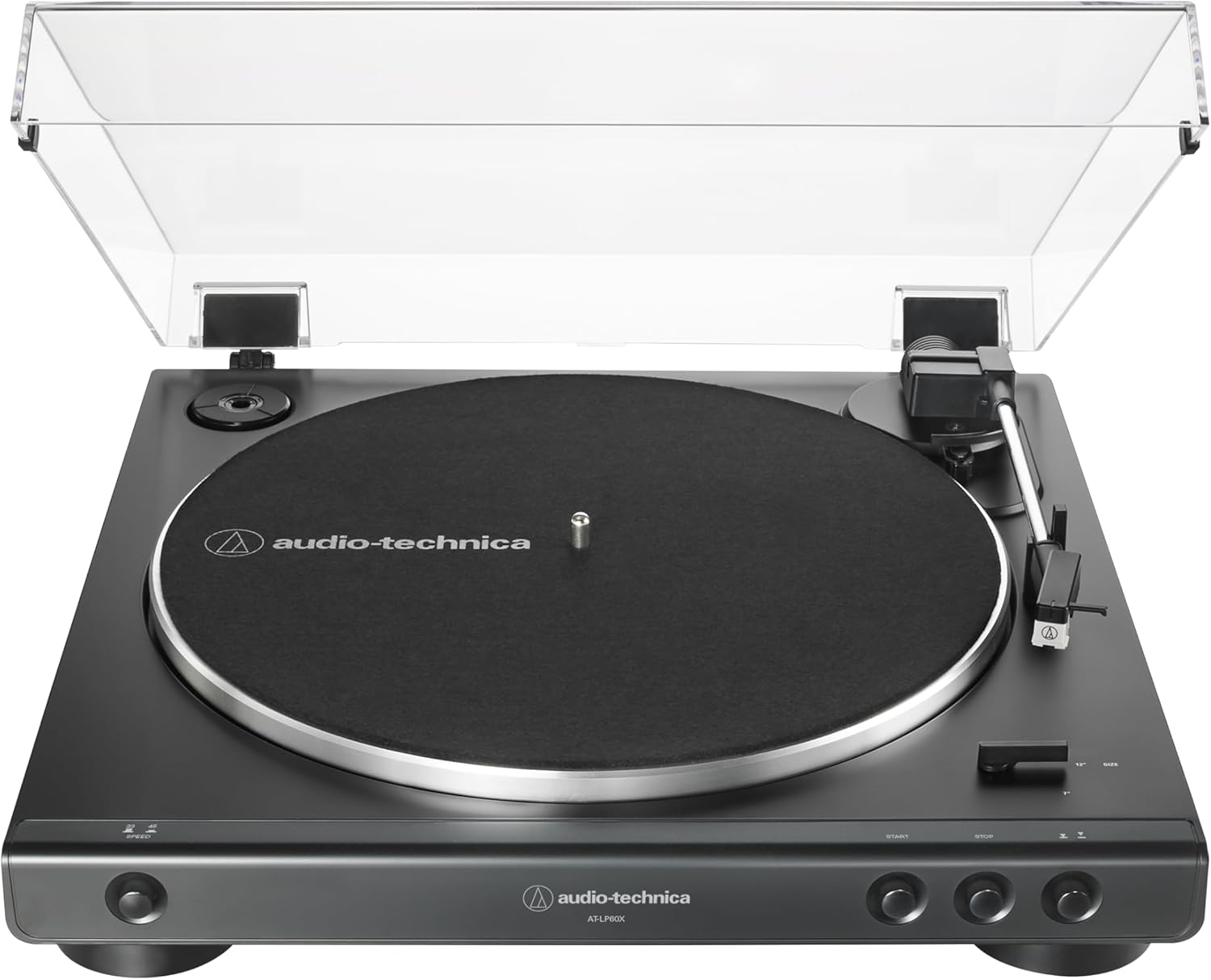
The Audio-Technica AT-LP60X is probably the turntable that brought most people reading this into the conversation. Owners consistently praise its plug-and-play simplicity — the built-in preamp means you connect the included RCA cable (the red-and-white plug pair) to powered speakers and you’re done. Reviewers across multiple retail platforms note that the included line cable “works charms” in straightforward setups, which tracks: it’s doing exactly what it’s designed to do.
The recurring complaint you see in AT-LP60X owner reviews is the limited output options — one output, no phono/line toggle, no USB. That’s a fair criticism if your needs grow. You’re locked into the line-level signal the turntable produces; you can’t bypass the internal preamp to use a better external one later without a hardware mod. For first-time setups and smaller rooms, that’s a fine tradeoff. For anyone who suspects they’ll want to upgrade the signal path eventually, it’s a ceiling you’ll bump against.
The Audio-Technica AT-LP120XUSB addresses several of those limits at once. Owners who’ve written long reviews — including at least one first-time quality-turntable buyer describing it as a rediscovery of vinyl after 40 years — highlight the PHONO/LINE switch as a meaningful feature. Flip it to PHONO, connect an external preamp, and you’ve opened a future upgrade path. Flip it to LINE, and you’re back to the convenient all-in-one experience. The USB output adds a separate but useful capability we’ll cover shortly.
The QLEARSOUL SoulBox S1 wins consistent praise from owners for the cushioned legs that reduce vibration feedback — a practical detail for anyone setting the turntable on a surface near a subwoofer or in a room with bass-heavy playback. Reviewers note the tonearm tracks reliably, and the built-in preamp makes setup fast. It sits in the same convenience-first category as the AT-LP60X, with the added physical isolation benefit.
By the Numbers: Output Scenario Comparison
| Your Setup | Preamp Needed? | Connection Path |
|---|---|---|
| Turntable → Receiver with PHONO input | No | RCA direct to PHONO jack |
| Turntable (built-in preamp) → Powered speakers | No | RCA or 3.5mm to LINE/AUX input |
| Turntable (no preamp) → Receiver LINE input | Yes | Turntable → external preamp → LINE in |
| Turntable → Bluetooth speaker | Depends | Built-in preamp or BT-capable table required |
Bluetooth Output: Practical Solution or Compromised Signal?
The QLEARSOUL ONE-S specifically wins points from reviewers for its Bluetooth input and output — a combination that reviewers call a practical solution when speakers aren’t physically close to the turntable. That’s a real-world problem in a lot of apartments and studio setups where running RCA cables across a room isn’t an option.
The honest tradeoff: Bluetooth introduces compression and a small but measurable latency. For background listening, dancing in your living room, or casual playback, it’s invisible. For anyone doing critical listening or A/B comparing pressings, the analog signal path through a wired preamp will sound more open. The Vinyl Factory’s setup guide makes this point directly — Bluetooth convenience is real, but it’s not the path to the best possible sound from your records.
The decision rule here is straightforward: if your room setup makes wired connections genuinely inconvenient and you’re not doing critical listening, Bluetooth output is a legitimate and underrated feature. If you’re the kind of person who reads matrix codes on Salsoul pressings, wire it up.
USB Output: What It Actually Does (and What It Doesn’t)
USB output on a turntable — present on the AT-LP120XUSB and several competitors — does one specific thing: it sends audio to a computer for recording. That’s it. It does not make the turntable sound better through your speakers. It does not replace the preamp requirement for speaker output. It does not stream audio wirelessly.
What it does do is let you digitize your vinyl collection without buying separate audio interface hardware. The signal goes USB into a computer, software records it (Audacity is the most common free option), and you export files. For someone with a collection of records that aren’t available on streaming — regional pressings, custom acetates, out-of-print dance 12-inches — this is genuinely valuable.
The AT-LP120XUSB’s USB implementation has been called out in owner reviews as a notable selling point alongside the stylus quality. Analog Planet’s coverage of budget-to-midrange turntable options has consistently noted that USB integration at this price tier saves a separate equipment purchase for anyone interested in archiving.
One thing to watch: some Bluetooth speaker systems (and some mixers aimed at this price range) have poorly translated setup documentation. Reviewers of certain budget mixers flag confusing manuals as a genuine friction point. If you’re adding a standalone preamp or a mixer with USB routing into the chain, budget 30 minutes for the initial setup and don’t skip reading the routing section — unclear gain staging at setup time causes the same “it sounds wrong” symptoms as a missing preamp.
External Preamps: When to Add One and What It Gets You
If your turntable doesn’t have a built-in preamp, or if you want to bypass a built-in one you suspect is limiting your sound, a standalone phono preamp is the answer. Entry-level options from brands like Behringer and ART start well under $50 and genuinely solve the compatibility problem. Mid-tier units from Pro-Ject, Rega, and Cambridge Audio are where reviewers — including Stereophile and Analog Planet consistently — say the audible improvement over built-in preamps becomes meaningful, typically in the $100–$300 range.
For the DiscoStore reader who’s pairing a vintage Technics SL-1200 with a quality cartridge, the external preamp question is non-negotiable — you want control over the gain and loading settings to match your cartridge’s output characteristics, something no $25 built-in circuit gives you. The Vinyl Factory’s setup guide and Sound On Sound’s analog coverage both make the same point: cartridge and preamp matching is where the real performance lift happens.
Frequently Asked Questions
Do I need an external preamp if my turntable already has a built-in one? No — if the turntable has a built-in preamp and you’re using the line-level output, you’re covered. An external preamp is only necessary if you want to bypass the internal one (for a quality upgrade) or if your turntable has no preamp at all. Check for a PHONO/LINE switch; if it’s set to LINE, the built-in preamp is active.
Can I plug a turntable directly into a Bluetooth speaker? Only if the turntable has a built-in preamp and the Bluetooth speaker accepts a line-level RCA or 3.5mm wired input — or if the turntable itself has Bluetooth output built in, like the QLEARSOUL ONE-S. A raw phono-level signal fed into a Bluetooth speaker’s line input will sound quiet and thin, same as any other line-level input without preamp correction.
What does USB output on a turntable actually let me do? It sends audio to a computer so you can record and digitize your records. It doesn’t affect your speaker output, doesn’t stream wirelessly, and doesn’t replace the need for a preamp on your speaker connection. Think of it as a separate, parallel output path specifically for archiving.
Will the included cable on the AT-LP60X work with any amplifier or receiver? Yes, with one important caveat: the AT-LP60X has a built-in preamp and outputs a line-level signal, so you need to plug it into a LINE or AUX input — not a PHONO input. If your receiver has a PHONO input and you use it with the AT-LP60X’s line output, you’ll get an over-amplified, distorted signal. Match line-level output to line-level input.
What is the difference between phono level and line level output? Phono level is the raw signal from your turntable’s cartridge — very quiet (around 2–5 millivolts) and tonally imbalanced because of the RIAA recording curve. Line level is the standard signal strength that amplifiers, powered speakers, and mixers expect — typically around 150–300 millivolts. A preamp converts phono to line level by amplifying the signal and applying RIAA equalization to restore correct tonal balance. Without that conversion, the signal is too quiet and sounds wrong.
The Decision Frame: If X, Then Y
If your receiver has a PHONO input: plug the turntable straight in with RCA cables, no additional hardware needed.
If you have powered speakers but no PHONO input: buy a turntable with a built-in preamp, or add an external preamp between the turntable and speakers.
If your speakers are across the room and wiring is a real obstacle: the QLEARSOUL ONE-S’s Bluetooth output is a genuinely practical solution, with the understanding that you’re trading some signal purity for convenience.
If you want to digitize your collection without buying additional hardware: the AT-LP120XUSB’s USB output makes that possible directly from the turntable.
If you’re pairing a vintage or high-end cartridge with a quality turntable: skip built-in preamps and invest in a standalone unit where you can control gain and loading — that’s where the performance gap between your record collection and your playback system finally closes.
The preamp question feels complicated until you draw out which of these scenarios is yours. After that, it’s just one cable.