August 19, 2026 • Roxanne Flair • 11 min reading time • Prices verified June 4, 2026
Budget RGB Par Lights Face-Off: 36W vs. 90W and When Wattage Actually Matters
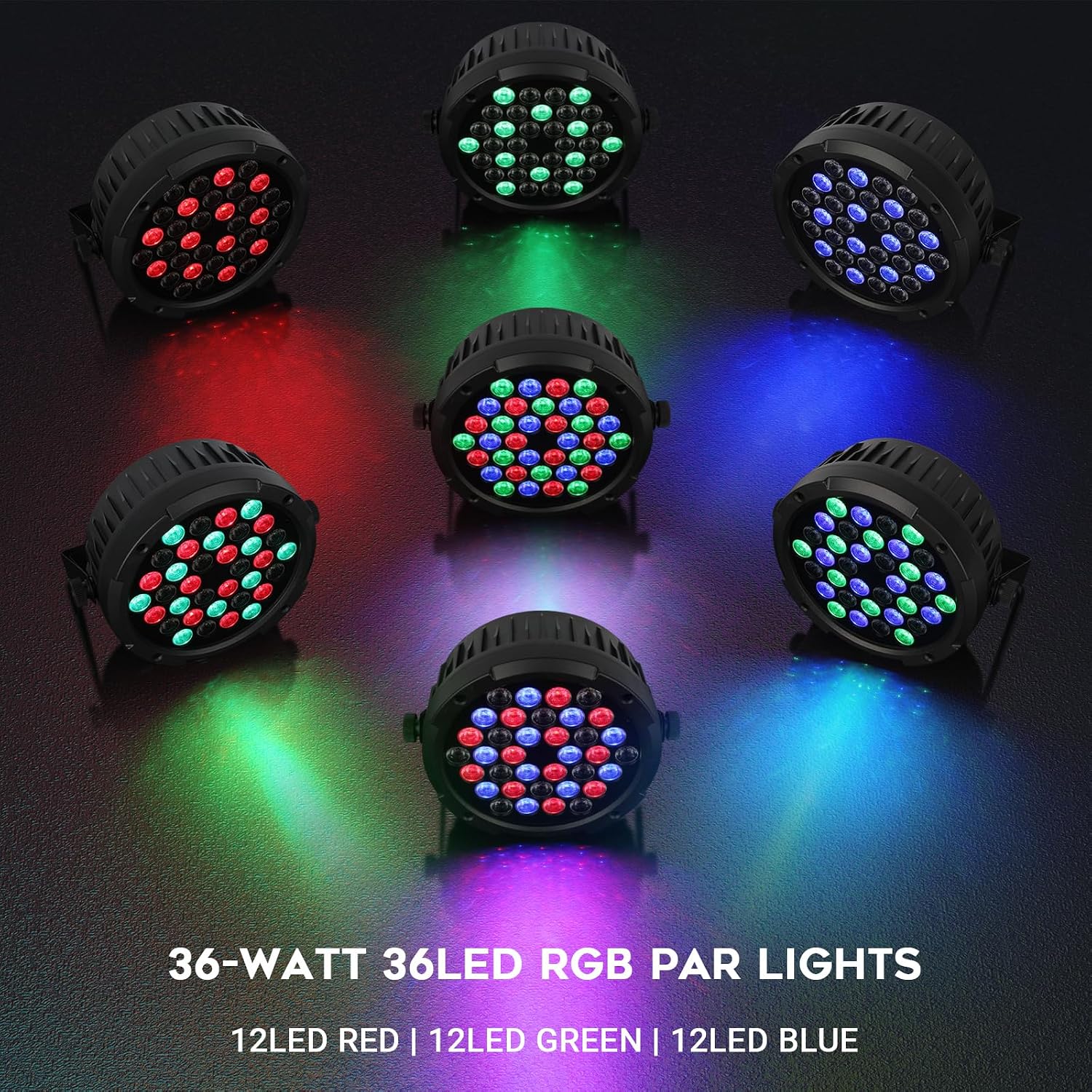
If you’ve ever tried to light up a party room, a stage, or a podcast background and found yourself staring at a wall of LED par lights on a retailer listing — wattage numbers everywhere, no clear explanation of what any of it means — you’re not alone. A “par light” (short for parabolic reflector light) is simply a can-shaped fixture that throws a wash of colored light across a surface. RGB stands for red, green, and blue LEDs combined inside the fixture; mix those three channels and you can produce most of the visible color spectrum. The wattage number tells you roughly how much power the fixture draws, which correlates — imperfectly — with how bright it is. This article digs into the two most common budget tiers you’ll actually encounter: 36-watt units like the OPPSK 36W and U’King 36W, and higher-output units like the OPPSK 90W and the SHEHDS 18×18W 6-in-1. We’ll show you what the wattage gap actually costs you, where it doesn’t matter at all, and which fixture belongs on which gig.
| EDITOR'S PICKU`King LED Par Lights DJ Stage… | Mid-tier36LEDs RGB Stage Par Lights - O… | Budget pickU`King LED Par Lights DJ Stage… | |
|---|---|---|---|
| Pack count | 8 Packs | — | 2 Packs |
| Wattage | — | 36W | — |
| Remote | ✓ | ✓ | — |
| DMX | — | ✓ | — |
| Price | $159.99 | $69.99 | $39.99 |
| See on Amazon → | See on Amazon → | See on Amazon → |
What the Wattage Gap Actually Buys You (and What It Doesn’t)
Let’s get specific about the difference, because “more watts = brighter” is true but incomplete.
The 36W Budget Tier: Vivid Color, Close Range, Real Tradeoffs
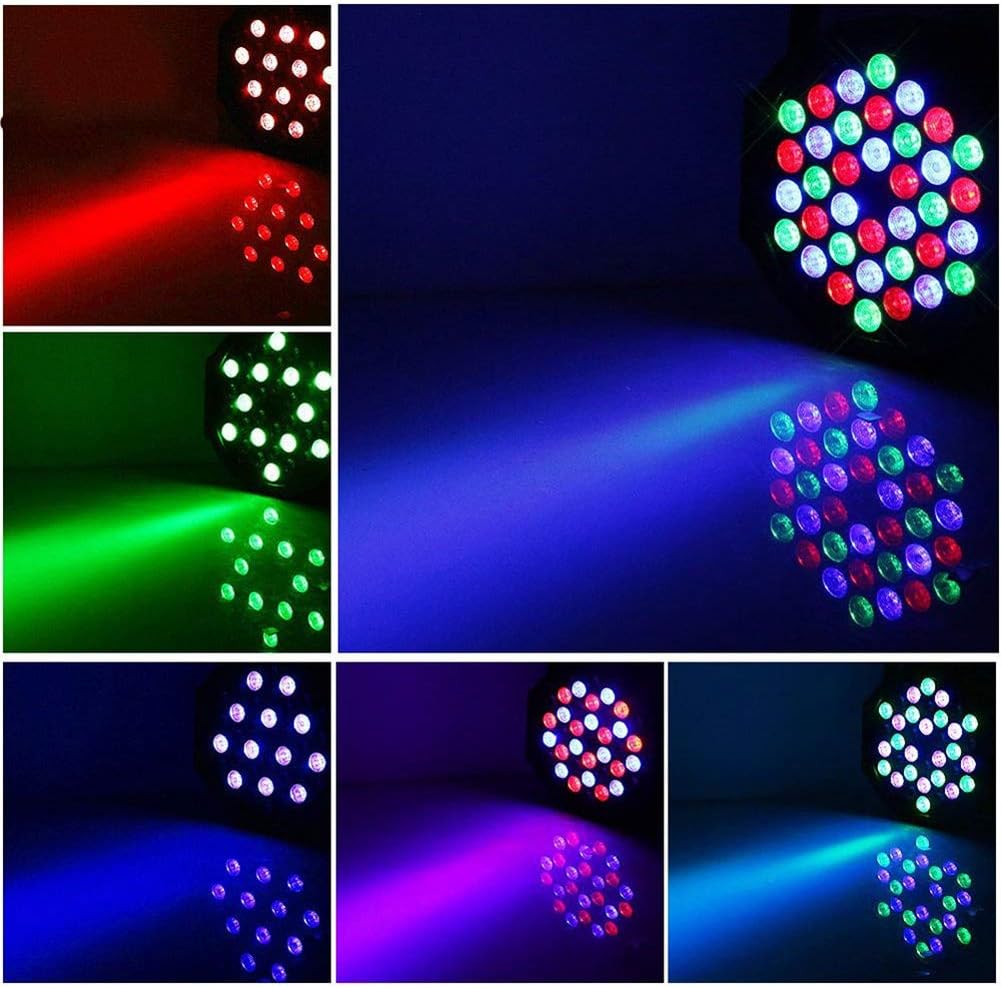
The OPPSK 36W uses a cluster of discrete RGB LEDs — meaning individual red, green, and blue diodes arranged in a grid. Each diode throws its own cone of light, and when they blend at distance they produce a solid color wash. At close range or in certain shadow angles, however, the discrete arrangement means the red, green, and blue cones don’t fully overlap — you get color fringing, sometimes called color aberration. A band drummer who installed OPPSK 36W units behind their kit reported exactly this in verified purchase feedback: vibrant, punchy color in direct-light zones, but noticeable color separation in the shadows cast by the kit hardware. For a stage wash seen from 20 feet, most audiences won’t register it. For a photo shoot or a tight streaming frame, it’s worth knowing about.
The U’King 36W corded unit operates in the same wattage class and shares the same fundamental LED arrangement. Owner feedback across verified purchase reviews consistently positions it as a background lighting fixture for streaming and podcast setups — low-output, manageable heat, and generally quieter in operation than higher-wattage alternatives. Multiple reviewers across U’King 36W listings cite that use case specifically, which signals a meaningful non-DJ buyer segment has organically found these fixtures as the right tool for camera-facing ambient lighting.
For practitioners who need vivid color at close-to-medium stage distances and want budget-appropriate fixtures for a working musician’s gear investment, the 36W tier is the logical entry point.
U`King
$39.99
In stock on Amazon
Check price on AmazonThe 90W Mid-Tier: Output Headroom and Placement Flexibility
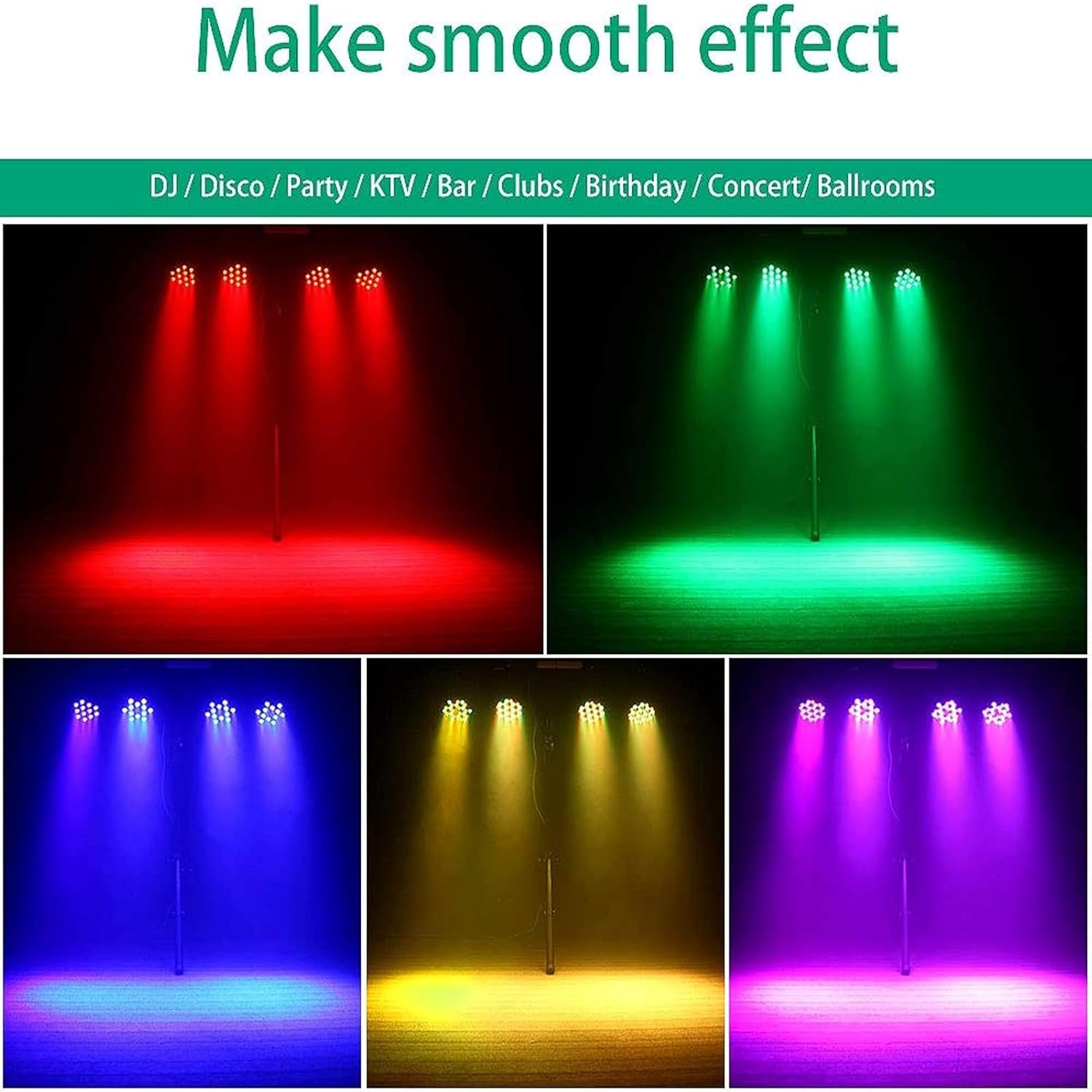
The OPPSK 90W jumps to a much larger LED array and substantially more raw output. Multiple owners describe it illuminating a room “like day” on full white — which is either a feature or a problem depending on your goal. For a wedding reception hall uplighting application where you need light to travel 10–15 feet up a wall and still look saturated, the 90W’s output headroom is genuinely useful. For a home studio podcast background where the camera is 4 feet away, it’s overkill and you’ll spend the whole event dimming it down.
The practical throw-distance advantage is measurable in real deployments. At 36W, most practitioners find the fixtures need to be placed 6–8 feet from the wall base to throw color up to ceiling height in a standard banquet room with 10–12 foot ceilings. At 90W, you can push that placement distance out to 10–12 feet and still get saturated color at the top of the wall — useful in venues with obstacles near the perimeter or where you need the cans out of foot-traffic zones.
Sound On Sound, in coverage of LED stage lighting technology, has noted that raw wattage in LED fixtures is a less reliable proxy for usable output than LED chip quality and optic design — which is worth keeping in mind when comparing spec sheets across brands. The 90W label means the fixture draws 90 watts from the wall; it does not guarantee any specific lux measurement at distance.
36LEDs
$69.99
In stock on Amazon
Check price on AmazonThe SHEHDS 18×18W 6-in-1: When You Need More Than RGB
The SHEHDS 18×18W 6-in-1 adds amber, UV, and white LED channels to the standard RGB trio — that’s the “6-in-1” label. The practical upside is skin-tone rendering and warm amber washes that pure RGB can’t cleanly produce. The fixture draws 324 watts total across its 18 individual 18W LED emitters, putting it in a different power class entirely from the two OPPSK options.
More importantly for practitioners running DMX-controlled rigs: verified purchase feedback from a technical director for a mobile performance company flagged the SHEHDS units for superior low-end DMX dimming linearity. DMX (Digital Multiplex) is the industry-standard control protocol that lets a lighting console fade and control individual fixtures precisely. Most budget pars dim acceptably in the upper 60–100% range but get steppy or flicker-prone at 10–30%. The SHEHDS units, per that practitioner’s account, hold smooth curves further down the dimmer range — a real advantage for theatrical mood transitions, though it’s completely invisible if you’re running the fixture in sound-activated or IR remote mode.
DJ Mag, in its coverage of club and touring lighting infrastructure, has consistently noted that smooth low-end dimmer response is one of the primary differentiators between entry-level and professional-tier LED fixtures — and it’s a specification that almost never appears on a spec sheet, making owner reports the most reliable source of that information at the budget end of the market.
U`King
$159.99
In stock on Amazon
Check price on AmazonThe DMX Channel Mismatch Problem Nobody Warns You About
Here’s the issue that bites practitioners who buy mixed packs: the OPPSK 36W 7-channel DMX layout and the OPPSK 90W 7-channel DMX layout are not the same. An owner of the 90W units made this explicit in their verified purchase review — they assumed that buying from the same brand, with the same stated channel count, meant they could program both fixture types identically in their controller and swap them freely. They couldn’t. The channel assignments differ between the two models, which means in a mixed rig you need separate fixture profiles (sometimes called personalities) for each unit type, effectively doubling your programming time.
This is not unique to OPPSK — it’s a systemic issue across budget LED manufacturers who often source LED engines from multiple factories and assign channel maps based on whatever firmware ships in that production run. The practical takeaway: never assume channel-map compatibility between two budget fixtures even from the same brand. Before you build a mixed pack, pull the printed manual for each specific model number and compare the DMX channel tables side by side. If you’re running QLC+, DMXControl, or a hardware console like a Chauvet Obey or ADJ Scene Setter, you’ll be building separate fixture profiles anyway — budget the programming time accordingly.
For practitioners running 8–16 fixtures at paid events, this is a gig-economics issue, not just a technical nuisance. An extra 45 minutes of programming time per event, multiplied across a season, is real money. Standardize your fixture library around one model if you possibly can.
The Fan Noise Question and Other Real-World Friction
Cooling fans are the friction point nobody fully discloses in product listings, and it surfaced in verified purchase reviews of both OPPSK and SHEHDS units. The problem isn’t that 90W budget pars have loud fans as a category rule — it’s that fan noise varies unit to unit within the same pack. Multiple buyers of both brands describe receiving a four-pack where two units are quiet, one is moderate, and one is noticeably louder than the others. This is a quality-control variance issue inherent to the price tier.
For a DJ or mobile event context where the music is running at 90–100 dB, fan noise is irrelevant. For a corporate presentation, a podcast recording environment, or a theater piece with quiet dialogue scenes, a single loud unit can be genuinely disruptive. Mixmag, in practical coverage of mobile DJ equipment, has noted that fixture reliability and unit-to-unit consistency are the most common pain points cited by working DJs who move from consumer-grade to professional-grade lighting — and fan noise variance is one of the most frequently mentioned consistency issues at the budget tier.
The honest guidance here: if fan noise in a quiet room is a hard requirement, budget for a pre-deployment test before the event. Have a plan for the loud unit before you arrive at the venue.
Fixture Comparison at a Glance
The table below summarizes the four fixtures discussed in this article. Note that street prices shift frequently; treat the tier labels as relative indicators, not fixed price points.
| Fixture | Wattage | LED Type | DMX Channels | 6-in-1? | Tier |
|---|---|---|---|---|---|
| OPPSK 36W | 36W | Discrete RGB | 7-ch | No | U`King — $39.99 |
| U’King 36W Corded | 36W | Discrete RGB | 7-ch | No | U`King — $39.99 |
| OPPSK 90W | 90W | RGB array | 7-ch | No | 36LEDs — $69.99 |
| SHEHDS 18×18W 6-in-1 | 324W total | RGBWAUV | Multi-ch | Yes | U`King — $159.99 |
Our Decision Frame: If X, Then Y
Gigging musician or band adding stage wash behind a drum kit or keyboard riser: The OPPSK 36W hits the sweet spot. Owners report vivid, punchy color at close-to-medium stage distances. The color aberration in shadow zones is real but irrelevant beyond 15 feet. Buy multiples; they’re budget-appropriate for a working musician’s gear investment.
Mobile DJ or event company uplighting reception halls, corporate ballrooms, or larger event spaces: The OPPSK 90W gives you the throw distance and output headroom to make 10–15 foot walls look saturated without straining the fixture. Budget the extra programming time for the channel-map differences if you’re running a mixed pack with 36W units.
Technical director, theatrical producer, or mobile performance company running DMX-controlled mood lighting with genuine dimming transitions — the kind where you need a smooth 10% fade, not a steppy jump: the SHEHDS 18×18W 6-in-1 justifies its higher price through better low-end dimmer linearity and the amber and UV channel options that give you warm and black-light effects from a single fixture.
Podcaster, streamer, or content creator adding color background ambiance to a camera frame: the U’King 36W corded units are the community’s organic recommendation in this category. Output is more manageable at close range, and the corded design keeps things simple for a permanent studio setup.
Frequently Asked Questions
Do the OPPSK 36W and 90W models use the same DMX channel layout? No. Despite both being labeled as 7-channel DMX units, owner reports confirm the channel assignments differ between the two models. If you’re mixing them in a DMX-controlled rig, you’ll need separate fixture profiles for each. Check the printed manual’s channel map before assuming compatibility.
What does color aberration in shadows actually look like, and does it matter for my use? With discrete RGB LED arrangements — where red, green, and blue diodes are physically separate — the three color cones don’t fully overlap at close range or at steep angles. In shadow zones you’ll see a red, green, or blue fringe rather than a blended color. At event distances of 15 or more feet from the fixture, most audiences won’t notice. In a tight camera frame or on a streaming background close to the fixture, it’s visible. For stage wash from an audience perspective, it’s a non-issue.
How loud are the cooling fans on 90W par lights in a quiet room? Variable — and that variability is the real answer. Owner reviews of both OPPSK and SHEHDS units note unit-to-unit fan noise differences within the same pack. Some units are nearly silent; others are audibly noticeable in a quiet room. In a music or DJ environment this is irrelevant. For spoken-word, theater, or content creation, test each unit before deployment and have a contingency for the loud one.
Can I run these lights without DMX, just using the remote or sound-activated mode? Yes. All of the units discussed here support standalone operation via IR remote control and sound-activated mode, where the fixture responds to ambient audio levels. DMX is an optional control layer, not a requirement. Most casual and semi-pro users never touch the DMX features. Sound-activated mode is genuinely useful for DJ sets where you want the lights to pulse with the music without programming.
How many units do I need to uplight the walls of a standard event space? A practical rule of thumb drawn from aggregated event production guides: one uplight per 8–10 linear feet of perimeter wall for full coverage in a standard banquet room. A 40×60 foot room has roughly 200 linear feet of perimeter — plan for 20–25 fixtures. For a budget or partial-coverage approach, prioritize the walls visible from the main seating area and the area behind the head table or stage, and work outward from there.