April 24, 2026 • Roxanne Flair • 8 min reading time • Prices verified June 4, 2026
Rechargeable Par Lights for Mobile DJs: The Cable-Free Case and Its Real Limits
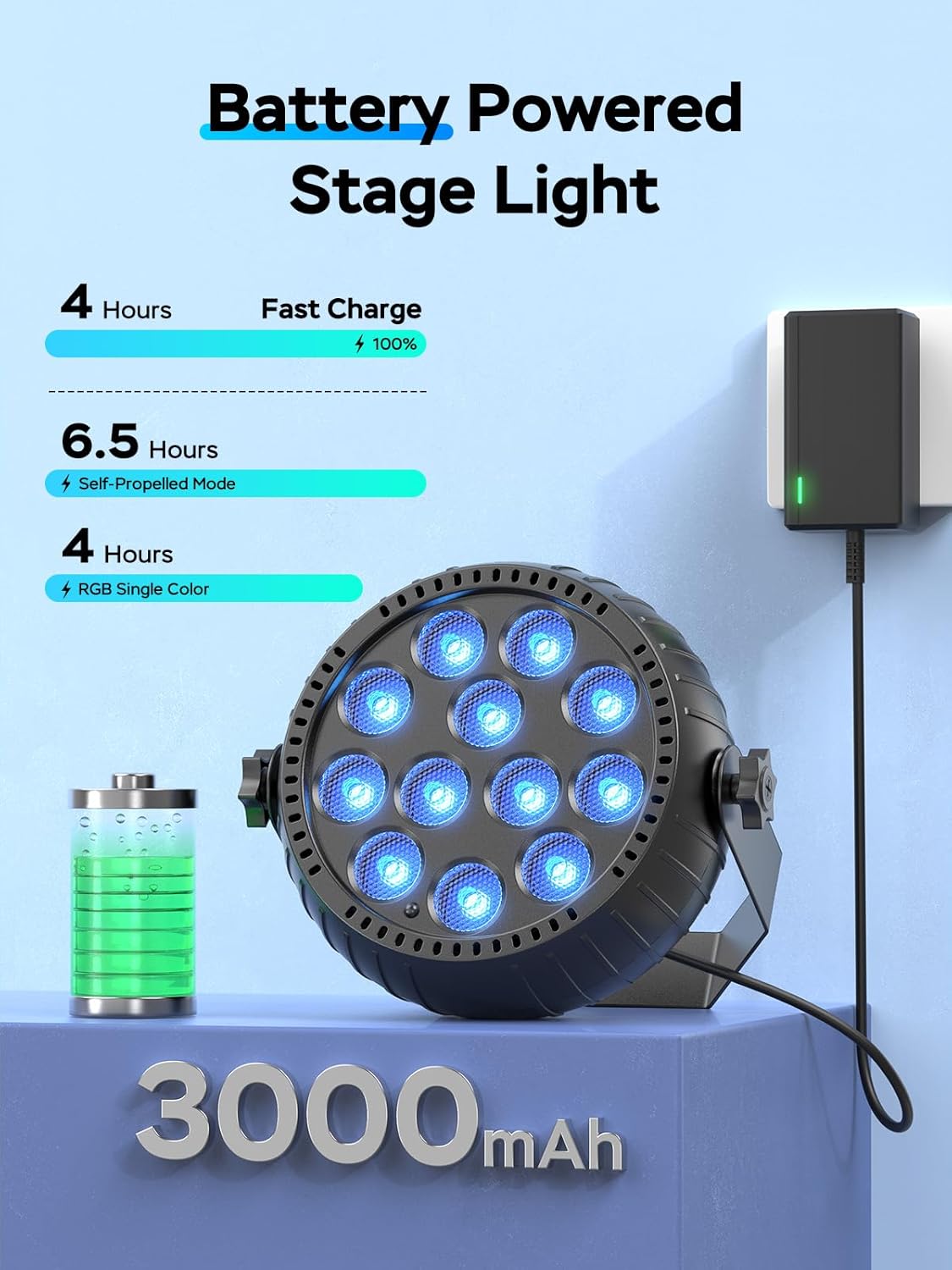
If you’ve ever watched a DJ set up for a wedding reception and wondered how the colored lights at the base of the dance floor got there with no visible cables snaking across the room — those are most likely rechargeable par lights. A “par” (short for parabolic aluminized reflector, but you won’t need that again) is simply a flat, can-shaped stage light, and the rechargeable version runs on a built-in battery instead of a power cord. For mobile DJs — performers who haul their own gear to venues rather than working a fixed installation — going cable-free sounds like an obvious win: faster setup, no tripping hazards, cleaner staging photos for your Instagram portfolio. The reality is more nuanced. Battery life is finite, output is often lower than wired equivalents, and the per-fixture price premium is real. This guide walks through when rechargeable pars earn their keep and when you’d be better off running cable.
| EDITOR'S PICKRechargeable Par Can Lights U`K… | Mid-tierBattery Powered Uplights Rechar… | Budget pickBattery Powered Stage Par Light… | |
|---|---|---|---|
| Wattage | 36W | 108W (6x18W) | 36W |
| Battery capacity | — | 9600 mAh | — |
| Battery life | — | — | 6-15 hours |
| Light colors | RGB | RGBWA+UV | RGB |
| Control methods | — | APP/Remote/DMX512 | Remote/DMX |
| Pack size | 4 pack | 1 pc | 2 pack |
| Price | $199.99 | $159.99 | $108.88 |
| See on Amazon → | See on Amazon → | See on Amazon → |
Why the Cable-Free Pitch Is Genuinely Compelling
Let’s get the honest case for wireless pars on the table, because it is a real one.
Load-in time is the underappreciated currency of mobile DJ work. Every minute you spend running extension cords and gaff-taping cable paths is a minute you’re not sound-checking or talking to the venue coordinator. Mixmag’s 2024 piece on touring-friendly DJ gear noted that experienced mobile operators consistently identify cable management as their single biggest time sink on multi-zone setups, ahead of even speaker placement. Rechargeable pars eliminate a category of labor entirely — drop the fixture, aim it, pair it to your DMX or wireless controller, done.
The cleaner aesthetic matters commercially too. Couples booking wedding DJs and corporate event planners booking party entertainment increasingly expect a “production look” — seamless staging without the visual noise of orange extension cords. If you’re competing for $1,500–$3,000 event packages in a mid-to-premium market, the staging photos you post afterward are part of your sales funnel. Wireless fixtures that sit flush on the floor or clamp to décor elements without visible cable runs photograph dramatically better.
There’s also a practical safety case. In high-traffic areas — wedding dance floors, school dances, outdoor festivals — cable runs are liability. Venues sometimes explicitly prohibit surface cables in fire egress lanes. Battery fixtures sidestep that conversation entirely.
The Output-vs-Runtime Trade-Off Nobody Advertises Loudly
Here’s where the math gets important. Battery capacity is finite, and manufacturers make quiet compromises between brightness (measured in lux or lumens) and how long the fixture will actually run on a charge.
The Chauvet DJ EZpar series — specifically the EZpar 64 RGBA and EZpar T6 USB — is the most commonly referenced entry point in this category. Per Chauvet DJ’s published spec sheets, the EZpar 64 RGBA is rated at roughly 6–8 hours at reduced output (their “low” DMX setting) but drops to approximately 2–4 hours at full intensity. A typical wedding reception with a four-hour dance set, plus a 30-minute setup window and breakdown, runs right up against that threshold at full power. Owners on long-run gig reviews note that actual runtime in hot venues — where the battery is working harder to cool itself — tends to land at the low end of the manufacturer’s range.
ADJ’s 5P HEX IP is a step up in the line: six-in-one RGBAW+UV LEDs, IP-rated (meaning it’s sealed against dust and moderate moisture for outdoor use), and published at roughly 12 hours at 50% output. That spec, per ADJ’s technical documentation for the fixture, holds better across reviewer reports than the Chauvet entry-level figures, partly because the 5P HEX IP is a heavier, higher-capacity battery platform.
By the numbers — representative rechargeable par specs at time of writing:
| Fixture | Battery Runtime (full output) | Battery Runtime (50% output) | Street Price (2026) |
|---|---|---|---|
| Chauvet DJ EZpar 64 RGBA | ~2–3 hrs | ~6 hrs | $180–$210 |
| Chauvet DJ EZpar T6 USB | ~2–3 hrs | ~5–6 hrs | $160–$185 |
| ADJ 5P HEX IP | ~6 hrs | ~10–12 hrs | $320–$360 |
| ADJ Mega QA GO | ~3 hrs | ~6 hrs | $220–$260 |
Street prices sourced from authorized dealer listings as of May 2026; individual dealer pricing varies.
The decision frame this creates: if your average paid gig runs 4–6 hours including setup, the EZpar-class fixtures require either a mid-event swap-and-charge rotation (operationally messy) or committing to running at reduced brightness for the full event. The ADJ 5P HEX IP’s runtime math is more comfortable for full-event deployment, which largely explains its higher adoption rate among working mobile operators versus hobbyist users.
Total Cost of Ownership: The Part That Changes the Calculation
Rechargeable pars cost more upfront than equivalent wired fixtures — typically 30–60% more for comparable LED output. That premium deserves scrutiny.
A wired RGBA par in the same brightness class as an EZpar 64 RGBA runs roughly $80–$110 from the same manufacturers. You’ll spend another $15–$30 on quality extension cables and a few dollars per gig in the time cost of cable runs. Over 50 gigs, the wired fixture’s total operational cost is still meaningfully lower.
The counter-argument — and it’s a legitimate one — is that rechargeable fixtures reduce physical wear on connectors, eliminate cable replacement costs, and lower the risk of a venue-damage claim from a tripped cable. Sound On Sound’s March 2025 mobile DJ essentials piece cited DJ operators reporting that a single venue incident involving a cable — damaged flooring, a tripped guest — cost more in remediation or insurance interaction than the price differential of an entire wireless fixture set. That’s a tail-risk argument, not an expected-value argument, but it’s the kind of consideration that professionals with active event schedules weigh differently than hobbyists.
There’s also a battery degradation curve to account for. Lithium battery cells lose capacity over charge cycles — typically rated to 80% capacity retention at 500 full cycles, per standard lithium-ion specifications cited across manufacturer documentation. At one full charge cycle per gig, a fixture used for 100 events per year starts showing meaningful runtime reduction around years four to five. Wired fixtures have no analogous degradation mechanism. Budget a replacement-cycle cost into your ROI math if rechargeable is where you’re landing.
When Rechargeable Pars Are Clearly the Right Call
The DJ Mag battery lighting roundup from 2025 identified three use profiles where the wireless case is strongest and the trade-offs are acceptable:
Uplighting-only deployments. If your primary use case is uplighting — illuminating draping, columns, or accent walls around a venue perimeter rather than washing the dance floor — you’re almost always running these fixtures at 30–50% intensity. That’s where battery runtime opens up, and where the visual impact of no cables is highest. A set of 8–12 EZpar-class fixtures around a ballroom perimeter is the canonical “wireless wins” use case.
Corporate and wedding markets with strong staging expectations. Per the DJ Mag piece, the premium event market has essentially normalized the expectation of wireless uplighting as a standard offering. If you’re quoting jobs where uplighting is a line item on your contract, buyers in that segment increasingly expect cable-free. Showing up with taped-down orange extension cords in a luxury hotel ballroom is a staging mismatch that can affect rebooking and referral rates.
Venues with restricted cable access. Some venues — outdoor marquees, historic properties, certain hotel setups — have power outlets only at the perimeter, making long cable runs across open floor genuinely impractical or prohibited. Rechargeable fixtures aren’t a luxury in those rooms; they’re the workable solution.
When You Should Run Cable Instead
Be honest with yourself about these scenarios:
Long-duration events with continuous operation requirements. Club residencies, multi-hour outdoor festivals, or any event running past the 6-hour mark without a convenient charging window between setup and strike are hard fits for most rechargeable pars. Unless you’re buying the ADJ 5P HEX IP tier (or above) and keeping output managed, you risk mid-event dimming or full shutdown. A wired fixture doesn’t get tired.
High-output wash applications. If you need to flood a large dance floor with saturated color — the kind of coverage that requires full or near-full fixture output — battery fixtures in the sub-$300 tier aren’t going to deliver the brightness of a wired equivalent at that price. The physics are straightforward: the battery management system throttles peak draw to protect runtime and cell longevity.
Budget-constrained builds. If you’re assembling a starter lighting rig and working with under $600 for fixtures, the wired equivalent set will outperform a rechargeable set at that total budget. Buy wired, buy tape, run clean cable routes, and revisit wireless when the per-fixture budget allows for the ADJ mid-tier or above.
The Decision Rule
Here’s the clean version:
If your core business is weddings or corporate events where uplighting is a contract line item, and you’re quoting gigs in the $1,500+ range, rechargeable pars at the ADJ 5P HEX IP tier ($320–$360/fixture) earn their cost premium within 20–30 events through staging differentiation and reduced venue-incident risk. Budget for a 5-year battery replacement cycle in your equipment depreciation.
If you’re running club nights, longer festival gigs, or building a first rig on a tight budget, wired fixtures give you better output-per-dollar and zero runtime anxiety. The cable-free aesthetic is real, but it doesn’t outweigh the operational risk of a fixture dying at hour three of a five-hour gig.
The EZpar-class fixtures ($160–$210) make the most sense as supplemental uplighting additions to an existing wired rig — not as primary dance floor fixtures and not as your only lighting investment. They’re genuinely useful in that supporting role, and the runtime limitations are manageable when the fixtures aren’t load-bearing for your main wash.
The cable-free case is real. So are its limits. The operators who get the most out of rechargeable pars are the ones who deploy them deliberately — right application, right tier, right event type — rather than buying into the wireless pitch wholesale and discovering its edges mid-gig.