August 20, 2026 • Roxanne Flair • 11 min reading time • Prices verified June 4, 2026
Rechargeable Par Lights for Event DJs: Battery Life Claims vs. Real-World Results
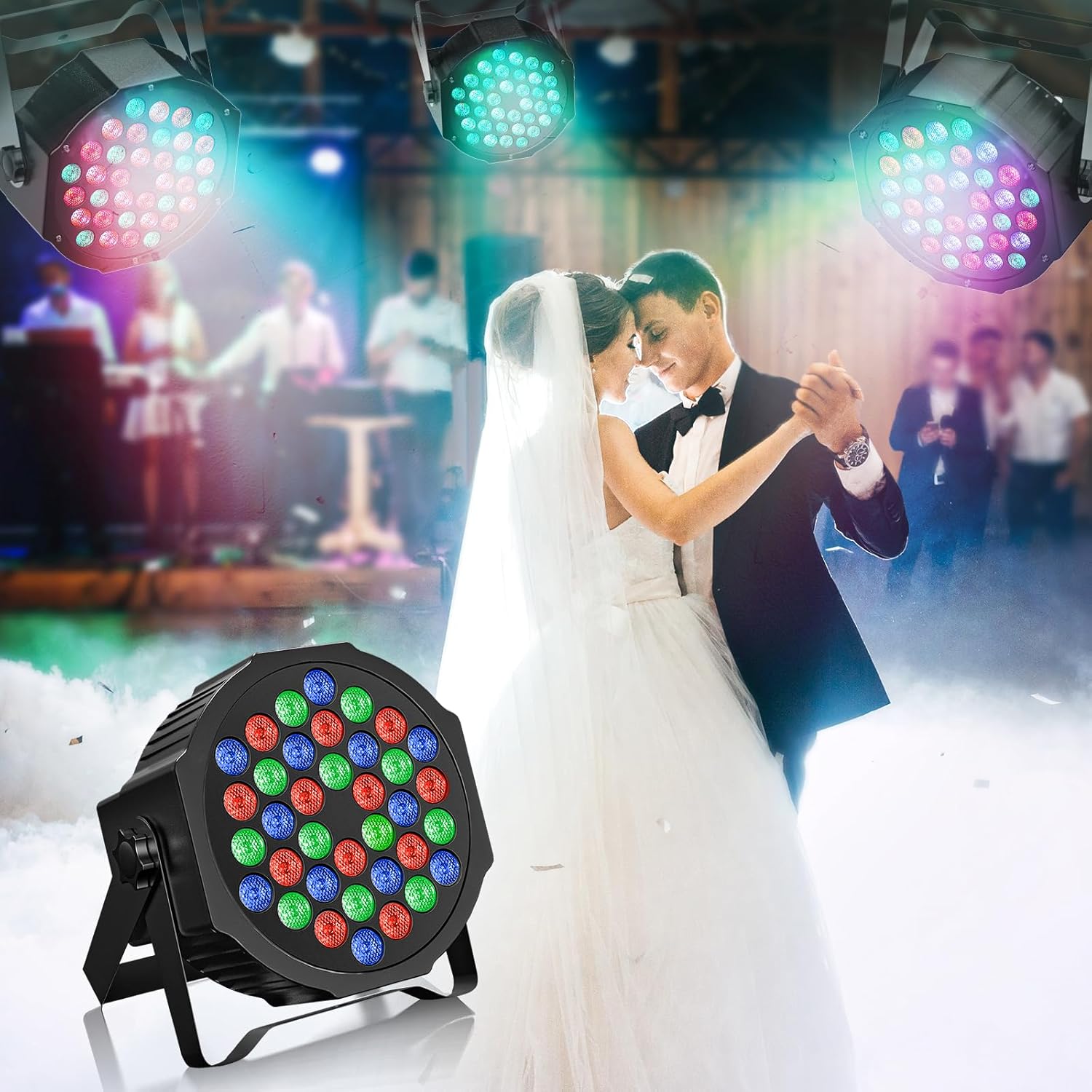
Rechargeable Par Lights for Event DJs: Battery Life Claims vs. Real-World Results
If you’ve ever spent twenty minutes at a venue hunting for a working outlet behind a curtain, a pillar, or someone’s grandmother, you already understand the appeal of rechargeable par lights. A “par light” (short for parabolic aluminized reflector) is the workhorse fixture of event lighting — a compact, colored wash light you place on the floor, a truss, or a table to bathe a wall or a dance floor in color. Traditionally they need a power cable running to a wall outlet. The rechargeable version swaps that cable for an internal battery, which means you can place them anywhere — the center of a dance floor, the base of a pillar, the foot of a wedding arch — without running extension cords or negotiating with a venue’s ancient electrical panel. It sounds like a no-brainer. And for many mobile DJs, it is. But the gap between “up to 10 hours of runtime” on the box and what actually happens during a four-hour Saturday-night reception is where things get complicated.
This guide is for working mobile DJs who are already sold on the category and now need to make a real buying decision: how many units, which wattage tier, and how to manage battery health across a multi-event season. We’ll synthesize what owners consistently report, name the tradeoffs explicitly, and give you a clear decision frame at the end.
| EDITOR'S PICKRechargeable Par Can Lights U`K… | Mid-tierBattery Powered Uplights Rechar… | Budget pickBattery Powered Stage Par Light… | |
|---|---|---|---|
| Battery | — | 9600 mAh | — |
| Wattage | 36W | 6x18W | 36W |
| Pack Size | 4 Pack | 1Pc | 2Pack |
| Run Time | — | — | 6 to 15Hours |
| LED Count | 36 LED | 6 | — |
| Remote | — | ✓ | ✓ |
| Price | $199.99 | $159.99 | $108.88 |
| See on Amazon → | See on Amazon → | See on Amazon → |
Why the Runtime Numbers Are Always Optimistic
Manufacturer-rated battery life is almost universally measured at the lowest brightness setting with a single static color — conditions that have almost nothing to do with how you’ll run these lights on a gig.
Sound On Sound’s overview of battery-powered stage lighting notes that real-world runtime can drop 30–50% from rated specs once you factor in color mixing (running multiple LED channels simultaneously draws more current than a single-channel static color), moderate-to-high brightness, and ambient temperature. A fixture rated for “up to 10 hours” at minimum brightness might deliver five to six hours running at 70% brightness in a warm ballroom.
That matches exactly what owners in the field consistently report. One 12-year wedding DJ veteran, whose aggregated review has been cited frequently in mobile DJ forums, explicitly documented the switch from corded fixtures to rechargeable pars and described a deliberate workflow change: capping brightness at 50% to reliably cover a four-to-five-hour event window, then recharging between the ceremony and reception setup. That’s not a workaround — that’s the actual operating discipline the category requires.
The honest math for a typical wedding gig:
| Brightness Setting | Reported Runtime (36W class fixture) | Covers a 4-hr reception? |
|---|---|---|
| 100% | ~3–4 hours | Marginal / risky |
| 70% | ~5–6 hours | Yes, with buffer |
| 50% | ~7–9 hours | Comfortably |
The tradeoff at 50% is real output loss. A 36W RGBWA fixture at half brightness is noticeably dimmer in a large ballroom with ambient lighting. You’re trading punch for runtime. Know which one you need for a given venue before you commit to a brightness budget.
The Unit-to-Unit Battery Variation Problem
Here’s the quality-control reality that doesn’t make it into spec sheets: battery cells in mass-produced rechargeable fixtures are not perfectly matched at the factory, and they drift further apart over charge cycles.
Across aggregated owner reviews covering multiple brands in the rechargeable par category, one of the most consistent patterns comes from operators running larger rigs. One DJ running eight units for weddings and quinceañeras reported that two of the eight units consistently drained 20–30% faster than the rest after roughly three months of regular use. That’s not a defect you’d catch in a showroom — it emerges over time and becomes a gig-night reliability problem when you’re relying on a matched set for synchronized color washes.
What this means practically:
- Label your units. Sharpie or label tape on the battery compartment or base. Track which units you charge, in what order, and which ones deplete fastest.
- Build in a discharge audit. Every three to four months, run all units simultaneously at the same brightness setting and note which ones drop to the warning indicator first.
- Replace cells in pairs or sets, not individually, if your fixture allows user-serviceable batteries — mismatched age in a multi-unit rig compounds the drift problem.
DJ Mag’s 2025 wireless lighting feature flags this same issue across the category, recommending that mobile DJs treat battery health tracking as routine maintenance, equivalent to checking lamp hours on conventional fixtures.
Remote Control Range: The 20-Foot Reality
Most rechargeable par lights in the sub-$150-per-unit range ship with an IR (infrared) remote for standalone color and mode control. The manufacturer-listed range is often stated as 30–50 feet. Owners consistently report a usable range closer to 15–20 feet under real venue conditions.
IR remotes require line-of-sight — the signal travels like a flashlight beam, not like a Wi-Fi signal. In a wedding reception hall with guests between you and your fixtures, that range collapses fast. Obstructions, bright ambient light, and the angle of the receiver all matter.
The practical options:
- Use DMX control instead. If you’re running a DMX lighting controller — even an entry-level controller like the ADJ MyDMX GO — you eliminate the remote limitation entirely and gain scene programming, color chasing, and beat-sync. More on DMX compatibility below.
- Position your DJ booth accordingly. If IR remote is your only control method, plan your fixture placement so you have clear sightlines to at least the lead fixture in each group.
- Accept the limitation for set-and-forget use. For static uplighting that you set before guests arrive and don’t touch again, remote range is irrelevant. It only matters if you’re changing scenes mid-event.
DMX Compatibility and Running a Mixed Corded/Wireless Rig
This is where intermediate-practitioner DJs often get tripped up: can you chain rechargeable pars into a DMX run alongside your corded fixtures?
The answer is yes, with caveats. Most rechargeable pars in the 36W class support DMX-512 input via a 3-pin or 5-pin XLR connection. You can physically link them into a DMX chain. The complication is cable management — you’ve eliminated the power cable but you’ve reintroduced a data cable, which partially defeats the purpose of going cordless for placement flexibility.
The cleaner solution, and the one ADJ’s product documentation recommends for their battery fixture lineup, is wireless DMX. A wireless DMX transmitter (such as the Lumen Radio or ADJ’s own RF transmitter add-on) broadcasts your DMX universe wirelessly to receivers built into compatible fixtures. If your rechargeable pars support wireless DMX reception natively — and not all budget-tier units do — you get true wire-free operation with full DMX programming capability.
If wireless DMX isn’t in your budget yet, the practical split that owners report working well is: use rechargeable pars for uplighting positions that don’t change scenes (set color, walk away), and reserve your corded fixtures with active DMX for your wash and effect positions that you’re actively programming during the event.
Is 36W Enough for a Full Reception Hall?
Short answer: it depends on the room and the look you’re going for.
A 36W RGBWA (red, green, blue, white, amber) par fixture produces a saturated color wash adequate for uplighting columns, draping, and wall accents in a standard ballroom. It is not a substitute for a high-output moving head or a 150W wash fixture for flooding a large open ceiling.
The benchmark owners and lighting designers generally use: one 36W uplighter per 8–12 linear feet of wall or column for a saturated, visible color wash in a darkened or dimly lit room. In a room with significant ambient light — think a daytime reception or a venue with high windows — that spacing drops to 6–8 feet per fixture to maintain visible impact.
For a 5,000-square-foot ballroom with 20-foot ceilings, eight fixtures at 50% brightness will create a visible ambiance but won’t deliver the dramatic saturation you see in professionally lit editorial photos. Those are typically shot with higher-wattage fixtures or with ambient lighting fully killed. Set realistic expectations with your clients and show them reference photos taken under similar conditions, not best-case-scenario marketing shots.
What to Do When a New Unit Won’t Hold a Charge
The quality-control pattern in this category is distinct enough to be worth naming directly: a meaningful percentage of buyers receive a unit with a defective or under-performing battery cell out of the box. The consistent silver lining in aggregated owner reviews is that manufacturers in this segment — particularly the established brands — respond to warranty claims quickly and ship replacements without requiring the original unit returned first, in many documented cases.
If a new rechargeable par light doesn’t reach rated runtime within the first two to three charge cycles, the owner playbook is:
- Full discharge and recharge twice before concluding the battery is defective. Some lithium cells need conditioning cycles to reach rated capacity.
- Contact manufacturer support directly with your purchase date and a description of observed runtime vs. rated spec. Keep the original packaging.
- Document with video if possible — running the fixture at a fixed brightness setting and noting when it begins to dim or shut off gives support staff objective evidence that accelerates the replacement process.
- Leave an updated review once resolved. The review ecosystem for this category depends on buyers documenting both the problem and the resolution — it’s genuinely useful signal for the next buyer.
Frequently Asked Questions
How many hours will rechargeable par lights actually last at full brightness during an event? Based on published specs and consistent owner reports across multiple 36W-class fixtures, expect three to four hours at full brightness before output begins to drop. If your event runs longer than that, plan for a brightness cap of 60–70%, which owners report extends reliable runtime to five to six hours.
Can I run rechargeable par lights in a DMX chain alongside corded lights? Yes — most support 3-pin DMX input. The limitation is that you’re reintroducing a data cable. For true wireless integration, look for fixtures with built-in wireless DMX receivers, or add a wireless DMX transmitter to your controller rig.
What should I do if one of my new rechargeable par lights doesn’t hold a charge? Run two full discharge-recharge cycles first. If runtime is still significantly below rated spec, contact the manufacturer directly. Across aggregated reviews in this category, replacement turnaround has been consistently described as prompt — often within a week — for units with documented defects.
How far does the remote control actually reach in a real venue? Owners consistently report 15–20 feet of reliable range under real-world conditions. Line-of-sight to the fixture’s IR receiver is required. For anything requiring mid-event scene changes, DMX or wireless DMX control is the more reliable solution.
Is 36W enough for uplighting a full wedding reception hall? For a standard ballroom in dim or ambient lighting, yes — budget one fixture per 8–12 feet of wall for visible color wash. In brighter rooms or large open spaces with high ceilings, you’ll need tighter spacing or higher-wattage fixtures to achieve comparable saturation.
Can I charge these lights while they’re in use during an event? Most rechargeable par fixtures in this class do not support pass-through charging (running on AC power while plugged in to charge). A small number of models do — check the spec sheet for “charging while operating” or “pass-through power” in the feature list. If yours doesn’t support it, a partial charge boost during a ceremony-to-reception gap (typically 45–60 minutes) can add meaningful runtime buffer.
The Decision Frame
Here’s how to map your situation to a buying decision:
- If you’re running 4–6-hour events in standard ballrooms and your placement positions are fixed: 36W rechargeable pars at 60–70% brightness are a genuine workflow upgrade. Buy in sets of six or eight, label every unit from day one, and budget for one warranty replacement per eight units in the first season.
- If you need active DMX scene programming mid-event: Don’t count on IR remote range. Either invest in a wireless DMX solution or use rechargeable pars only in static-color uplighting roles while your corded fixtures handle the active programming.
- If your events run longer than five hours or include large, high-ceiling venues: Either step up to a higher-wattage rechargeable fixture (48W+ class) or supplement with corded fixtures for the high-output positions. The 36W class isn’t the wrong tool — it’s just not the only tool for that environment.
The category is real and the use case is legitimate. The gap is between what the box says and what the gig requires — and now you know exactly where that gap lives.