September 20, 2026 • Roxanne Flair • 10 min reading time • Prices verified June 4, 2026
Pioneer PLX-500 vs. Audio-Technica AT-LP120XUSB: The $300 Direct-Drive Decision
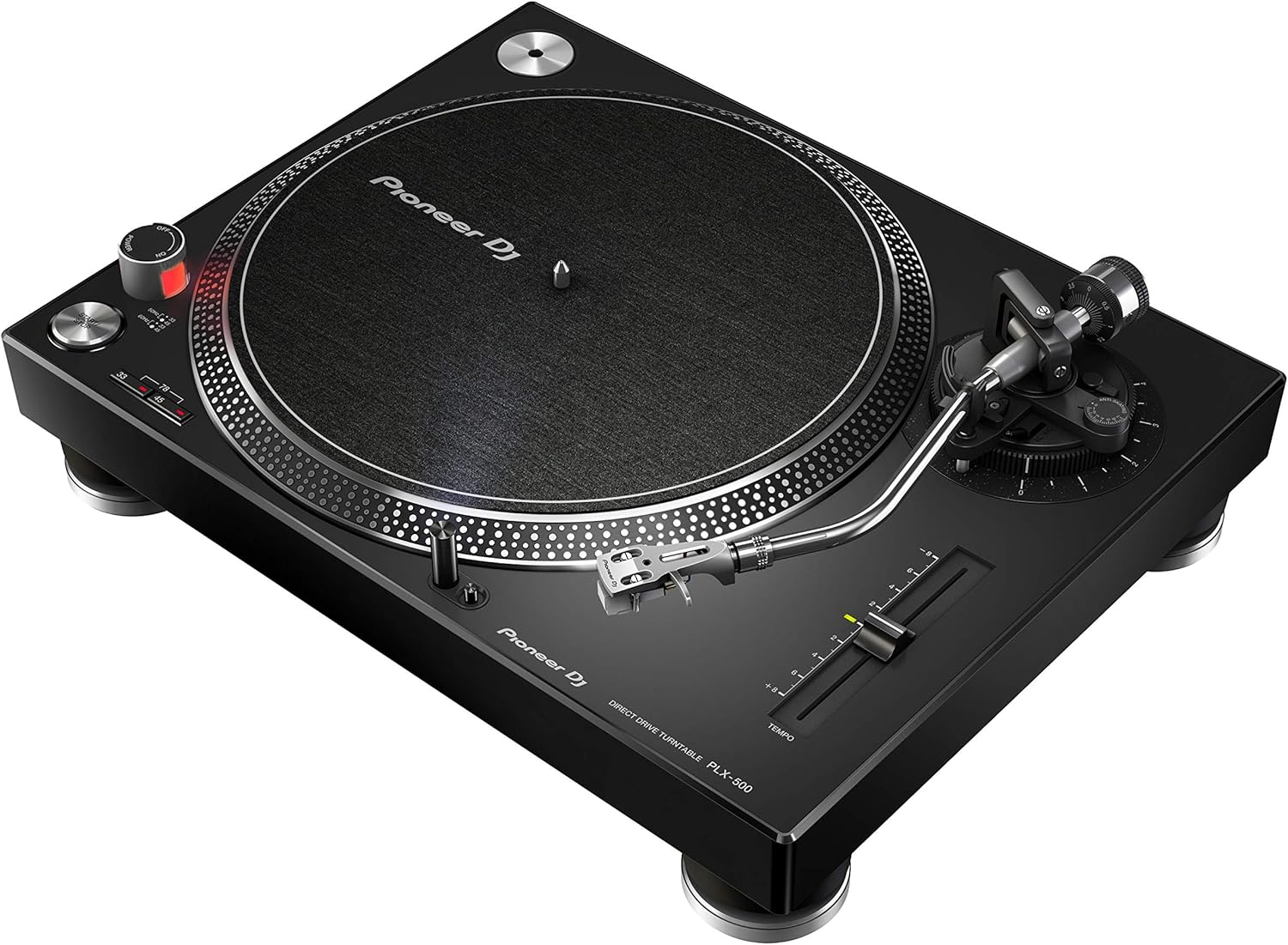
If you’ve been out of the vinyl world for a while — or you’re just getting in — the turntable market at the $250–$350 price point can feel surprisingly crowded and confusing. A direct-drive turntable is one where the motor connects directly to the platter (the spinning platform that holds your record), as opposed to a belt-drive design that uses a rubber band-style loop. Direct-drive spins up faster, handles back-cueing (manually spinning the record backward, a DJ technique), and is generally preferred when precision matters. At the $300 mark, two models come up in almost every forum thread, buyer guide, and “should I buy it?” conversation: the Pioneer PLX-500 and the Audio-Technica AT-LP120XUSB. Both are direct-drive. Both include a built-in phono preamp — the small circuit that boosts a turntable’s quiet signal up to a level your speakers can use. Both land around $300 street price. And yet they’re genuinely different machines built for subtly different people. This guide lays out exactly where each wins, who should buy which, and the tradeoffs most reviews gloss over.
| EDITOR'S PICKAudio-Technica AT-LP140XP-BK Di… | Mid-tierPioneer DJ PLX-500 Direct Drive… | Budget pickAudio-Technica AT-LP120XUSB-BK… | |
|---|---|---|---|
| Operation | Fully manual | — | Fully manual |
| Speeds | 3 speed | — | 3 speed |
| USB output | — | — | ✓ |
| Pitch control | — | — | ✓ |
| Motor torque | High torque | — | — |
| Price | $549.00 | $449.00 | $399.00 |
| See on Amazon → | See on Amazon → | See on Amazon → |
The Short Version (For Readers Mid-Decision)
If you’re already familiar with both models and you’re here to break a tie, here’s the quick frame:
Buy the Pioneer PLX-500 if you have any intention of DJing, mixing, or scratching — even casually — or if you want a turntable that physically resembles and partially behaves like the industry-standard Technics SL-1200 that Pioneer’s design is explicitly referencing.
Buy the AT-LP120XUSB if your primary goal is listening to and archiving your record collection, you want USB digitization built in, or you’re returning to vinyl after a long break and want a more complete out-of-box experience.
Now let’s earn that verdict.
Build, Feel, and First Impressions
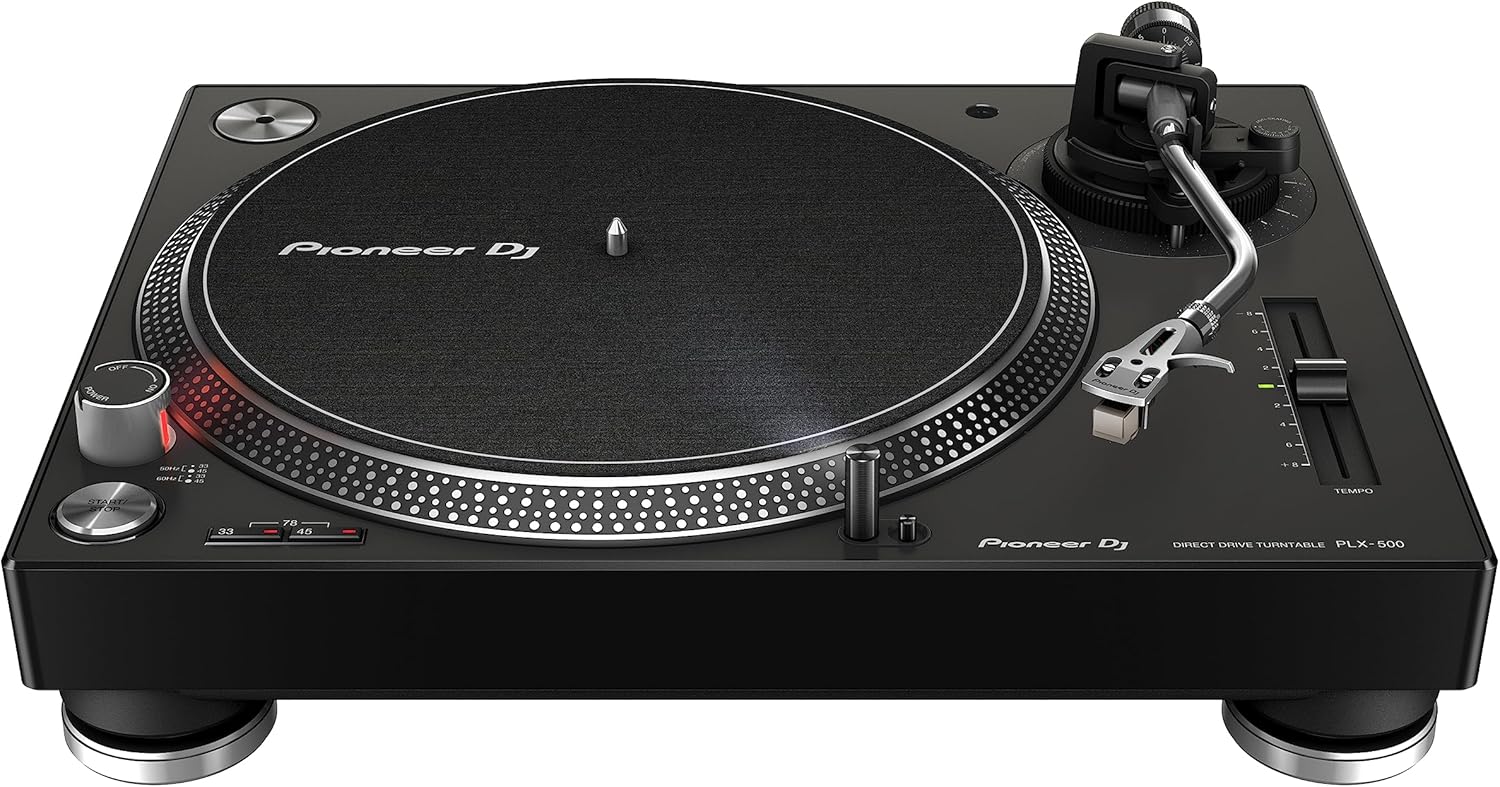
Both decks use S-shaped tonearms — the curved arm that holds the needle — and include a cartridge pre-installed from the factory. Both sit on a similar chassis footprint. Owners who’ve handled both consistently describe a slight edge to the Pioneer in motor responsiveness: the PLX-500’s motor spins up and slows down noticeably faster, a tactile difference you feel when cueing records. This isn’t a lab-measured result, but it reflects a pattern across user comparisons and aligns with Sound On Sound’s coverage of DJ-grade direct-drive turntables, which consistently identifies motor torque and response as the primary variable separating DJ-oriented designs from audiophile-oriented ones at this price tier.
The AT-LP120XUSB gets strong marks for its included AT-VM95E cartridge — a moving-magnet design where a small magnet vibrates to generate signal. Analog Planet’s coverage of the AT-VM95 series describes the VM95E as a genuine high-value performer, not merely a bundled afterthought. Audio-Technica sells the VM95E separately for around $100, which puts the AT-LP120XUSB’s bundled value in clear perspective: you’re getting a real cartridge, not a throwaway.
The PLX-500 ships with Pioneer’s own cartridge, which is widely described as serviceable but not a long-term keeper. A common upgrade path among PLX-500 buyers is to swap in an Audio-Technica AT-VM94E stylus within the first few months. Some owners also replace the stock platter mat with a cork alternative to reduce resonance — unwanted vibration that can muddy sound. This upgrader-community activity is worth knowing going in: the Pioneer functions as much like a platform as a finished product at its price point.
Head-to-Head: Three Scenarios That Decide the Purchase
Scenario 1 — The Passive Listener and Record Archivist
Pioneer
$449.00
In stock on Amazon
Check price on AmazonIf your primary use is sitting down with records and letting sides play — or preserving your collection as digital files — the AT-LP120XUSB wins this scenario clearly on two features.
Auto-return means the tonearm automatically lifts and returns to its rest position at the end of a record side rather than sitting in the run-out groove until you manually intervene. Multiple PLX-500 buyers note this absence with genuine surprise; the assumption that a $300 turntable would include it is reasonable but incorrect. The Pioneer PLX-500 does not have auto-return. The AT-LP120XUSB does.
USB digitization is the AT-LP120XUSB’s clearest functional differentiator in the entire comparison. The USB output, combined with free software such as Audacity (an open-source audio recording program), lets you plug directly into a laptop and record your records as audio files. The Wirecutter’s turntable coverage has consistently identified USB output as a deciding feature for buyers whose primary goal is vinyl-to-digital archiving, and the AT-LP120XUSB is one of the most commonly recommended decks for that workflow in its price bracket. The Pioneer PLX-500 does not include USB output.
If ripping your collection to digital is part of your plan — even occasionally — the Audio-Technica wins without contest.
Pioneer
$449.00
In stock on Amazon
Check price on AmazonScenario 2 — The Aspiring DJ and Home Mixer
Pioneer
$449.00
In stock on Amazon
Check price on AmazonPioneer designed the PLX-500 as a deliberate entry point into the Technics SL-1200 lineage. The platter weight, pitch slider position, and start/stop behavior are all calibrated with the SL-1200 as a reference — a professional DJ standard that currently retails between $1,600 and $1,900 for the SL-1200MK7. DJ Mag’s coverage of entry-level DJ turntables positions the PLX-500 explicitly in this category: a deck whose ergonomics and motor behavior are tuned for mixing and cueing rather than passive listening.
The PLX-500’s pitch range extends to ±16% (compared to ±10% on the AT-LP120XUSB), which gives it more flexibility for matching tempos across records with very different original speeds — a practical advantage in any mixing context.
One note of honesty: neither deck is a serious professional DJ setup. Working DJs at mid-to-upper tier events typically run Pioneer CDJ media players or Technics SL-1200MK7s. The PLX-500 is a DJ-leaning home deck, and that’s a legitimate and useful category — just worth naming clearly. For learning the layout, practicing transitions, and building muscle memory for the Technics-style workflow, the PLX-500 is the right starting point at this price.
The AT-LP120XUSB can be used for basic DJing — its pitch range covers most situations — but its ergonomics and motor behavior aren’t tuned for it the way the Pioneer’s are.
Pioneer
$449.00
In stock on Amazon
Check price on AmazonScenario 3 — The Returning Enthusiast on a Compact Budget
Pioneer
$449.00
In stock on Amazon
Check price on AmazonBuyers returning to vinyl after 20 or 30 years represent a significant share of both decks’ audiences. For this group, the AT-LP120XUSB is generally the stronger recommendation, for three reasons that compound:
First, the included AT-VM95E cartridge is genuinely good. As noted in Analog Planet’s AT-VM95 series coverage, the VM95E is not a bundle throwaway — it’s a cartridge that holds up against competitors sold separately at its price point. A returning listener doesn’t need to think about a cartridge upgrade immediately.
Second, auto-return means the tonearm lifts at the end of a side. For listeners who want to put a record on and walk away, this is a meaningful quality-of-life feature.
Third, the USB output provides a path to digitizing records they care about — a use case that comes up naturally for people reconnecting with records they’ve owned for decades.
The PLX-500 is a fine deck, but it rewards buyers who want to tinker. The AT-LP120XUSB rewards buyers who want to play records. For the returning enthusiast, that distinction matters.
Pioneer
$449.00
In stock on Amazon
Check price on AmazonFeature Comparison at a Glance
| Feature | Pioneer PLX-500 | AT-LP120XUSB |
|---|---|---|
| Drive type | Direct | Direct |
| USB output | No | Yes |
| Auto-return | No | Yes |
| Included cartridge | Pioneer VM-style | AT-VM95E |
| Pitch range (±) | ±8% / ±16% | ±10% |
| Quartz speed lock | No | Yes |
The Quartz Speed Question
Quartz-regulated speed means the platter’s rotation is locked to a quartz crystal reference — the same principle that keeps quartz watches accurate — so the speed doesn’t drift over time. The PLX-500 lacks quartz regulation; the AT-LP120XUSB includes it.
Does the absence of quartz regulation on the PLX-500 cause audible problems? Sound On Sound’s coverage of DJ-grade turntables notes that quartz lock is most critical in professional mixing contexts where precise pitch-matching across extended sets is required. For home listening, motor stability at this price tier is generally sufficient. Most PLX-500 owners do not report perceptible speed drift during normal home use. It’s a spec-sheet gap that matters more in theory — or in professional DJ applications — than it does for the actual daily use most buyers at this price point will put the deck through.
What About the AT-LP140XP?
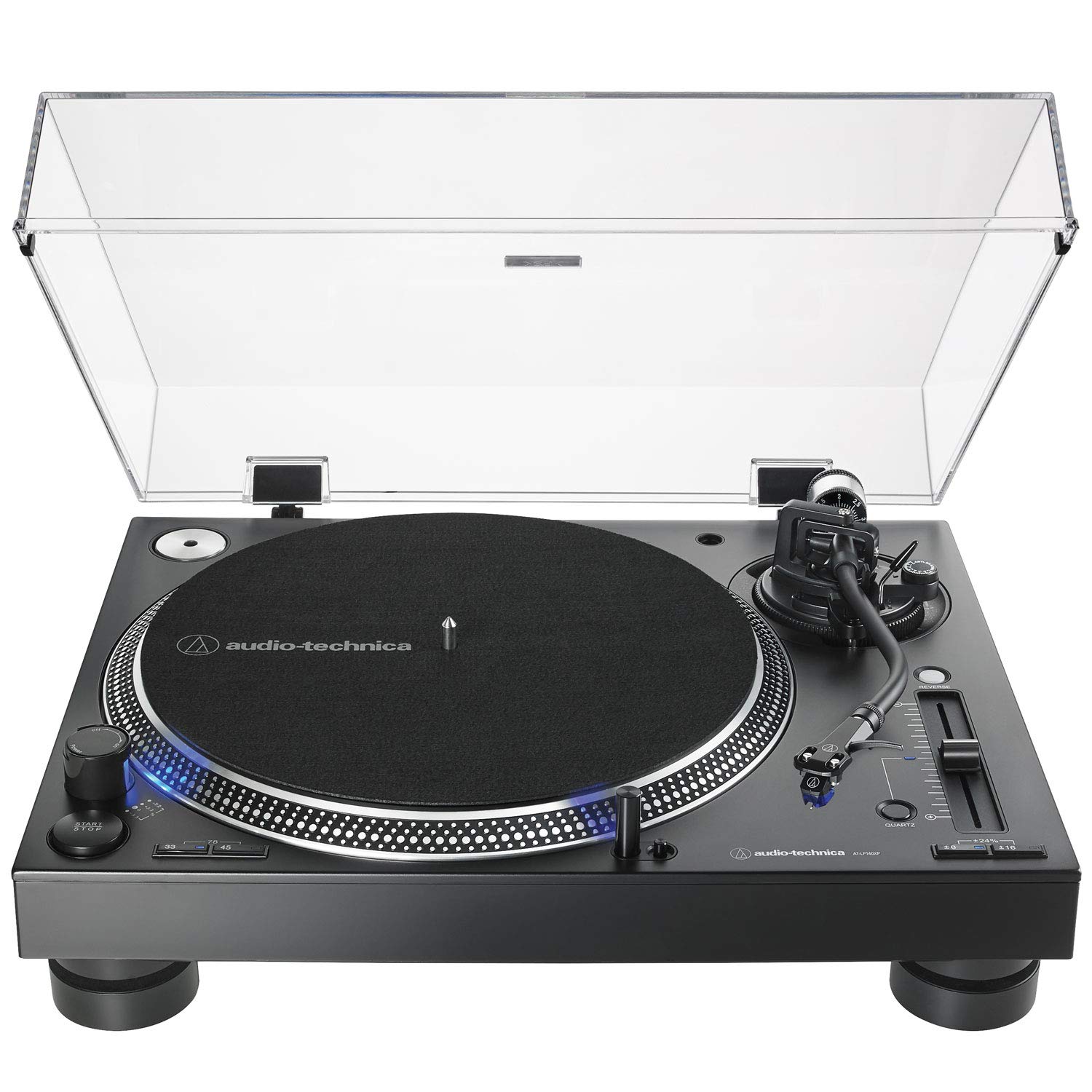
The AT-LP140XP is Audio-Technica’s step-up model, designed more explicitly for DJ use. The Vinyl Factory’s buyer guides position it as a meaningful upgrade in platter weight and motor authority over the LP120XUSB — owners consistently describe improved build quality and feel, and many compare it favorably to higher-priced belt-drive units they replaced.
The tradeoff: the AT-LP140XP does not include USB output, and it sits at a higher price point. If your budget extends there and DJing is the priority, it’s worth a direct comparison against the PLX-500. But if USB digitization is on your list, the LP140XP doesn’t solve for that — and neither does the PLX-500. In that case, the AT-LP120XUSB remains the only deck in this conversation with the feature built in.
Audio-Technica
$549.00
In stock on Amazon
Check price on AmazonDecision Rules in Plain Language
- If you want to rip records to your laptop: AT-LP120XUSB — only option in this comparison with USB output.
- If auto-return matters (you listen passively, you don’t want to babysit the tonearm): AT-LP120XUSB.
- If you’re returning to vinyl after decades away and want a fully sorted, minimal-fuss experience: AT-LP120XUSB — the VM95E cartridge and auto-return make it the friendlier choice.
- If you want to learn DJing, practice scratching, or build Technics-style muscle memory: Pioneer PLX-500.
- If you know you’ll upgrade the cartridge and platter mat anyway: PLX-500’s upgrader community gives you a clear roadmap.
- If you have more room in your budget and DJing is the goal: Look at the AT-LP140XP before committing to either of these.
Neither deck is a bad buy. The mistake is buying the wrong one for your actual use case.
Frequently Asked Questions
Does the Pioneer PLX-500 have auto-return? No. Multiple buyers report this as a surprise at the $300 price point — the assumption is reasonable but the feature isn’t there. If auto-return matters to your listening workflow, the AT-LP120XUSB is the deck in this comparison that has it.
Can I use the AT-LP120XUSB to rip my vinyl collection to a computer? Yes, and it’s one of the primary reasons to choose it over the Pioneer if digitizing records is part of your plan. The USB output sends audio directly to your computer; free software like Audacity handles the recording side. The Wirecutter’s turntable guidance identifies this as one of the most practical and well-documented USB-archiving workflows at this price tier.
What does quartz-regulated speed mean and does its absence on the PLX-500 matter audibly? Quartz regulation locks the platter’s spin speed to a precise crystal reference. The PLX-500 lacks it; the AT-LP120XUSB includes it. In practice, most listeners don’t notice audible speed drift on the PLX-500 during normal home listening. As Sound On Sound’s coverage of DJ turntables notes, quartz lock matters most in professional mixing contexts — a use case somewhat beyond both decks’ primary audience.
Is the AT-LP140XP worth the extra cost over the AT-LP120XUSB? If DJing or build quality is the priority, The Vinyl Factory’s buyer coverage consistently positions the LP140XP as a meaningful step up in motor feel and construction. It does not include USB digitization. Whether the premium is worth it depends almost entirely on whether DJing or archiving is your primary use case.
Which turntable is better for someone returning to vinyl after 30 or 40 years? The AT-LP120XUSB. The included AT-VM95E cartridge is genuinely good (Analog Planet’s coverage of the VM95 series confirms it as a real performer at its price point, not a throwaway bundle part), the auto-return lifts the tonearm at the end of a side, and the USB digitization option gives you a path to preserving records you care about. The PLX-500 is a fine deck, but it rewards buyers who want to tinker; the AT-LP120XUSB rewards buyers who want to play records.