August 7, 2026 • Roxanne Flair • 9 min reading time • Prices verified June 4, 2026
Mid-Tier DJ Controllers $250–$500: When the Pioneer DDJ-FLX4 Stops Being Enough
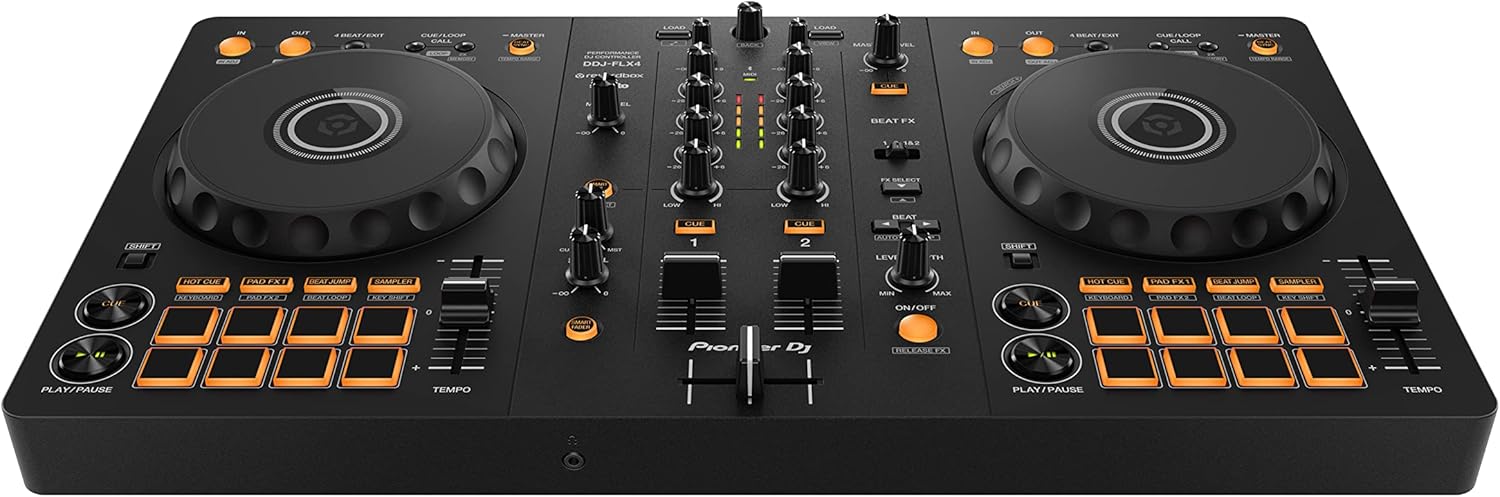
There’s a moment every developing DJ recognizes in hindsight: the night the gear starts saying no before your ideas do. A DJ controller is a piece of hardware that lets you mix music from a laptop — blending tracks, adjusting tempo, adding effects — without needing two turntables and a separate mixer. Most people start on something in the $150–$250 range, get comfortable, and then hit a wall. The jog wheels (the circular platters you spin to cue and scratch music) feel mushy. The effects sound toy-like. You keep brushing knobs you didn’t mean to touch. The Pioneer DDJ-FLX4, which retails around $249, is genuinely excellent for where it sits — but if you’re booking real gigs, practicing daily, or just finding that your workflow has outpaced the hardware, the $250–$500 tier is where things get meaningfully different. This guide maps that territory clearly, with honest tradeoffs and a decision rule at the end of every comparison.
What Actually Changes in the $250–$500 Range
Let’s name the real differences, because spec sheets at this price tier can be misleading. The jump from entry-level to mid-tier isn’t primarily about build material or brand prestige — it’s about workflow consequences. Three things change in ways that matter during a live set:
Jog wheel quality and feel. Higher-end controllers use heavier, more precisely tensioned platters. For beatmatching by ear and for scratch technique, the tactile response isn’t cosmetic — it directly affects timing accuracy. Owners of the Numark Mixtrack Platinum FX, in long-run forum reviews aggregated on DJ Mag’s forum coverage, consistently single out the jog wheel displays (small screens embedded in the platter surface that show BPM, track position, and cue points) as transforming their live workflow. That’s not a luxury feature for a wedding DJ reading a crowd — that’s situational awareness you can’t get by glancing at a laptop screen ten feet away.
Software depth and dual-platform compatibility. Entry-level controllers typically lock you into one software ecosystem. Mid-tier units increasingly support both rekordbox (Pioneer’s proprietary DJ software) and Serato DJ (a widely used alternative platform with a strong professional install base). The distinction matters if you ever sit in on a friend’s setup, walk into a venue with house gear, or want to migrate your library later without rebuilding everything.
Stem separation and FX routing. Stems — the technology that isolates vocals, drums, melody, and bass from a single audio file — moved from novelty to practical tool as the algorithms matured. Mixmag’s coverage of mid-tier controllers in their 2025 roundup notes that stem separation at this tier is now stable enough for live use on modern hardware, not just for home experimentation.
The Main Contenders, Side by Side
Pioneer DDJ-FLX4 (staying point, ~$249) This is the baseline. It’s Pioneer’s entry into two-channel mixing (two-channel meaning you manage two tracks at once, the standard for most mixing styles), runs rekordbox natively, and handles Serato DJ Lite (the free, feature-limited version of Serato). Owners in reviews aggregated by Sound On Sound consistently praise the layout as clean and the build as solid for the price. The limitation isn’t quality — it’s ceiling. You get four hot cue pads (assignable markers you can trigger instantly during a mix), a basic effects unit, and a layout optimized for learning. The FLX4 earns its reputation. But if you’re reading this article, you’ve probably already made peace with what it can’t do.
Pioneer DDJ-FLX6-GT (~$449–$499) The meaningful upgrade within Pioneer’s own line. Four channels instead of two — meaning you can manage four tracks simultaneously, layer loops, or blend in a third source like a live vocal input or a secondary playlist. The jog wheels are larger and heavier. The build is noticeably more substantial. Per published specs, the FLX6-GT includes a dedicated stem separation mode and an expanded effects suite. DJ Mag’s 2025 controller roundup notes the FLX6-GT as the clearest “first professional controller” recommendation in Pioneer’s lineup for DJs who’ve moved past the learning phase. The tradeoff: you pay for Pioneer’s ecosystem premium, and the price ceiling of this guide is tight here — street pricing fluctuates.
Numark Mixtrack Platinum FX (~$299) The strong alternative case. Owners who DJ weddings specifically — a context where reading a room and executing transitions under pressure matters more than technical flex — cite the jog wheel displays as transformative. The ability to see your track’s waveform and position on the platter itself, rather than tracking it on a laptop screen while also managing a crowd, is a real workflow advantage. Mixmag’s 2024–2025 coverage of the Mixtrack line consistently flags this as the unit’s defining differentiator at this price point. It runs Serato DJ Lite out of the box, with a path to Serato DJ Pro (the full paid version) if you upgrade your software license separately. The tradeoff: jog wheel feel and build aren’t quite at Pioneer’s level per long-run owner reviews, and rekordbox compatibility is limited.
Pioneer DDJ-REV1 (~$299) This one is deliberately different. The REV1 uses a battle-style layout — meaning the mixer section sits in the middle and the decks flank it on the left and right, rather than the standard setup where the mixer sits between decks aligned horizontally. Resident Advisor’s gear coverage notes that scratch DJs and hip-hop-focused DJs choose the REV1 for layout reasons, not price or spec. It’s built for a different physical workflow. Reviewers across aggregated forum threads make the point clearly: the REV1 isn’t a compromise pick for scratch beginners — it’s a deliberate choice for DJs who know they want that style. If you’re mixing house music for weddings, the battle layout will feel counterintuitive. If you’re cutting and scratching, it will feel like the only sensible option.
By the Numbers
| Controller | Channels | Jog Wheel Displays | Native Software | Street Price (May 2026) |
|---|---|---|---|---|
| Pioneer DDJ-FLX4 | 2 | No | rekordbox + Serato Lite | ~$249 |
| Numark Mixtrack Platinum FX | 2 | Yes | Serato DJ Lite | ~$299 |
| Pioneer DDJ-REV1 | 2 | No | Serato DJ Lite | ~$299 |
| Pioneer DDJ-FLX6-GT | 4 | No | rekordbox + Serato Lite | ~$449–$499 |
The Four-Deck Question
Two-channel controllers handle the overwhelming majority of what most DJs do live. But there’s a specific moment when two channels become a structural limitation rather than a stylistic preference: when you want to blend a third element in real time without killing one of your two running tracks.
Wedding DJs layering a crowd-read intro over a transition, mobile DJs running a loop while loading the next track, DJs who want to introduce a vocal acappella over a running mix — these workflows technically require a third channel. On a two-channel controller, you can fake some of it with loop tricks and hot cues, but you’re problem-solving around the hardware’s limits. The DDJ-FLX6-GT solves this directly. The honest framing: if you’ve never felt constrained by two channels in a live context, you probably don’t need four yet. If you’ve felt the constraint once, you’ll feel it again.
Frequently Asked Questions
What is the difference between rekordbox and Serato DJ Lite, and which controllers support both?
Rekordbox is Pioneer DJ’s own software platform — it handles library management, track analysis, and mixing. Serato DJ is a separate, widely adopted platform made by a New Zealand company; Serato DJ Lite is the free version bundled with many controllers, while Serato DJ Pro is the paid upgrade with the full feature set. The DDJ-FLX4 and DDJ-FLX6-GT support both platforms natively. The Numark Mixtrack Platinum FX and DDJ-REV1 ship with Serato DJ Lite and have limited or no rekordbox support. Per DJ Mag’s platform comparison coverage, the practical implication is portability: if you ever need to sit in at a Pioneer-equipped venue running rekordbox, having that native support already built into your practice controller is an advantage.
Do jog wheel displays on the Numark Mixtrack Platinum FX make a real difference for live performance?
Based on aggregated owner reviews and Mixmag’s coverage, the answer is yes — specifically for DJs performing in environments where they can’t constantly reference a laptop screen. Wedding DJs and mobile performers working in dimly lit rooms cite the on-platter display as the clearest practical advantage over competing units at the same price. It’s not a flashy feature; it’s an ergonomic one.
Is the Pioneer DDJ-REV1 layout good for beginners, or is it only for scratch DJs?
Resident Advisor’s gear coverage and long-run owner reviews both make the same point: the battle-style layout is logical and learnable, but it’s optimized for scratch and cut workflows. Someone learning to mix house, techno, or pop tracks will find the standard layout of the FLX4 more intuitive. Someone who knows they want to scratch — even a beginner who’s committed to that style — will find the REV1’s layout more natural from day one. It’s a style choice, not a skill-level choice.
When does a two-deck controller become a limitation, and how do I know I need four decks?
The signal is specific: you’ve found yourself wanting to introduce a third audio element without stopping or restarting one of your two running tracks. If you haven’t felt that constraint in practice, two channels is almost certainly enough for where you are now. If you’ve felt it — even once during a real set — the DDJ-FLX6-GT solves it directly at this price tier.
Can I DJ professionally without a laptop using any controller in this price range?
No. Every controller in this guide requires a connected laptop running compatible software. Standalone (laptop-free) DJ performance requires dedicated media players — like the Pioneer CDJ series — which operate at a significantly higher price point and different workflow. That’s a separate buying decision. Every controller discussed here is a laptop-dependent device.
The Decision Rule
Here’s where the research lands, stated plainly:
- If you’re DJing weddings or mobile events and want better situational awareness without leaving Pioneer’s ecosystem, the Numark Mixtrack Platinum FX is the most defensible pick at $299 — the jog wheel displays are a real tool, not a gimmick.
- If scratch technique and battle-style workflow are your actual goals, the DDJ-REV1 is the right choice and the layout is the whole reason to buy it.
- If you’re staying in the Pioneer/rekordbox world and want the clearest path to professional use, stretch to the DDJ-FLX6-GT. The four-channel upgrade and the heavier build justify the price jump for anyone booking consistent paid gigs.
- If the DDJ-FLX4 is genuinely serving your current needs, don’t upgrade yet. The FLX4 stops being enough when you can specifically name what it can’t do — not before.
The gear doesn’t make the DJ. But the wrong gear for a specific workflow creates friction that compounds every session. Know what constraint you’re solving, name the controller that solves it, and buy that one.