August 4, 2026 • Roxanne Flair • 9 min reading time • Prices verified June 4, 2026
LED Par Lights for DJ Events: How to Stop Buying the Wrong Uplights
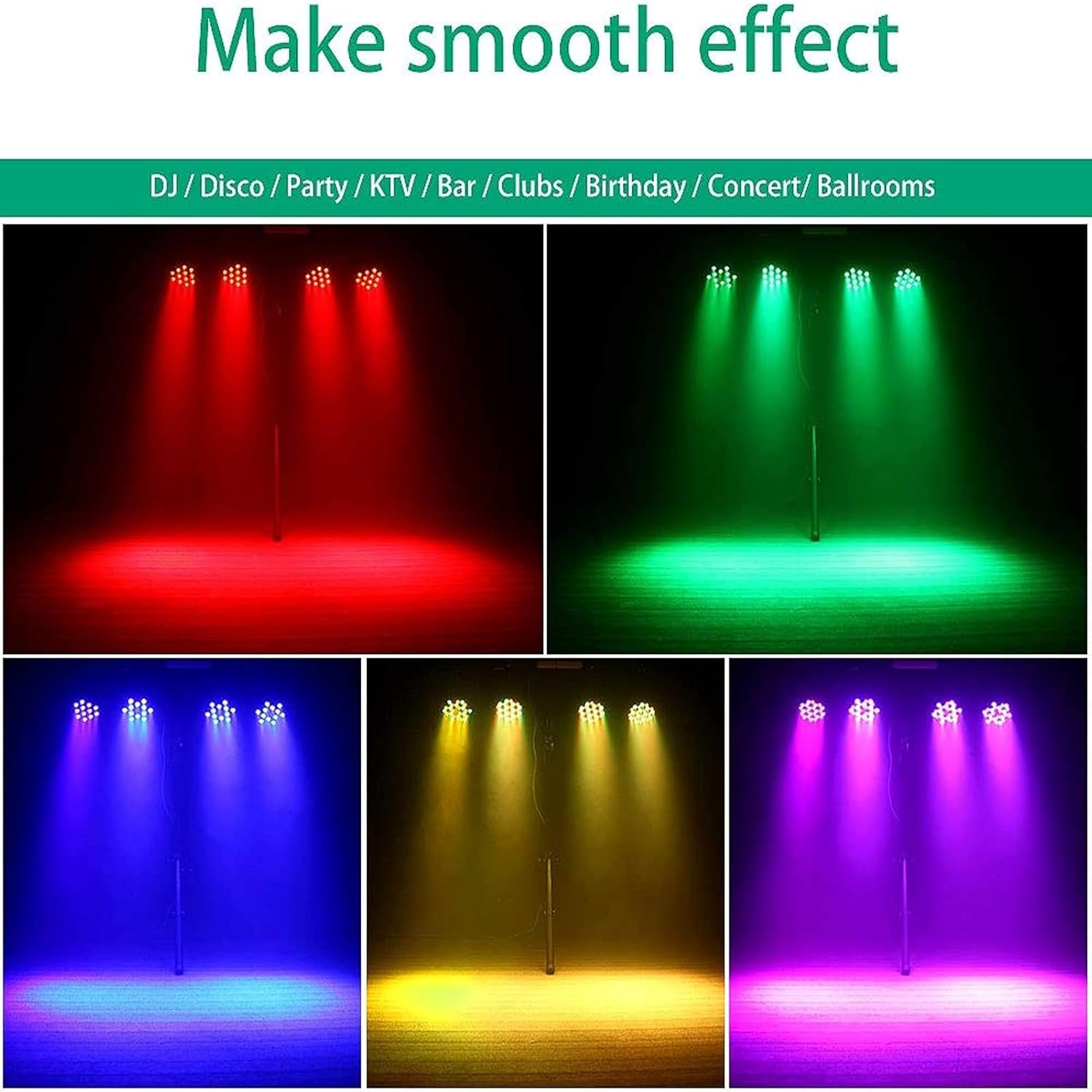
If you’ve ever walked into a wedding reception or corporate dinner and seen those glowing washes of color along the walls — that warm amber or deep blue light that makes even a plain hotel ballroom look intentional — you’ve already seen uplighting at work. Uplights are simply fixtures (the housing that holds the light source) placed on the floor and aimed upward at walls, columns, or drapes to add color and atmosphere to a room. The specific type most DJs use is called a PAR can — short for Parabolic Aluminized Reflector — a cylindrical light that focuses its beam into a tight or wide wash of color. Modern ones use LEDs (energy-efficient bulbs built from dozens of tiny diodes) instead of hot, power-hungry halogen bulbs. They’re wireless or wired, battery or plug-in, and they range from $25 novelties to $400 professional workhorses. The problem isn’t finding them — it’s figuring out which one is worth your money for the gig you’re actually running.
This guide is built for DJs and event operators who’ve already bought a lighting rig (or are about to), understand the basics, and want to stop making $300 mistakes. We’ll name the tradeoffs, show the math, and end with clear decision rules.
| EDITOR'S PICKU`King LED Par Lights DJ Stage… | Mid-tierSHEHDS LED Stage Par Lights LED… | Budget pickU`King LED Par Lights DJ Stage… | |
|---|---|---|---|
| Pack count | 8 Packs | — | 2 Packs |
| LEDs | 36 | 18x18W | 36 |
| Color | RGB | RGBWA+UV | RGB |
| Remote | ✓ | — | — |
| Control | Remote | DMX512 | — |
| Price | $159.99 | $128.88 | $39.99 |
| See on Amazon → | See on Amazon → | See on Amazon → |
Why Most DJs Overbuy or Underbuy Uplights (And How to Know Which Mistake You’re Making)
The two failure modes in uplight purchasing are almost perfectly symmetrical. Underbuyerss grab the cheapest 12-LED PAR cans they can find on a major retailer — often marketed with impressive-sounding wattage claims — and then wonder why their colors look washed out in a lit banquet hall. Overbuyers purchase eight full-featured RGBAW+UV fixtures with onboard DMX and wireless control for a gig that runs four hours a year in a VFW hall.
Both mistakes hurt your margin. Here’s the core diagnostic: what kind of room, how often, and who’s paying for it?
DJ Mag’s 2025 lighting buyer’s guide frames the decision around two variables: ambient light level and gig frequency. A venue with recessed can lighting running at 50% during dinner service is a fundamentally harder environment to light than a dark club. In brighter rooms, you need more lumens (the actual measure of light output — more lumens means more visible, punchier color). Gig frequency determines whether you’re amortizing a $350 fixture over 80 events or 8.
The second mistake is buying on LED count instead of LED quality. A fixture spec’d at “54 LEDs” sounds more powerful than one rated for “18 LEDs,” but the relevant number is the wattage and type of each individual LED. Eighteen 3W tri-color LEDs will outperform 54 cheap 0.5W diodes every time — often dramatically. Sound On Sound’s practical overview of stage lighting specifically flags this as the most common source of confusion for buyers who are new to professional fixtures.
The Four Tiers: What You Actually Get at Each Price Point
This is where most guides leave you hanging. Let’s be specific.
Tier 1 — Under $50 per fixture (party-starter range) Fixtures like generic 18x3W RGB PAR cans sold in 6- or 8-packs. These are fine for a backyard party or a teenager’s bedroom rave, but owners consistently report color mixing that reads as muddy in anything brighter than a dark room, and build quality that doesn’t survive more than a season of regular transport. The polarity of reviews is stark: love them for the price in pitch-dark settings, frustrated by them everywhere else.
Tier 2 — $50–$120 per fixture (working hobbyist / part-time DJ) This is where ADJ’s entry lines and Chauvet DJ’s SlimPAR series live. The ADJ 5P HEX, for example, adds a white and amber LED to the standard RGB mix (making it RGBAW — that extra “A” for amber and “W” for white transforms skin tones from green-tinged to flattering). ADJ’s published spec sheets put the 5P HEX at a 25° beam angle with enough output to hold its own in moderately lit rooms. Owners in long-run reviews note these fixtures survive regular gigging with minimal failure if transported correctly. At this tier, you’re buying reliability and better color science, not features.
Tier 3 — $120–$250 per fixture (serious mobile DJ, semi-pro) The Chauvet DJ SlimPAR Pro H USB and ADJ 12P HEX operate here. These add onboard DMX control (a professional lighting control protocol that lets you synchronize fixtures from a lighting board or software), brighter output, and in many cases wireless DMX receivers. Chauvet DJ’s spec sheet rates the SlimPAR Pro series for significantly higher lumen output than Tier 2 fixtures — the difference is visible in venue photos shared by operators across lighting-focused DJ forums. This is the tier where the cost-per-use math starts to work clearly for DJs running 30+ paid events per year.
Tier 4 — $250–$450 per fixture (professional, high-volume, or rental-fleet) Fixtures like the ADJ Encore BP100 (battery-powered, wireless DMX) or the Elation KL PAR FC enter this range. Battery-powered uplights eliminate cable runs entirely — a meaningful operational advantage in high-end venues where visible cables can cost you a rebooking. Operators in long-run reviews describe the battery fixtures as transformative for setup time in ballrooms, though they note that battery life management becomes its own discipline. At this tier, you’re also buying into IP ratings (a standardized measure of how well a fixture resists dust and moisture — IP65 means fully protected against dust and water jets), which matters for outdoor events.
By the Numbers
| Tier | Price per fixture | LEDs | Typical use case |
|---|---|---|---|
| 1 | Under $50 | 18–54 low-watt | Dark rooms, occasional use |
| 2 | $50–$120 | 18–36 HEX/RGBAW | Part-time DJ, 10–30 events/yr |
| 3 | $120–$250 | 18–36 HEX + DMX | 30+ events/yr, lit venues |
| 4 | $250–$450 | High-output + battery | Professional, venues, rental |
The Specs That Actually Matter (and the Ones You Can Ignore)
You’ll see a lot of numbers on fixture listings. Here’s a brutally honest filter.
Matters a lot:
- RGBAW or RGBAW+UV vs. plain RGB. The amber and white LEDs in a HEX-format fixture are responsible for warm whites and skin-tone accuracy. Plain RGB uplights can’t produce a true warm white — they fake it with a blue-green cast that flatters no one. ADJ’s product documentation explicitly distinguishes their HEX LED line from RGB for this reason.
- Beam angle. A 15°–25° beam gives you a tight column of light that reaches high ceilings without spilling. A 40°+ beam washes wider — good for low ceilings or wash coverage, less dramatic for columns and draping.
- Wireless protocol. If you’re buying battery fixtures, make sure all your fixtures speak the same wireless DMX protocol. Mixing brands with incompatible wireless systems means you’re running two separate universes (DMX terminology for a group of up to 512 individually addressable channels). DJ Mag’s 2025 guide flags inter-brand wireless compatibility as one of the most common fleet management headaches for mobile DJs.
Matters less than you think:
- Total LED count. As covered above, this number is nearly meaningless without knowing the wattage per LED.
- Auto-sound mode quality. Most fixtures have a mode where they react to music automatically, without a controller. Owners consistently describe this as a party-trick feature, not a professional one. It’s nice to have, but don’t let it influence your purchase decision.
- Max DMX channels. Unless you’re running a full lighting console (a dedicated hardware controller for large rigs), you likely won’t use more than 6–10 channels per fixture anyway.
The Gig-ROI Math: How Many Events Before a Tier-3 Fixture Pays Off
This is the math most guides skip, but it’s the frame that justifies the upgrade.
Assume a part-time DJ charges a $150 uplighting add-on for 8 fixtures per event. At 20 events per year, that’s $3,000 annually from uplighting alone.
A Tier-2 setup of 8 fixtures at $90 each costs $720. The math looks fine until you factor in replacement: owners of budget fixtures consistently report failures within 18–24 months of regular gigging — blown LED boards, cracked housings, faulty DMX chips. If you replace two to three fixtures per year at $90, you’re spending $180–$270 annually on attrition.
A Tier-3 setup at $180 per fixture costs $1,440 upfront — double the Tier-2 investment. But operators in long-run reviews report significantly lower failure rates, and Wirecutter’s general methodology notes on LED product evaluation echo the principle: higher-quality LEDs and driver circuits have dramatically longer rated lifespans. If Tier-3 fixtures last four to five years with minimal replacement, the annualized cost per fixture drops well below the Tier-2 math — while also delivering the output quality that justifies the $150 add-on in lit ballrooms where Tier-2 looks underwhelming.
The break-even point is roughly 25–30 paid events. If you’re below that annually, Tier-2 is defensible. Above it, the Tier-3 upgrade pays for itself inside 18 months.
Decision Rules: Which Tier Is Yours
Here’s the clean if/then framework:
If you’re hosting occasional private parties or testing whether clients will pay for uplighting: Buy 6–8 Tier-2 RGBAW fixtures. Don’t go cheaper — plain RGB will embarrass you in any lit room. The ADJ 5P HEX or comparable Chauvet DJ SlimPAR entry-level HEX units are the floor for professional-looking results.
If you’re running 20–40 paid events per year in mixed venue types: Move to Tier-3. The output difference in lit rooms is meaningful enough to protect your reputation, and the ROI math closes within a year and a half. Prioritize fixtures with onboard DMX and a clear wireless upgrade path.
If you’re doing 40+ events, high-end venues, or building a rental fleet: Budget for Tier-4 battery-powered fixtures. The operational time savings on cable elimination across a 150-person ballroom setup is real money — operators consistently report cutting setup time by 30–45 minutes when moving from wired to battery wireless. At $350–$450 per fixture, 8 units is a $2,800–$3,600 fleet investment. Amortized over 60 events a year at a $200 uplighting add-on, it clears in a single season.
If you’re buying for outdoor events regardless of tier: Confirm IP54 or IP65 ratings before purchasing. This is non-negotiable. An unrated fixture in a dewy outdoor tent is a warranty-voiding situation that manufacturers won’t cover.
The wrong uplight isn’t the one that breaks — it’s the one that was right for a different gig than yours. Buy to the room, buy to the frequency, and run the math before the listing page does it for you.