August 24, 2026 • Roxanne Flair • 10 min reading time • Prices verified June 4, 2026
How to Layer Disco Ball Decorations Across an Entire Event Space
A disco ball — the mirrored sphere that hangs from a ceiling and scatters hundreds of small spots of reflected light around a room when a beam hits it — is the single most iconic piece of party décor in existence. If you’ve been to a 70s-themed event or a club night at any point in the last 50 years, you’ve seen one doing its job. But here’s the thing most buyers figure out only after the party: one ball alone rarely fills a space the way you’re picturing. The light coverage from a mirror ball is proportional to its size and how far it hangs from the light source, and a single undersized piece in a corner leaves most of your room looking like an afterthought. This guide is about building a system — a layered approach that uses a hierarchy of different ball sizes, formats, and supplementary pieces to cover your entire venue, whether that’s a basement, a backyard tent, or a rented hall.
If you’ve already got one ball on order and you’re starting to suspect it might be too small, you’re probably right. Let’s fix that before the event.
| EDITOR'S PICK17 Pcs Disco Ball Decor: Mini L… | Mid-tierYoudepot Disco Ball 12-Inch – L… | Budget pickMTLEE 20 Pcs Disco Balls Decora… | |
|---|---|---|---|
| Largest ball | 12" | 12" | 2.4" |
| Piece count | 17 | 1 | 20 |
| Assorted sizes | ✓ | ✗ | ✓ |
| Material | Mirror | Mirror | Glass |
| Hanging rope | — | — | ✓ |
| Use case | Stage/Club/Prop | Party/Event | Wedding/Dance |
| Price | $107.99 | $45.99 | $11.99 |
| See on Amazon → | See on Amazon → | See on Amazon → |
Why Layering Matters: The Coverage Math Behind Mirror Ball Placement
The most consistent complaint across hundreds of disco ball product reviews — and reviewers of the 12-inch Youdepot ball explicitly state this — is that buyers underestimate how much room a single ball leaves uncovered. This isn’t a product flaw; it’s a geometry problem. A standard mirror ball reflects light in a cone pattern that fans outward from the ball’s position. The bigger the ball, the larger the mirror facets, and the larger (but fewer) the light spots. A smaller ball throws more spots but smaller ones.
The practical framework, synthesized from owner reports and Mixmag’s mirror ball coverage overview:
By the numbers:
- A 12-inch ball covers roughly a 15–20 ft diameter floor sweep when hung at 8–10 ft with a focused pin spot.
- A 16–20 inch ball extends that sweep to 25–30 ft under the same conditions.
- Small accent balls (4–6 inch) are decorative above ~15 ft; they’re coverage tools below that.
- A 32-inch format (including oversized balloon versions) serves as a visual anchor, not a light engine.
The takeaway for your planning: your centerpiece ball handles the ceiling and mid-room coverage; secondary pieces fill the perimeter; accent pieces handle surface-level detail. These are three separate jobs, and trying to do all three with one item is why parties look half-finished.
Layer One: The Centerpiece Ball (And How Not to Undersize It)
For a standard living room or basement in the 300–500 sq ft range, a 12-inch ball is the realistic minimum for a centerpiece, but reviewers consistently say they wished they’d gone to 16 inches. For anything larger — a 700–1,000 sq ft open event space, a garage conversion, a backyard tent — start at 20 inches and consider going larger.
The Youdepot 12-inch Mirror Disco Ball is a solid entry-level centerpiece with consistent reviewer praise for build quality, though as noted above, the most common follow-up comment from buyers is that they should have sized up. It’s the right call for a small apartment living room or a kid’s birthday setup. For a basement party with 20–40 guests, size up.
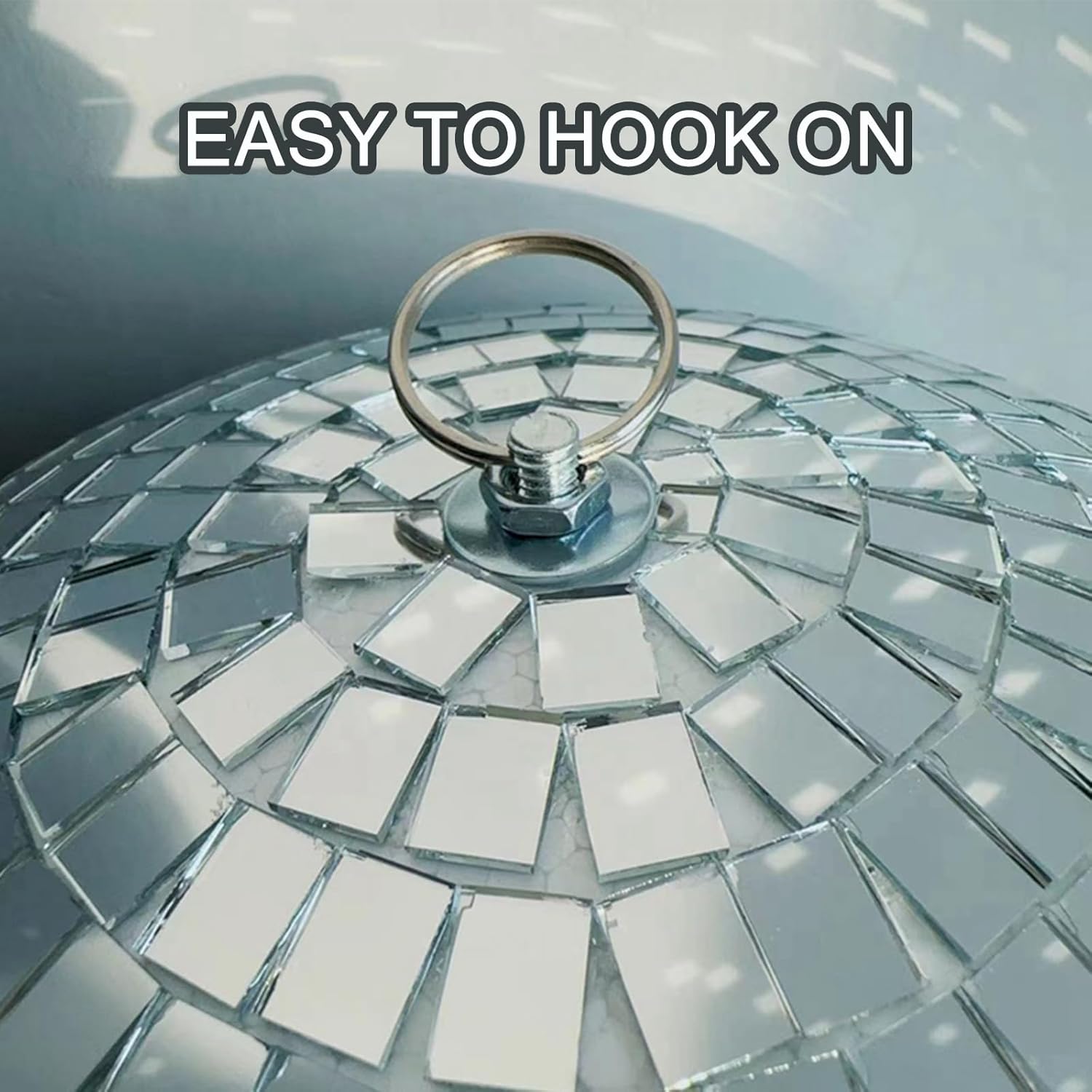
Hanging hardware is not always included. This is a real practical gap: the Alytimes 8-inch ball, for example, ships without ceiling hardware, and reviewers flag this as a surprise. Before your event, verify whether your ball ships with a swivel hook and hanging wire — and if not, budget for a rated ceiling hook, a length of clear monofilament or thin wire rope, and a swivel joint (which lets the motor spin the ball without tangling the cord). Apartment Therapy’s guide on hanging without drilling recommends adhesive ceiling hooks rated for 5–10 lbs for rental-safe installs, with the caveat that you should confirm the weight rating against your specific ball before trusting it.
Motor note: most entry and mid-tier disco balls require a separate motor to spin. The motor is what creates the sweeping light effect; without it, the ball is static and the effect is dramatically reduced. If the listing doesn’t include a motor, add one to your cart at the same time.
Layer Two: Mid-Room Accent Balls and Perimeter Coverage
Once your centerpiece is placed, your second job is filling the dead zones: corners, above buffet tables, near the DJ setup, over the dance floor perimeter. This is where multi-pack mini ball sets earn their keep.
Multi-pack mini disco ball sets — typically including 6 to 12 balls in the 1.5-inch to 4-inch range — are one of the most genuinely versatile products in the party decoration category. Owners report using them simultaneously as ceiling cluster hangers, cake toppers, and table scatter pieces, and in at least one recurring reviewer pattern, the same set gets repurposed as Christmas tree ornaments after the event. That multi-use track record is a real argument for buying a slightly larger pack than you think you need.
For perimeter coverage, hang clusters of 3–5 mini balls at varying heights in each corner using clear fishing line. The overlapping reflections from multiple small balls at different angles create a randomized sparkle effect that a single large ball can’t replicate at the edges of a room. Reviewers consistently recommend staggering the hang heights by 6–12 inches within each cluster rather than hanging them all at the same level.
How many do you need? For a room in the 400–600 sq ft range, a working estimate from aggregated owner reports is:
- 1 centerpiece ball (12–20 inch depending on ceiling height)
- 4 corner accent clusters, 3–5 mini balls each = 12–20 mini balls minimum
- Surface-level toppers (cake, table centerpieces, bar top) = 4–8 additional pieces
A 20-pack of mini balls is the practical minimum for full coverage. A 30-pack gives you flexibility and leftovers for future events.
Layer Three: Oversized Statement Pieces and Balloon Formats
The 32-inch disco ball balloon format — the giant foil balloon shaped like a mirror ball — occupies a specific and well-defined role: it’s a visual anchor and a photo opportunity, not a functional light diffuser. Owners report these lasting a full week without helium when tied off at the knot (the foil retains air well), and the reviews are clear on one practical point: you cannot blow these up by mouth. An electric pump is required; the volume is too large for lung power alone, and attempting it is the fastest way to end up with a half-inflated prop the morning of your event. Add an electric balloon pump to your planning list if you’re going this route.
These oversized pieces work best at entry points — directly above the front door or venue entrance, at the end of a hallway leading into the party space — where guests encounter them as a threshold moment. Paired with a neon sign or LED strip framing, they create the “moment” shot that’s become standard in event photography per Rolling Stone’s 2024 overview of the disco revival aesthetic.
Layer Four: Lighting Integration (The Piece Most Buyers Skip)
A mirror ball without a dedicated light source is close to useless. The ball reflects; it does not emit. For home party setups, a dedicated pin spot (a narrow-beam spotlight aimed directly at the ball) is the correct tool. Diffuse room lighting, overhead can lights, or ambient LEDs will not create the characteristic sweeping-spot effect. Wirecutter’s party lighting guide consistently emphasizes this point: the pin spot-to-ball pairing is non-negotiable for the effect to read across a room.
For color, a color wheel or RGB LED pin spot lets you shift from white sparkle to colored sweeps without buying multiple fixtures. Budget pin spots in the $25–$60 range are widely reviewed as functional for home use; they’re not club-grade but they do the job for a four-hour event.
Frequently Asked Questions
What size disco ball is right for a standard living room or basement party? For a living room in the 200–350 sq ft range, a 12-inch ball is the minimum — but buyer regret runs high at this size, and a 16-inch is a safer call. For a basement in the 400–700 sq ft range, start at 16 inches and consider 20 if your ceiling is 9 feet or higher. Reviewers of the 12-inch Youdepot ball are consistent: they wished they’d gone larger.
Do disco ball balloon sets come with helium, or do I need to buy it separately? Helium is never included — you source it separately from party supply stores or tank rental services. That said, owners confirm the 32-inch foil balloon format holds air (not helium) for up to a week when tied, which is a practical alternative if you’re hanging it rather than floating it.
How do I hang a disco ball without drilling into the ceiling? Adhesive ceiling hooks rated for the ball’s weight are the standard rental-safe solution. Apartment Therapy’s no-drill hanging guide recommends confirming the adhesive hook’s weight rating (most handle 5–10 lbs) against your ball before the event. For heavier balls, a tension rod system stretched between walls at ceiling height can support a hanging wire without any ceiling contact.
Do I need to buy hanging hardware separately for most disco balls? Yes, frequently. This is one of the most consistent practical gaps in product reviews — the Alytimes 8-inch ball is a documented example of a product that ships without ceiling hardware. Check the listing carefully and budget for a swivel hook, rated hanging wire, and a motor separately if they’re not listed as included.
How many small disco balls do I need to fill a full party room? For a 400–600 sq ft space with corner clusters, table toppers, and a few floating accent pieces, a 20-pack is the realistic minimum. A 30-pack covers the same space with enough left over for table scatter and backup pieces. Multi-pack mini sets cover ceiling, surface, and tree/ornament roles simultaneously — which is why most experienced party planners buy more than they think they need.
The Decision Frame: If X, Then Y
If your space is under 350 sq ft: a 12-inch centerpiece plus a 20-pack of minis covers the room, but size up the centerpiece if your ceiling clears 9 feet.
If your space is 400–700 sq ft: start with a 16–20 inch centerpiece, plan four corner clusters from a 30-pack of minis, and add one oversized balloon at the entrance.
If you’re in a rented hall or event space over 700 sq ft: a single centerpiece ball is not enough regardless of size — plan for two hung centerpieces (one over the dance floor, one over the dining/lounge area), full perimeter mini clusters, and coordinate with your venue on ceiling mounting options before assuming adhesive hooks will hold.
The through-line in every successful layered setup: the centerpiece ball is always larger than your first instinct suggests, the mini pack is always larger than you think you need, and the pin spot is never optional.