August 15, 2026 • Roxanne Flair • 10 min reading time • Prices verified June 4, 2026
Disco Ball Without a Spotlight: How to Light One You Already Own
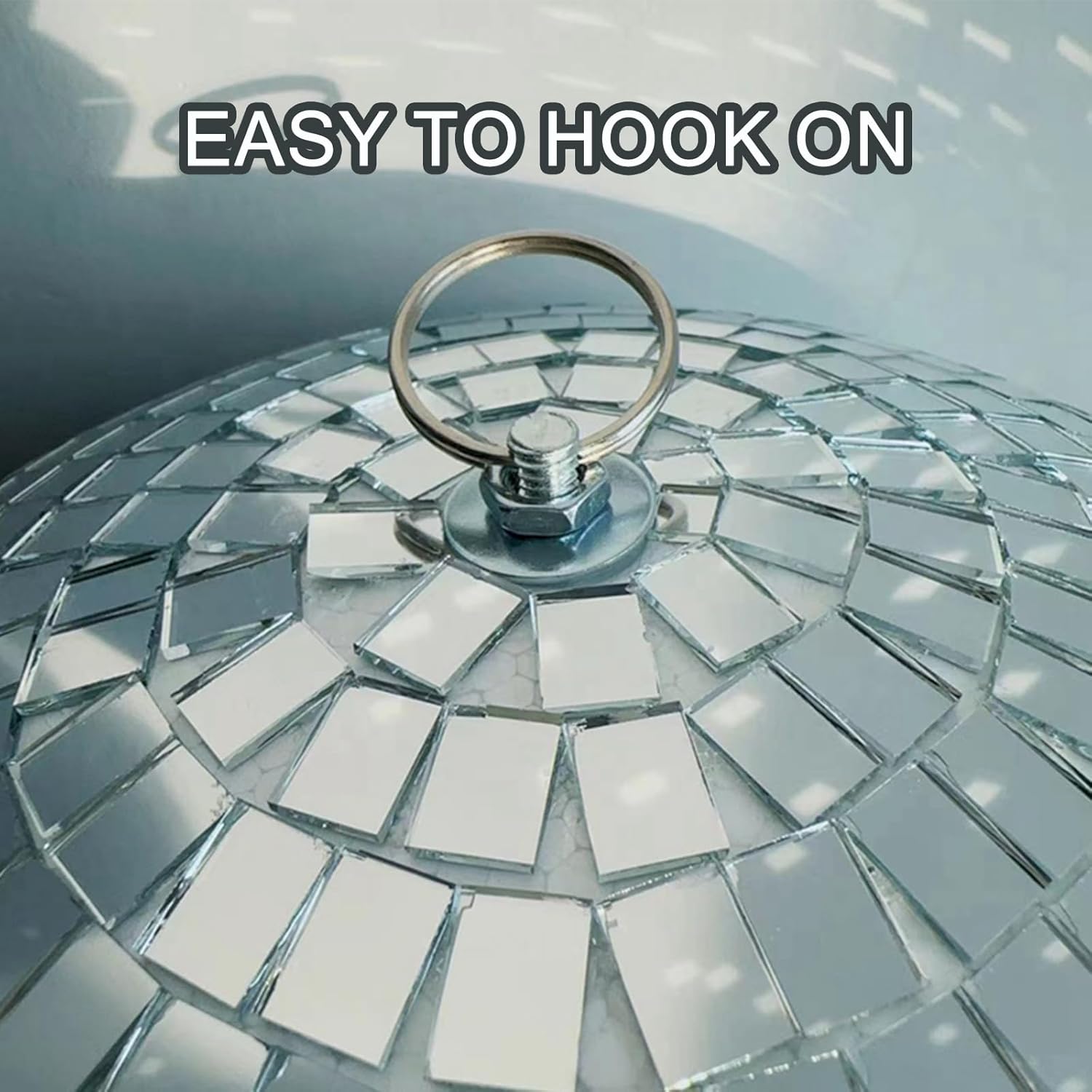
You just unboxed a disco ball — a mirrored sphere covered in hundreds of tiny glass or plastic tiles — and hung it from your ceiling. You plug in the little motor that makes it spin. And then you flip off the overhead lights and wait for the magic.
Nothing happens. Or almost nothing: a faint shimmer, maybe, if the room isn’t completely dark. That’s because a disco ball isn’t a light source. It’s a reflector — essentially a mirror broken into a few hundred angled fragments, each one bouncing a beam of incoming light onto the walls, ceiling, and floor as the ball rotates. Without a focused incoming light source aimed directly at the ball, you get a spinning decoration instead of a room full of drifting light dots. This guide explains exactly what kind of light you need, how to position it, and which affordable options are genuinely worth buying — because this is a more specific decision than it looks.
Why Your Disco Ball Isn’t Doing Anything (And What It Actually Needs)
The complaint shows up constantly in owner reviews of popular balls like the Youdepot 12-inch and 16-inch models. One reviewer put it plainly: “This does NOT come with a spotlight to, you know, make the disco ball light up.” That same reviewer noted one accidental workaround: direct sunlight coming through a window at the right angle of the day actually does work — the ball lit up the room beautifully. That’s not a joke recommendation; it’s actually a useful proof of concept. It tells you exactly what kind of light you need.
Sunlight works because it has three qualities your disco ball craves:
- It’s a point source — the light originates from a single, narrow direction rather than flooding the room from everywhere at once.
- It’s intense — enough lumens (the measurement of how much light is actually emitted) to produce a visible reflection off small mirror tiles.
- It’s aimed directly at the ball — not bouncing around the room diffusely.
A standard overhead LED bulb or a lamp with a shade fails on all three counts. It fills the room with ambient light, which means the ball is competing with that ambient light instead of being the only thing producing directional reflections. The dots wash out. This is why “par cans” — short for parabolic aluminized reflector lights, a stage-lighting standard since the 1970s — became the default disco ball companion. They’re built specifically to throw a focused, intense, collimated beam. That’s the thing you’re missing.
The Four Light Types Worth Considering (And One to Avoid)
1. LED Par Cans: The Right Tool for the Job
Par cans are the industry default for a reason. They’re designed to push light in one tight direction with minimal spread, and the better ones produce enough intensity to generate crisp reflections off even modestly-tiled balls.
The U’King LED Par Can consistently earns strong marks across aggregated reviews for brightness and focused beam quality. Reviewers describe it as genuinely bright with a tightly controlled output — one owner used a pair as background lighting for a podcast set, which tells you something about how clean the beam looks on camera. For a disco ball application, that beam focus is exactly what you want: less spill, sharper dots.
The OPPSK 36W LED Par Can is a popular budget pick, but there’s a tradeoff worth naming explicitly. OPPSK’s 36W units use discrete color-separated LEDs — meaning the red, green, and blue emitters are physically spaced apart rather than combined in a single lens. Owners report visible shadow aberration at close range: instead of one clean dot, you can see a colored halo or double-shadow around each reflected spot. For dance-floor environments where the effect is supposed to be chaotic and energetic, this is barely noticeable. For a home listening room or smaller space where you’re sitting closer to the walls, it’s more distracting. Know your room size before you commit.
By the numbers:
- OPPSK 36W rated draw: ~36W actual consumption, manufacturer-rated
- U’King par cans: typically rated 18W–54W depending on configuration
- Effective beam angle for disco ball use: 15°–25° is ideal; wider than 30° begins to lose dot crispness
- Minimum recommended room dimension for par can use: 10 ft × 10 ft
2. Dedicated Disco Ball Spotlights
Some manufacturers sell pinspot-style lights specifically designed for mirror ball use. These are narrow-beam (often 5°–10° beam angle) fixtures that throw an extremely focused column of light. The ADJ EM16 — a 16-inch mirror ball praised in reviews as “club quality” — is frequently paired with ADJ’s own pinspot accessories, and the reason the ball earns that “club quality” label comes down partly to tile density and glass quality. More tiles, smaller tiles, and actual glass (versus plastic) produce tighter, more defined reflection dots. If you’ve upgraded to a ball in that category, pair it with a pinspot rather than a wide-beam par — you’ll see the difference.
3. Sunlight and Natural Light (The Accidental Method)
As noted above: direct sunlight through a window absolutely works if the geometry lines up. South- or west-facing windows in mid-afternoon can throw a beam intense enough to light a 12-inch ball effectively. This isn’t a reliable party setup — it’s weather- and time-dependent — but if you’re experimenting with placement before buying a dedicated light, it’s a legitimate proof of concept. Apartment Therapy’s coverage of disco ball home décor actually notes this technique as a daytime styling option for rooms where the ball serves double duty as art object and occasional party piece.
4. Regular LED Bulbs (The One to Avoid)
A standard A19 LED bulb in a lamp or ceiling fixture does not work as a disco ball spotlight. Even a high-lumen smart bulb pointed vaguely toward the ball will produce at best a faint shimmer rather than crisp traveling dots. The issue is diffusion: consumer bulbs are engineered to spread light evenly to reduce harsh shadows in living spaces. That’s the opposite of what a mirror ball needs. Sound On Sound’s overview of stage lighting physics explains the principle clearly — parabolic reflector designs exist specifically because unfocused light sources produce unusable results in directional applications.
Positioning: Distance, Angle, and Height
Getting the light in the right place matters as much as choosing the right fixture. Here’s the decision framework:
Distance from ball to light: Most par can and pinspot manufacturers rate their fixtures for effective illumination at 3–15 feet. For home use with a 12- or 16-inch ball in a standard 8–10 foot ceiling room, a distance of 4–8 feet between fixture and ball is the practical sweet spot. Too close and the beam overpowers the reflections (everything looks blown out); too far and the beam spreads enough to lose dot definition.
Angle: The light should hit the ball from roughly a 30–45 degree downward angle, not straight-on horizontal. Horizontal placement reflects light primarily sideways along the walls at the same height as the ball — you get a strip of dots at eye level, not the full ceiling-to-floor scatter that makes the effect immersive. Mounting the light slightly above and to the side of the ball produces the most room-filling result.
One light vs. two: One focused light produces the classic single-sweep-dot effect. Two lights from opposite angles produce a denser, more overlapping pattern. For a small room (under 15 × 15 feet), one par can is usually sufficient and produces a cleaner result. Two lights start to make sense for larger spaces or when you want more continuous wall coverage as the ball rotates.
White Light vs. Colored Light: Which Produces Better Effects?
This is one of the most common questions in buyer forums, and the answer is more nuanced than “colored is more fun.”
White light produces sharp, bright, clearly defined reflection dots. Because the mirror tiles are reflecting a single unified color, each dot is crisp and travels cleanly across walls. This is what you see in classic disco footage — a white pinspot on a silver ball, producing dozens of traveling white points of light. It reads as elegant and works well in any ambient lighting condition.
Colored light (RGB par cans, colored gels) adds a layer of visual complexity. The dots carry the color of the light source, which can be striking in a dark room. The tradeoff is that color-separated LED sources (like the OPPSK 36W) introduce the shadow aberration issue described above. If you want color, look for fixtures where the RGB LEDs are tightly combined behind a single lens (sometimes called RGBW integrated emitters) rather than physically spaced apart — the dots will be cleaner.
The honest verdict: For most home setups and smaller event spaces, start with a white par can. You’ll immediately see whether your ball has good tile density and glass quality (the ADJ EM16 category), and you’ll get the effect that decades of disco parties have established as the reference. Add color later if you want it — but white makes the diagnostic easier and the baseline result better.
Frequently Asked Questions
What kind of light do I need to make a disco ball actually work? You need a focused, directional light source — a par can or pinspot — not a diffuse ambient bulb. The light must be aimed directly at the ball from a close enough distance to produce intense, narrow-beam illumination.
Can I use a regular LED bulb to light a disco ball? Not effectively. Standard LED bulbs spread light in all directions to reduce shadows in living spaces. A disco ball needs the opposite: a concentrated beam from a single direction. You’ll get a faint shimmer at best, not traveling dots.
How far should the light be from the disco ball? For home setups with a 12- or 16-inch ball, 4–8 feet is the practical range. Mount the light above and to the side of the ball at roughly a 30–45 degree downward angle for the most room-filling dot pattern.
Does a colored or white LED produce better disco ball effects? White produces sharper, cleaner, more defined dots. Colored adds visual interest but introduces shadow aberration if the fixture uses physically separated RGB emitters rather than combined-lens RGBW arrays. Start with white; add color deliberately.
Why does my disco ball spin but not produce dots on the walls? Almost certainly because there’s no focused light source aimed at it. The ball is a reflector, not a light source. If the room has only ambient overhead lighting, the ball has nothing directional to reflect. Aim a par can or pinspot directly at the ball in an otherwise dark or dim room and the effect will appear immediately.
The Decision Frame
If you’re here because your Youdepot ball arrived and the walls stayed dark: get a par can, aim it at the ball from 4–6 feet away at a slight downward angle, and do it in a dimmed room. The U’King par can is the pick for a focused beam without the shadow aberration issue. If you’re willing to live with some color fringing in exchange for a lower price point, the OPPSK 36W works fine in larger spaces where you won’t be close to the walls.
If you’ve already invested in a higher-density glass ball like the ADJ EM16, the tile quality is doing its job — it just needs a quality light source to show it. Step up to a dedicated pinspot in that case; the narrower beam angle will reward the tile investment with noticeably crisper dots.
One focused beam. Dark room. Ball spinning. That’s the whole formula — and now you have it.