August 30, 2026 • Roxanne Flair • 9 min reading time • Prices verified June 4, 2026
Disco Ball Mirrors as Pest Deterrents: The Unexpected Practical Use Buyers Swear By
If you’ve ever scrolled through the customer reviews on a disco ball listing hoping to figure out whether the mirror tiles are glued on straight, you’ve probably stumbled across something unexpected: a whole thread of people who bought the thing entirely to hang over their chicken coop. Or their back porch. Or their vegetable garden. Not for a party — not even close. These buyers are using disco balls — the same rotating, mirror-tiled spheres (a disco ball is simply a sphere covered in small square mirrors designed to scatter light in all directions when it rotates or catches sunlight) that pack a 1970s dance floor with a thousand fractured light points — as practical pest-control tools. And the reviews, across multiple sizes and brands, keep saying the same thing: it actually works.
This guide digs into the pattern, the science behind why reflective deterrents disrupt insects and birds, which size ball makes sense for which application, and — critically — the hardware and durability questions that real-world buyers keep raising. If you’re considering a disco ball for pest deterrence and want to know what you’re actually buying into, this is the decision frame you need.
| EDITOR'S PICKYoudepot Disco Ball 12-Inch – L… | Mid-tierAlytimes Mirror Disco Ball - 8-… | Budget pickMTLEE 20 Pcs Disco Balls Decora… | |
|---|---|---|---|
| Diameter | 12 in | 8 in | 2.4 / 2 / 1.6 / 1.2 in |
| Quantity | 1 | 1 | 20 pcs |
| Mirror material | — | — | Glass |
| Hanging rope | — | — | ✓ |
| Assorted sizes | ✗ | ✗ | ✓ |
| Price | $45.99 | $17.98 | $11.99 |
| See on Amazon → | See on Amazon → | See on Amazon → |
Why Reflective Light Disrupts Pests: What the Research Actually Says
The mechanism here isn’t mystical. Reflective deterrents exploit a real vulnerability in how many pest species — particularly birds and flying insects — process visual information.
Penn State Extension’s nuisance bird management series explains that birds navigating by visual landmarks are easily disoriented by unpredictable, shifting light. Shiny, moving reflections don’t read as a known threat; they read as environmental noise that makes a location feel unstable or unsafe. The same principle underpins commercial-grade bird tape, flash tape, and reflective pinwheels that orchards and vineyards have used for decades.
The University of Florida IFAS Extension’s research on reflective mulch — silver polyethylene film laid around crop rows — documents measurable reductions in aphid and whitefly pressure, attributing the effect to UV-spectrum reflection that interferes with how insects orient toward host plants. A disco ball isn’t reflective mulch, obviously, but the underlying principle — that reflected, scattered light disrupts insect navigation — has documented support in agricultural research.
The Royal Society Open Science study on iridescence in animals (2019) adds another layer: many insects use polarized or directionally consistent light cues to navigate. Randomized, multi-directional scatter from a mirrored surface degrades those cues in ways that static shiny objects don’t.
Apartment Therapy’s piece on shiny bird deterrents notes — honestly — that reflective deterrents are situational. They work best in contained areas where the pest has alternative locations to go, and they can lose effectiveness over weeks as birds habituate. That’s a real limitation worth naming: disco balls are not a permanent solution for serious infestations. They’re a meaningful deterrent for incidental pressure — flies around a doorway, birds eyeing a raised garden bed, insects hovering over a patio dining area.
Size vs. Application: The Decision Matrix Buyers Keep Getting Wrong
Reviewers across 12-inch, 16-inch, and small-ornament packs describe using them in meaningfully different contexts. Here’s the honest breakdown:
By the numbers — coverage rule of thumb from aggregated owner reports:
| Ball diameter | Reflection spread at 6 ft | Best application |
|---|---|---|
| 4–6 inch ornament | ~3 ft diameter | Raised bed, single plant, close-range insect work |
| 12 inch | ~8–10 ft diameter | Doorway, small patio, coop entrance |
| 16–20 inch | ~15–20 ft diameter | Open porch, garden perimeter, barn door |
| 20-piece mini set | Variable / distributed | Strung across a full fence row or vine canopy |
The 12-inch ball is the most commonly purchased size for doorway fly deterrence, and owners consistently describe it as right-sized for a covered porch or single entry point. Reviewers report that the 8-inch Alytimes ball draws specific praise for clean mirror tile attachment — owners flag the lack of sharp exposed edges as a genuine quality differentiator when you’re handling the ball to reposition it outdoors. That matters if you’re working with it barehanded in a garden context.
For bird pressure over a full garden row or vineyard-style setup, the 20-piece mini-set approach — stringing multiple smaller balls at intervals — outperforms a single large ball because you’re distributing reflection across a wider horizontal plane. A single 16-inch ball creates one intense focal point; a distributed string creates the kind of persistent, unpredictable shimmer that’s harder to habituate to.
Wirecutter’s bird deterrent guide reinforces the distribution logic: point-source deterrents are easier for birds to route around than distributed ones, which is exactly why flash tape lines perform better than single shiny objects in commercial orchard settings.
The Hardware Problem: Why “Some Assembly Required” Is an Understatement
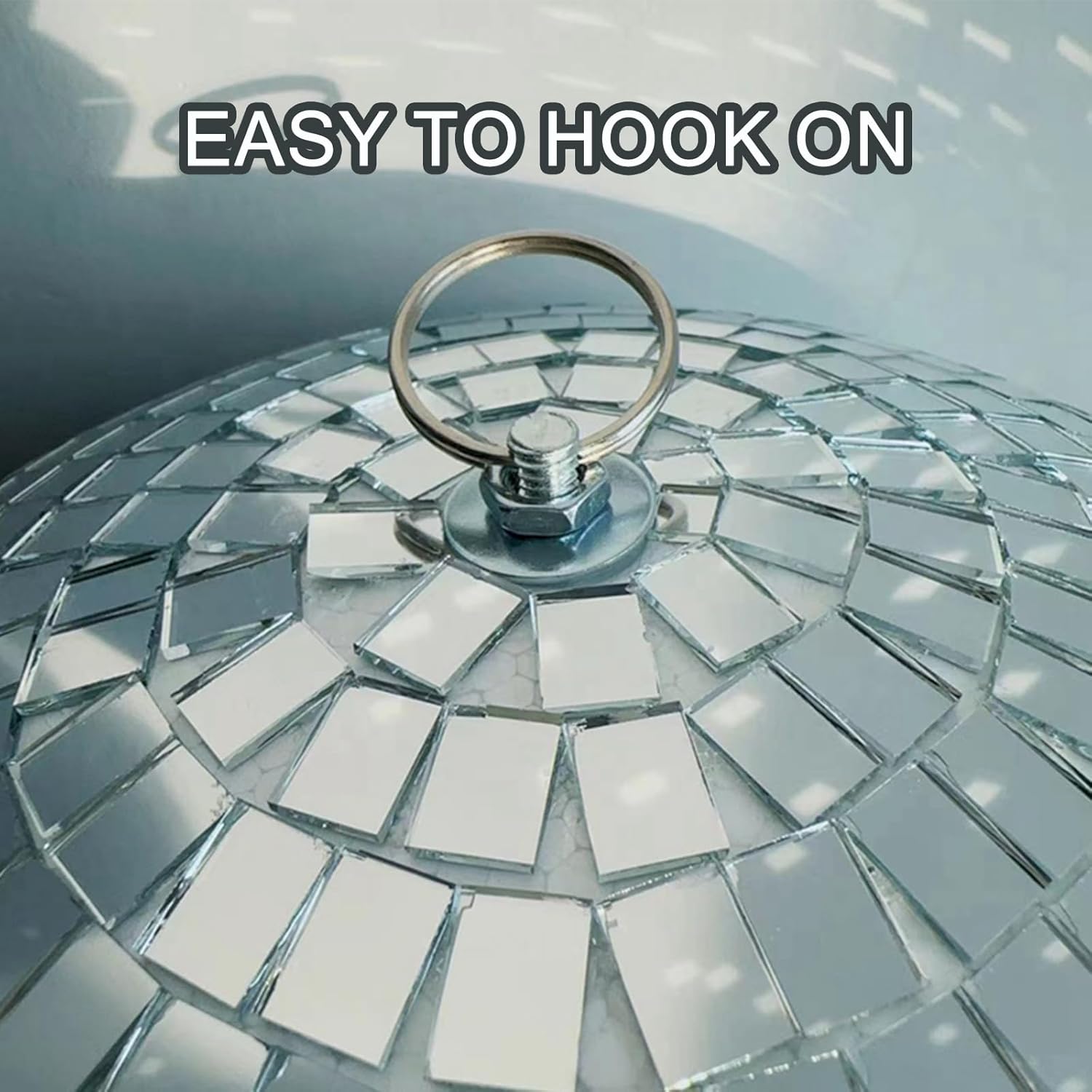
Here’s the bluntest thing this guide can tell you: across virtually every disco ball listing reviewed — 12-inch, 16-inch, ornament packs, and everything in between — the single most consistent complaint is that no hanging hardware is included. Not a hook. Not a swivel. Not a length of chain. Just the ball.
For a dance floor application, you probably have rigging experience or at least know to buy a swivel hook. For a first-time outdoor buyer who found this thing while searching “bird deterrent garden,” the absence of hardware is a real friction point.
Here’s what owners actually use:
- Ceiling or beam hooks (screw-in, rated for outdoor use): For a covered porch or barn, a simple galvanized screw-in eye hook handles anything under 5 lbs. A 16-inch ball typically runs 1.5–2.5 lbs depending on tile density and core material. Check the weight rating on your specific ball’s listing before assuming.
- Ball-bearing swivel hooks: This is the piece that actually matters for pest deterrence. A swivel allows the ball to rotate freely in wind, which dramatically increases the scatter effect. A static ball is much less effective than a spinning one. Owners who add a swivel report noticeably better results outdoors. Look for stainless or galvanized finish for rust resistance.
- Monofilament or stainless wire: Nylon fishing line (20–30 lb test) is commonly used to hang lighter ornament-size balls from garden structures. It’s nearly invisible and holds up to weather. For heavier balls, thin stainless cable with crimped ends is more secure.
- Shepherd’s hook stakes: For garden beds where you have no overhead structure, a simple shepherd’s hook stake gives you a freestanding hang point at adjustable height.
Budget $8–$20 for hardware if you’re buying new. If you’re sourcing from a hardware store, you’ll spend 20 minutes and less than a six of the right parts will cover most setups.
Outdoor Durability: The Cold and Wet Climate Question
This is the second most common concern in reviews, and the honest answer is: it depends on construction quality, and most product listings don’t tell you what you need to know.
What to evaluate:
- Mirror tile adhesive: Cheaper balls use water-soluble adhesive that fails in prolonged rain. If tiles are already loose on arrival (a complaint in multiple reviews), they’ll detach faster outdoors. Owners report that balls with tightly flush-set tiles and no visible adhesive gaps hold up better in wet weather.
- Core material: Styrofoam cores disintegrate faster than plastic or metal cores in freeze-thaw cycles. A foam-core ball in a Minnesota winter is a single-season purchase. A plastic-shell ball with a proper hang point can survive several seasons under a covered porch.
- Finish on the tiles: The mirror tiles themselves are typically glass or mirrored acrylic. Glass tiles hold up better to UV and temperature swings but add weight. Acrylic tiles can yellow or haze over one to two outdoor seasons in direct sun.
The practical decision rule: if you’re in a climate with hard freezes, keep the ball under a covered structure (porch ceiling, greenhouse overhang, barn door) rather than fully exposed. If you’re in a mild, damp climate like the Pacific Northwest, the tile adhesive is your bigger concern — prioritize reviews that specifically mention wet-weather resilience. No single low-to-mid price disco ball is rated for true outdoor, all-weather exposure. Treat them as “covered outdoor” products and your expectations will align with reality.
Frequently Asked Questions
Do disco balls actually work to repel flies and birds, or is it a myth? There’s legitimate agricultural science behind reflective deterrents — it’s not myth. Penn State Extension and University of Florida IFAS research document reflective surface effectiveness for birds and certain flying insects. That said, effectiveness is situational: disco balls work as a meaningful deterrent for incidental pest pressure in a bounded area, not as a solution for serious infestations. Owners consistently report results for fly and bird deterrence around porches, coops, and garden beds.
Which size disco ball works best as an outdoor pest deterrent? For doorways and small porches: 12-inch. For open patios and medium garden areas: 16-inch. For a full fence row or wide garden: a distributed set of smaller balls (4–6 inch) at intervals outperforms a single large ball because it prevents easy routing around the deterrent zone.
Can these balls be left outside year-round in cold or rainy climates? Not reliably. Most consumer disco balls use adhesive that degrades in sustained wet exposure, and foam cores don’t survive hard freeze-thaw cycles. Under a covered structure, a quality ball can last two to three seasons. Fully exposed in a cold or wet climate, expect one season or less before tile loss begins.
What hanging hardware do I need since none is included? At minimum: a screw-in eye hook or ceiling hook rated for the ball’s weight, plus a ball-bearing swivel hook to allow free rotation. Add monofilament or stainless wire for the drop length. Total hardware cost: $8–$20 from any hardware store. The swivel is the most important piece — free rotation dramatically increases the scatter effect that drives deterrence.
Will wind spinning the ball increase or decrease its effectiveness? Increase, meaningfully. A static ball creates a predictable reflection pattern that pests can habituate to faster. Wind-driven rotation creates unpredictable, moving light scatter — closer to the randomized flash that makes reflective deterrents effective in agricultural applications. A ball-bearing swivel hook lets even light breezes spin the ball freely.
Do the reflections work without direct sunlight? Direct sunlight produces the most dramatic scatter, but owners report useful reflective effect in bright indirect light and on overcast-but-bright days. Deep shade significantly reduces effectiveness. For north-facing porches or heavily shaded garden beds, consider supplementing with an inexpensive LED spotlight aimed at the ball — the same scatter effect is produced with artificial light, which also extends coverage into evening hours.
The bottom line here is that this is one of those cases where a product found a second life its designers probably didn’t anticipate — and the real-world reports are consistent enough to take seriously. If you’re weighing whether a disco ball is worth it for pest deterrence: yes, with the right hardware and realistic expectations about outdoor durability. The reflective science is sound, the owner reports are unusually consistent, and the worst case is a ball that also happens to look good on your porch. Just buy the swivel hook.