September 23, 2026 • Roxanne Flair • 10 min reading time • Prices verified June 4, 2026
Disco Ball Motor Speed Guide: Why 6 RPM Makes Some Rooms Nauseating
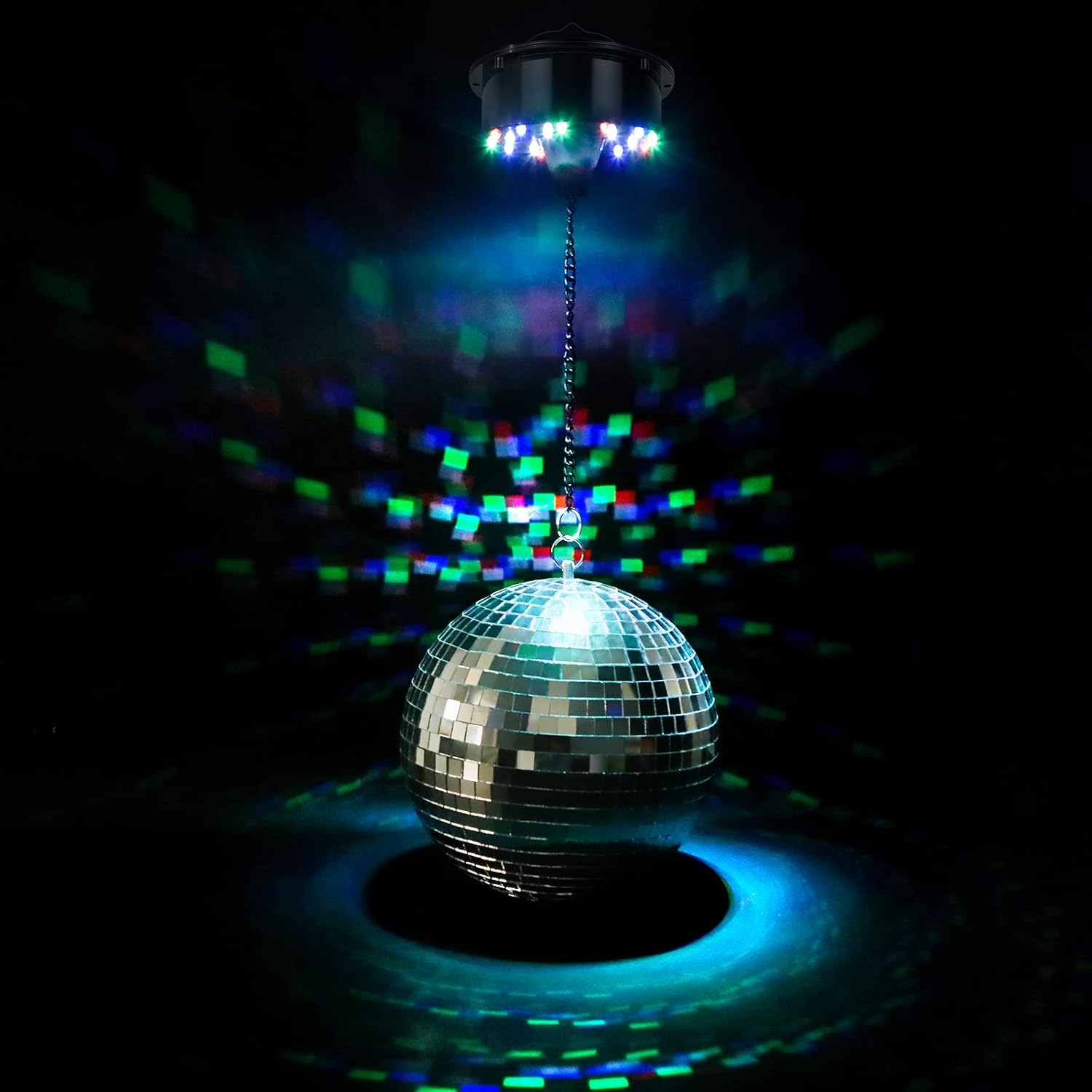
If you’ve ever stood under a spinning disco ball — that mirrored sphere hanging from the ceiling, bouncing tiny dots of reflected light across every wall — and felt vaguely seasick after a few minutes, you weren’t imagining it. The culprit is almost always motor speed. RPM stands for revolutions per minute, and it’s simply how many full rotations the ball completes each minute. At low speeds, those traveling dots of light drift lazily around the room and feel dreamy. At high speeds, they streak across walls fast enough to make some people genuinely uncomfortable. One reviewer describing a common 6 RPM motor at 11 feet used the word “disorienting.” A separate Yescom motor reviewer used “nauseating.” These aren’t drama — they’re physics. This guide explains why RPM matters more than wattage for most buyers, how room size amplifies or softens the effect, and exactly which motor speed range fits which situation — so you make the right call before the motor arrives, not after.
| EDITOR'S PICKYescom 16" Large Disco Ball wit… | Mid-tierMeagoo Disco Ball with Motor an… | Budget pickSlow Rotating Disco Ball Motor… | |
|---|---|---|---|
| Ball Size | 16" | 8" | — |
| Rotation Speed | 6 RPM | 6 RPM | Slow |
| Power Source | — | Batteries | Battery |
| Ball Fit | 16" | 8" | — |
| Price | $109.90 | $38.99 | $9.49 |
| See on Amazon → | See on Amazon → | See on Amazon → |
Why the Same RPM Hits Differently in Different Rooms
Here’s the core concept that most product listings skip entirely: the speed you perceive is not the motor’s RPM — it’s the arc velocity of the reflected dot at your walls.
A disco ball motor rated at 6 RPM completes one full rotation every 10 seconds. That sounds gentle. But a mirror tile near the ball’s equator throws a reflection outward at a distance equal to the throw length — the distance from the ball to the surface the light hits. In a small living room where the ball is 8 feet from the nearest wall, that reflected dot travels a short arc and completes its loop quickly. In a large event space where walls are 20–30 feet away, the same 6 RPM motor throws a dot that must travel a much longer arc in the same 10 seconds, so paradoxically, the dot appears to move more slowly on distant walls.
The counterintuitive result: 6 RPM is harder to tolerate in small, low-ceilinged rooms than in large ones. The reviewers who reported dizziness were almost always working in home setups, not ballrooms. Sound On Sound’s coverage of stage lighting fundamentals confirms this geometric relationship — apparent motion speed scales with throw distance, which is why lighting designers always spec effect intensity relative to room dimensions, not just fixture output.
Apartment Therapy’s party-planning coverage makes a similar point in lay terms: small rooms amplify every lighting effect, and what looks subtle on a spec sheet can feel overwhelming at eight feet.
The RPM Landscape: What’s Actually Available
Before choosing a motor, it helps to know the realistic range you’re shopping across.
By the numbers:
| Speed | Full rotation time | Best-fit scenario |
|---|---|---|
| 1 RPM | 60 seconds | Ambient / art installation |
| 1.5 RPM | 40 seconds | Small rooms, long events, dizziness-sensitive crowds |
| 3 RPM | 20 seconds | Home parties, medium event spaces |
| 6 RPM | 10 seconds | Large venues only; risky in rooms under ~20 ft |
| 9–15 RPM | 4–7 seconds | Dance floors, club use, short-duration effect |
Most motors on the market cluster around a few categories:
Fixed-speed 6 RPM motors are the most common entry-level option. They’re inexpensive, widely available, and work well in large rooms. In small spaces — a basement, a living room, a sunroom — they’re the single biggest source of “why does this feel awful?” complaints. Aggregated owner reviews across multiple retail platforms show this pattern clearly: buyers in large spaces rate 6 RPM motors highly; buyers in smaller rooms rate the same motors poorly, often citing dizziness without understanding why.
Fixed-speed 1.5 RPM slow motors are a specific product category that exists precisely because of this problem. Owners who switch to a 1.5 RPM motor from a 6 RPM consistently report that the dizziness disappears. One owner in aggregated review data reports using a 1.5 RPM motor for over a year with no issues — the slower cadence simply removes the stroboscopic edge entirely. If your room is under 15 feet in any dimension and you plan to run the ball for more than 20–30 minutes at a stretch, the 1.5 RPM motor is worth finding.
Adjustable-speed motors with remote control sit at the practical top of the consumer market. The most capable versions offer six discrete speeds — typically 0/3/6/9/12/15 RPM — controllable via handheld remote. This is the option serious users gravitate toward. One reviewer documented deploying an adjustable-speed remote motor for an actual disco film scene and praised the ability to dial in exactly the visual effect the director wanted, switching speeds between takes. That use case is unusual, but it illustrates the real value: you’re not locked into a single speed before you know how the room behaves.
Battery-operated motors represent a separate design category. The standout characteristic isn’t speed — most run at a comparable RPM to their corded equivalents — it’s acoustic silence. Owners consistently highlight this as an unexpected benefit. Because there’s no transformer hum and no cord pulling slightly at the motor housing, battery motors are noticeably quieter. The tradeoff is runtime and torque, which is why the FAQ below addresses ball size limits directly.
How to Diagnose Your Room Before Buying
If you already have a motor and a room, the fastest diagnostic is simple: hold your hand up at roughly the height where you expect guests to be standing and watch a reflected dot cross it. If the dot crosses your palm in under one second, that’s a strong signal the effect will feel busy or disorienting at sustained exposure. For reference, at 6 RPM in a 10-foot-radius room, a dot makes a full wall circuit in about 10 seconds — which sounds slow until you’re tracking it in your peripheral vision for an hour.
Three variables you can actually control:
- Motor speed — the most direct lever. Drop from 6 RPM to 3 RPM and perceived velocity roughly halves.
- Ball height — raising the ball increases the throw distance to walls, which spreads the dots across a larger arc and makes them appear to slow down.
- Light source intensity — a dimmer, wider-beam light source makes individual dots less distinct and less likely to register as fast-moving. This isn’t a speed fix, but it softens the perceptual edge.
What you can’t easily control: the diameter of the ball itself. Larger balls (12-inch, 16-inch) create larger mirror facets, which throw broader, softer dot patches rather than tight pin-points. This is part of why experienced buyers in small rooms often pair a larger ball with a slow motor — the combination gives you the room-filling effect without the strobe-like precision of a small ball at high speed.
Matching Motor to Ball Weight: The Load Question
A question that comes up constantly in owner reviews: will a heavier disco ball slow down a 6 RPM motor? The short answer is: sometimes, slightly, and not reliably enough to use it as a speed-control strategy.
Most consumer motors are rated for balls up to 12 inches or up to a specific weight (commonly 6–11 lbs depending on the motor). When a ball exceeds the motor’s rated load, two things happen. First, the motor may run measurably slower than its rated RPM as it works against excess inertia — but the slowdown is unpredictable and varies with motor temperature and age. Second, and more practically, running an overloaded motor shortens its lifespan significantly. Owners who report motors dying early almost always trace it back to running a ball larger than the rated capacity.
If your ball is heavy, buy a motor rated for that weight. Don’t deliberately overload a smaller motor hoping the drag will tame the speed — it will, briefly, and then you’ll be buying a replacement motor.
Frequently Asked Questions
What RPM is best for a small room vs. a large event space?
For rooms under roughly 15 feet in any major dimension — a living room, a basement, a hotel suite — 1.5 to 3 RPM is the range most owners find comfortable at extended durations. For large event spaces (20+ feet to walls, high ceilings), 6 RPM works well and actually looks more dynamic at distance. If you want one motor that handles both contexts, an adjustable-speed remote model is the practical answer.
Will a heavier disco ball slow down a 6 RPM motor?
It may slow it slightly, but not reliably and not safely. Running a motor beyond its rated load shortens the motor’s life. If you need a slower speed, buy a slower motor or an adjustable one — don’t use ball weight as a brake.
How do I stop my disco ball from spinning too fast?
The cleanest fix is an adjustable-speed motor with a remote. If you already own a fixed-speed 6 RPM motor, your options are limited: raise the ball higher to increase throw distance (which makes dots appear slower on walls), dim or widen your light source, or replace the motor with a 1.5 or 3 RPM fixed model. There’s no reliable way to add a speed governor to a fixed-speed motor after the fact.
Are battery-powered disco ball motors powerful enough for larger balls?
Generally, no — not for heavy balls. Battery motors excel at silent operation and cable-free placement, but their torque is lower than comparable corded motors. Most are rated for balls up to 8 or 10 inches. For a 12-inch or larger ball, a corded motor with the appropriate weight rating is the safer choice. If silence is your priority and your ball is on the smaller side, battery operation is genuinely excellent.
Can I use a disco ball motor outdoors or in humid spaces like a sunroom?
Most consumer disco ball motors are not rated for outdoor or high-humidity use. The motor housing on standard units is not sealed against moisture, and sustained humidity — the kind in a sunroom on a summer day, let alone outdoor use — can corrode motor contacts and shorten lifespan significantly. If you’re committed to outdoor or sunroom use, look specifically for motors with an IP (Ingress Protection) rating on the spec sheet; most budget and mid-range consumer motors won’t have one. Alternatively, run the motor indoors and position the ball near a window or opening where the light effect projects outward, keeping the motor itself in a controlled environment.
The Decision Frame
Here’s the clean if/then:
- If your room is small (under 15 feet) and you’ll run the ball for an hour or more: buy the 1.5 RPM fixed slow motor. Owners who switch to it consistently report the dizziness problem disappearing entirely.
- If your room is large or you’re working events in different venues: the adjustable-speed remote motor is worth the premium. The ability to dial between 3 and 6 RPM based on how the specific room behaves is exactly the kind of flexibility that separates a polished effect from an uncomfortable one.
- If silence matters more than anything else and your ball is 10 inches or smaller: the battery-operated motor is the call. Owners consistently cite the acoustic quiet as a genuine surprise.
- If you’re tempted to run a heavy ball on a light motor to tame the speed: don’t. Match the motor’s rated weight capacity and buy the right RPM for your room — those are two separate decisions and both matter.
The disco ball is one of those pieces of gear where the physics are unforgiving in small rooms and forgiving in large ones. Get the speed right first, and everything else — the light scatter, the ambiance, the duration — tends to fall into place.