August 28, 2026 • Roxanne Flair • 9 min reading time • Prices verified June 4, 2026
All-in-One Disco Ball Kits: Motor, Light, and Ball Bundles Ranked by Gig ROI
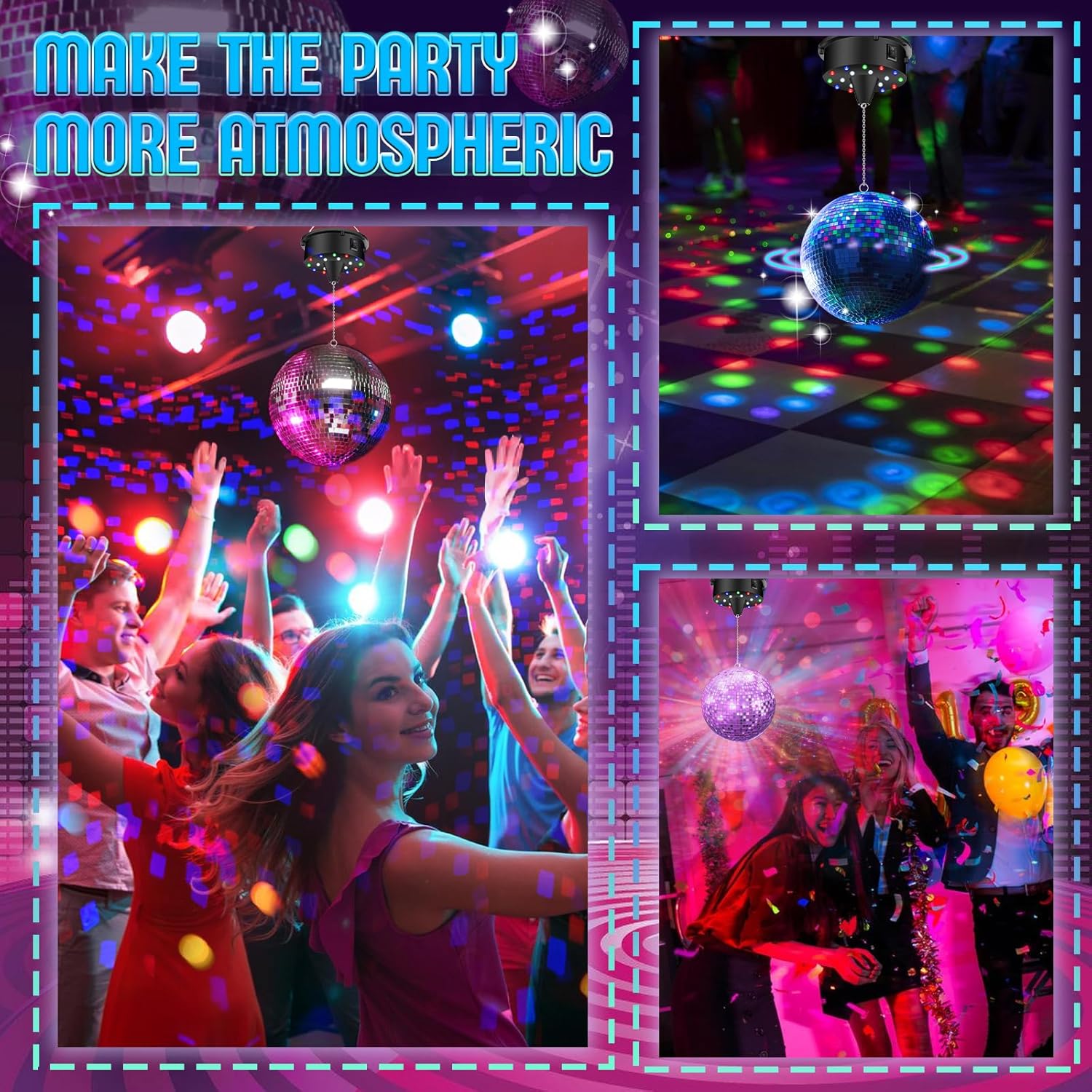
If you’ve ever walked into a great 70s-themed party and felt that unmistakable shimmer washing across the ceiling — hundreds of tiny light dots spinning slowly around the room — you’ve experienced what a mirror ball does. A mirror ball (also called a disco ball) is a sphere covered in small mirrored tiles that reflects a light source in every direction as it slowly rotates. The catch: the ball itself doesn’t do anything without two companions — a motor to spin it and a light pointed at it. You can buy all three separately, or you can buy an all-in-one kit that bundles the ball, the motor, and at least one dedicated spotlight into a single package. That’s what this guide is about: which bundles are actually worth buying, at which price point, and for which kind of gig.
If you’re a one-night party host, the answer is simple and cheap. If you’re a working mobile DJ dropping these into paid events every weekend, the math changes fast — because cheap kits fail at moment three, and a dead motor at hour two of a Sweet 16 is not a recoverable situation.
| EDITOR'S PICKYescom 16" Large Disco Ball wit… | Mid-tierMeagoo Disco Ball with Motor an… | Budget pickMirrors Ball Light with Remote | |
|---|---|---|---|
| Ball size | 16" | 8" | 6" |
| Motor rotation | 6 RPM | 6 RPM | 5–10 RPM |
| Light source | 3W RGB | 18 LEDs, 4 colors | 23 RGBW LEDs |
| Power source | — | Batteries | — |
| Remote | — | — | ✓ |
| Voice control | — | — | ✓ |
| Price | $134.90 | $38.99 | $31.99 |
| See on Amazon → | See on Amazon → | See on Amazon → |
Why Bundles Exist (and Where They Cut Corners)
The appeal of an all-in-one kit is obvious: no guessing about whether your motor’s RPM (rotations per minute — how fast the ball spins) matches the ball weight, no hunting down a compatible pin-spot (a focused beam spotlight designed to hit a mirror ball), no calculating hanging hardware. You open a box, hang it, plug it in, done.
The problem is that kit manufacturers optimize for the unboxing photo, not the fourth gig. The three most common failure points reviewers identify across aggregated Amazon and DJ forum feedback are: (1) motors that vibrate heavily and slow down under load, (2) pin-spot LEDs that are too wide-angle or too warm to create tight reflection dots, and (3) hanging hardware — usually a thin wire hook — that isn’t rated for the ball’s actual weight over time.
DJ Mag’s Party Lighting Buyer’s Guide 2025 specifically flags that entry-level mirror ball motors rated for “up to 12-inch balls” on packaging frequently wobble noticeably with anything over a 10-inch sphere, because the weight rating assumes a stationary load, not a rotating one on a flexible cable.
Sound On Sound’s Stage Lighting Fundamentals for Live Events notes that the quality of the pin-spot matters as much as the ball itself: a narrow 5–8° beam angle creates the tight, moving dots that read as “disco” across a large room, while a 15–20° flood angle scatters the effect and washes it out. Most budget kits ship with whatever LED spotlight clears margin — and it’s rarely a true narrow-beam pin-spot.
Understanding those failure points before you shop is the whole game.
The Four Kit Tiers: Price, Use Case, and What You’re Actually Getting
Tier 1 — Under $50: Party Decoration, Not Gigging Gear
Representative product: Coidak 12-Inch Mirror Ball Kit (ball + motor + two color LED pin-spots, ~$35–$45)
This is the bracket Apartment Therapy’s “How to Set Up a Disco Ball for a Party at Home” is writing for, and that context matters. Owners consistently report that kits in this range look genuinely fun in a small living room or apartment for a single event — the rotation is smooth enough, the colored lights are punchy in the dark, and the unboxing experience is solid. The ball is typically a 12-inch acrylic sphere with plastic-backed mirror tiles rather than glass tiles; glass tiles reflect more cleanly and hold up longer, but acrylic is lighter and safer for ceiling mounts that aren’t load-tested.
The math against using this tier for paid gigs is straightforward:
By the numbers — Tier 1 gig ROI check: Average kit lifespan (owner-reported): 4–8 hours of use before motor wobble or LED failure Average gig requirement: 4–6 hours per event Break-even events before likely failure: 1–2 Replacement cost factored over 10 gigs: $175–$225 in kit replacements vs. $120–$150 for a Tier 2 kit that survives all 10
The verdict: buy one for your own birthday party. Don’t put it in a client’s venue.
Tier 2 — $80–$160: The Real Starting Point for Mobile DJs
Representative products: ADJ (American DJ) Starburst, Eliminator Lighting Mirror Ball Kits, Chauvet DJ Swarm Wash FX (used as companion to an add-on ball)
This is where the hardware starts earning its keep. Kits in this range typically include a glass-tile mirror ball (not acrylic), a dedicated motor with a weight rating that’s honest about 12–16 inch ball sizes, and a pin-spot with a beam angle closer to the 8–12° range. ADJ’s published specs on their mirror ball motor line confirm RPM ratings are stable under rated ball weight — owners in long-run DJ forum reviews note these motors running 50+ events without significant wobble, which is the baseline you need for mobile work.
The tradeoff at this tier is the lighting: a two-pin-spot setup is common, but the color output is often limited to white or a single fixed color. If your event requires the classic white-dot look of a true 70s ballroom, that’s fine — great, even. If the client wants color washes cycling around the ball, you’re going to want to add a dedicated LED PAR can (a flat-faced, multi-color stage light) pointed at the ball separately, which adds $40–$80 to the kit cost.
Rolling Stone’s feature on disco’s gear revival noted that working DJs recreating the original 1970s ballroom look specifically seek out narrow-beam white pin-spots, not color-changing LEDs, because the authentic effect comes from a single white beam breaking into hundreds of moving white dots — not a rainbow flood. That historical note is actually a shopping note: if authenticity matters to your client, don’t overpay for RGB pin-spots you’ll turn off anyway.
Tier 3 — $200–$500: Professional Mobile and Semi-Permanent Install
Representative products: Chauvet DJ Intimidator Spot 110 (paired with a quality motor), Martin Lighting rig-style setups, ADJ Vizi Spot 30W configurations
At this level, you’re generally not buying a single box kit anymore — you’re buying a glass-tile ball (16–20 inches, typically), a professional-grade motor with a rated torque spec, and a pin-spot that’s a genuine stage fixture with a replaceable LED engine and a proper yoke mount (the adjustable bracket that lets you aim the beam precisely). This is the configuration that owners running club residencies and wedding receptions consistently describe in DJ forums as the “set it and forget it” setup.
The economic frame here is gig ROI (return on investment — how many paid events it takes for the gear to pay for itself). A $350 ball-plus-motor-plus-pin-spot configuration at an average mobile DJ rate of $600–$900 per event pays for itself in less than one gig when you factor that it replaces a $120 kit you’d otherwise replace every 8–12 events. The motor alone at this tier — a professional swivel-mount with sealed bearings — is rated by manufacturers for 500+ hours of continuous rotation, which is north of 80 four-hour gigs.
The honest caveat: true all-in-one kits at this tier are rare. You’re more often assembling components. That’s actually a feature — if the pin-spot LED engine dies in year two, you replace the engine, not the whole rig.
Tier 4 — $500 and Up: Permanent Venue and High-End Event Production
At this level, the mirror ball itself is often 24–36 inches — a size that requires a rigging point rated for 30+ pounds of dynamic load (the weight of a spinning object on a flexible mount, which creates lateral stress that static weight ratings don’t account for). Professional rigging hardware — safety cables, rated swivel hooks, structural ceiling anchors — adds $60–$150 to the budget and is non-negotiable from a safety standpoint.
The lighting fixtures at this tier are typically moving-head spots (motorized fixtures that can be pointed, panned, and tilted remotely) or high-output LED pin-spots with a 5° or tighter beam angle. The difference in room effect is significant: a properly aimed 5° pin-spot on a 30-inch glass-tile ball in a 5,000-square-foot ballroom creates reflection dots that travel across the full room perimeter. A 12° spot on the same ball creates a cluster of light that barely reaches the walls.
This bracket is also where licensed 70s venue operators and boutique event spaces land — installations that need to look right every night, not just for one party.
The Decision Frame: Which Kit for Which Gig
Here’s the honest if/then breakdown:
If you’re hosting one party at home and want the effect without thinking about it: Buy a Tier 1 kit for $35–$45. You’ll get the look, it’ll survive the night, and you won’t feel bad retiring it afterward.
If you’re a mobile DJ playing 10–30 events per year at small-to-mid venues (up to ~3,000 sq ft): The Tier 2 bracket ($80–$160) is your floor, not your ceiling. Budget $120–$150 for the ball-and-motor portion, then add $40–$80 for a quality white narrow-beam pin-spot separately rather than relying on the kit’s bundled lighting.
If you’re running 30+ events per year or have any semi-permanent venue installs: Tier 3 component builds ($200–$500 total) pay back within the first two or three gigs versus the replacement-cost curve of cheaper hardware. Owner feedback across DJ hardware forums is consistent: the motor is where you should never cut corners, because a motor failure mid-event is visible and client-facing in a way that most gear failures aren’t.
If you’re outfitting a permanent venue or high-production event: Tier 4 is the right conversation, but so is a licensed rigger. The hanging hardware at this size is not DIY territory.
One last frame worth naming: the mirror ball effect is one of the very few lighting elements that works better in a large, partially dark room than in a small one. The dots need travel distance to read as the classic disco shimmer rather than a concentrated cluster. If your typical venue is under 500 square feet, a 12-inch ball with a quality pin-spot will outperform a 20-inch ball with a mediocre one every time. Size isn’t the variable that matters most — beam quality and motor stability are.
Spend your money there first.