August 23, 2026 • Roxanne Flair • 10 min reading time • Prices verified June 4, 2026
Disco Ball Decorations Beyond the Ball: Balloons, Mini Sets, and Novelty Shapes Compared
If you’ve ever been handed the job of decorating for a 70s theme night — or just wanted to add a little shimmer to an everyday room — you already know the classic disco ball (a mirrored sphere hung from the ceiling that scatters reflected light across a room when it spins) isn’t always the right tool. Sometimes the venue is too small, the ceiling is too low, or the budget is $25 instead of $250. That’s where the broader world of disco ball decorations comes in: mylar balloons shaped like mirror balls, mini mirror ball multi-packs you can cluster or hang individually, and novelty silhouettes — think cloud shapes, stars, or elongated eggs — covered in the same mirrored tiles. This guide exists to help you pick the right format for your actual situation, whether that’s one big party night, a permanent installation above your breakfast nook, or a Christmas tree that deserves better than pine cones.
The tradeoffs between these formats aren’t obvious until you’ve read through a few hundred owner reviews and spec sheets. Balloon buyers discover you need a pump. Mini-pack buyers discover the “4-inch” hero piece ships with companions that are 1.5 inches wide. Novelty-shape buyers discover the cloud-shaped mirror ball they bought for a party now lives on their wall permanently. Let’s work through all of it.
The Disco Ball Balloon: What It Actually Does (and Doesn’t)
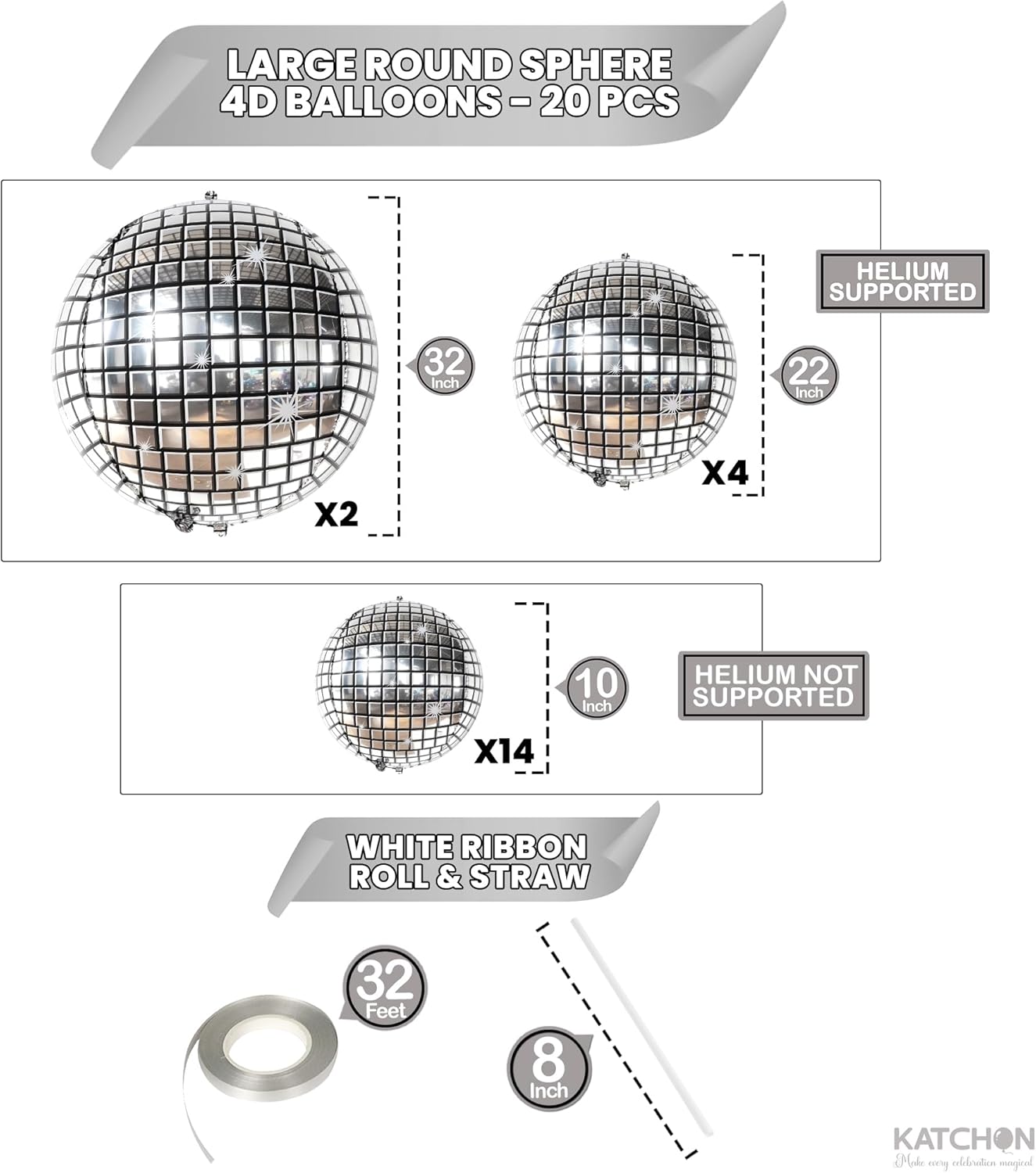
A disco ball balloon is a foil mylar balloon — the shiny, non-latex kind used for number balloons and star balloons — printed or embossed to mimic a mirror ball’s grid of reflective tiles. It does not scatter light the way a real mirrored ball does; the surface is a single printed film rather than hundreds of individual glass or acrylic tiles set at slight angles. What it does do is photograph extremely well, read as “disco ball” from ten feet away, and float at the end of a ribbon with zero rigging required.
The helium question is the one buyers ask most. Owners across aggregated reviews consistently report that disco ball balloons hold air for approximately five to seven days without helium — they simply don’t float, they sit or are tied to a surface. If you want float, you need helium; if you want upright display on a table or propped in a balloon stand, air works fine and lasts the week. Apartment Therapy’s coverage of party balloon trends notes that foil mylar balloons retain air significantly longer than latex alternatives, making them viable for multi-day installations.
The size discovery that catches buyers off guard: the 18-inch and 22-inch sizes common in this category look proportionate in product photography, but the 36-inch “jumbo” versions — increasingly common in 2025–2026 listings — genuinely cannot be inflated by mouth. Lung pressure isn’t sufficient. Owners report this with a mix of surprise and mild frustration, but the fix is simple: any balloon hand pump (available for a few dollars) or a tank with a nozzle adapter handles the job. If you’re ordering the large format, just order the pump at the same time.
The real-world use case split:
- One-night party: Any size works. Helium float is worth the cost for visual impact.
- Weekend-long installation: Air-inflated, no helium. Tie to a stand or tape ribbon to wall. Holds through the event.
- Permanent or semi-permanent room décor: Balloons are not the right format here. The foil creases over weeks and the look degrades. Move to a mini mirror ball or novelty shape for anything longer than two weeks.
Mini Mirror Ball Multi-Packs: The Size Guide Nobody Includes in the Listing
Mini mirror ball multi-packs are exactly what they sound like — sets of actual mirrored tile balls (real mirror ball construction, not balloon-style printing) in small sizes, sold in groups of four to twelve. They do scatter light. A lamp or spotlight directed at one will produce the characteristic moving dot pattern, even at small scale. That’s the upside.
The downside is the size discovery problem. Buyers repeatedly surface this in reviews: a pack listed as “4-inch disco balls” ships with a hero piece that measures 4 inches, plus filler pieces at 3 inches, 2 inches, and 1.5 inches. The listing headline is technically accurate; the implication that every piece is 4 inches is not. Here’s what the common configurations actually look like based on aggregate review measurements:
| Pack Size Label | Actual Piece Distribution |
|---|---|
| ”4-inch set” | 1× 4 in, 2× 3 in, 3× 2 in |
| ”3-inch set” | 2× 3 in, 2× 2 in, 2× 1.5 in |
| ”Mini assorted” | 1× 3 in, 2× 2 in, 4× 1.5 in, 1× 1 in |
The 1.5-inch and 1-inch pieces are genuinely ornament-scale — perfect for a Christmas tree or garland, questionable as standalone room focal points. If you need even light scatter across a table centerpiece, the 3-inch and 4-inch pieces do the work; the small fillers are accent only.
Clustering strategy: Rolling Stone’s guide to disco party aesthetics recommends grouping mirror balls in odd numbers at varied heights for visual rhythm. Owners who install mini-packs above a bar cart or fireplace mantel consistently describe the effect as “more dramatic than expected” when a directed light source (even a small LED spotlight) is pointed at the cluster.
The weight issue: A 4-inch mirror ball with real mirrored tiles weighs more than buyers expect — typically in the range of 6 to 10 ounces depending on construction. Buyers who hang these from porch structures, tree branches, or adhesive ceiling hooks without checking the hook’s rated load capacity report failures. For ceiling mounting of any mirror ball over 2 inches, use a rated ceiling hook with a swivel rather than an adhesive strip. We’ll cover this in the hardware section below.
Novelty Shapes: Who Actually Buys These and Why
Cloud-shaped disco balls — a silhouette shaped like a cartoon cloud, surfaced with the same mirrored tiles as a sphere — represent a genuinely distinct buyer from the party planner market. Reviews for cloud-shaped mirror balls are unusually personal. Owners describe placement in breakfast nooks, above reading chairs, in children’s rooms, and in home offices. One reviewer pattern that Apartment Therapy’s coverage of decorative lighting aligns with: buyers describe these as adding “a little bit of happy” to an everyday space rather than a party aesthetic. The cloud shape reads as whimsical-permanent rather than disco-temporary.
The practical light-scatter question: novelty shapes do reflect light, but not like a sphere. A real mirror ball’s spherical geometry means every tile faces a slightly different direction, producing scatter that covers 360 degrees. A flat or low-relief novelty shape — a cloud, a star, a heart — has tiles mostly facing the same direction (forward), so the light scatter is front-facing rather than room-filling. The effect is more like a shimmering wall object than a light-projecting fixture. That’s not a flaw; it’s the right tool for ambient decorative use and the wrong tool if you want the classic “moving dots on the ceiling” disco experience.
The dual-use buyer profile deserves direct acknowledgment here: if you’re buying for a single party but would genuinely keep the piece afterward as wall or shelf décor, the novelty shape has better long-term ROI than a balloon or even a standard mini ball, which can look odd outside a party context. Wirecutter’s party lighting coverage consistently frames decorative lighting decisions around “what happens to this item the day after the party” — and the cloud or star shape has a cleaner answer than a half-deflated foil balloon.
Hanging Hardware: The Part Nobody Talks About Until Something Falls
Across all three formats — balloons, mini balls, novelty shapes — the most avoidable buyer mistake is underestimating what’s needed to hang them safely and attractively. Here’s the decision tree:
Balloons: No hardware needed for air-filled floor display. For helium float with a ribbon, any ceiling anchor rated for 1–2 lbs works; the balloon itself weighs ounces.
Mini mirror balls (under 3 inches): Adhesive ceiling hooks rated at 3–5 lbs are adequate for most 1.5- to 2-inch pieces. For pieces at 3 inches and above, verify the hook’s rated load — don’t rely on the “holds up to X lbs” claim on decorative hooks sold for photo frames. Use a swivel attachment between the hook and the hanging cord so the ball can rotate without tangling.
Mini mirror balls (4 inches and above) and novelty shapes: These require a proper ceiling anchor — either a toggle bolt (for drywall without a stud) or a screw directly into a ceiling joist. A 4-inch mirror ball weighing 8 oz needs a rated anchor; an adhesive strip is not sufficient. For rooms with finished ceilings where you don’t want visible hardware, a tension rod mounted in a window frame or doorway can hold a swivel hook rated for 5–10 lbs without any ceiling penetration.
Do these require ceiling anchors or drywall screws? For pieces under 3 inches and under 6 oz: no, a quality adhesive hook is adequate. For pieces over 3 inches or over 6 oz: yes, either a toggle bolt or a joist screw is the right call. The “is this heavy enough to require real hardware” threshold is lower than most buyers expect.
Frequently Asked Questions
Can disco ball balloons stay inflated without helium and for how long? Yes. Foil mylar balloons hold air inflation for approximately five to seven days at room temperature. They won’t float — they’ll sit or need a stand — but the visual effect holds through a week-long installation. For anything longer, expect gradual deflation and creasing.
What sizes do the mini mirror ball multi-packs actually come in? Most packs labeled “4-inch” contain one 4-inch piece plus smaller companions ranging from 3 inches down to 1.5 or even 1 inch. Expect a range, not uniformity. If you need all pieces at a specific size for a centerpiece, buy single-size listings rather than multi-packs.
Do novelty disco ball shapes like clouds actually reflect light like a real mirror ball? They reflect light, but not in all directions. A spherical mirror ball scatters light 360 degrees; a flat or low-relief novelty shape scatters light primarily forward from its face. The result is a shimmering, sparkly effect rather than the classic room-filling dot projection. It’s genuinely beautiful for ambient décor — just a different thing.
What hardware do I need to hang a disco ball ornament from a ceiling? For pieces under 3 inches: an adhesive ceiling hook rated at 3–5 lbs with a swivel. For pieces over 3 inches or over 6 oz: a toggle bolt (for drywall) or joist screw, plus a swivel hook to allow rotation.
Are these mini disco balls heavy enough to require ceiling anchors or drywall screws? Pieces over 3 inches generally are. The mirrored tile construction adds more weight than buyers anticipate. When in doubt, check the listed weight and compare it to the rated load of whatever hook you’re planning to use.
Can I reuse party disco ball decorations as Christmas tree ornaments? Yes, and owners do this regularly. The 1.5-inch and 2-inch pieces from mini multi-packs are exactly ornament scale. Foil balloons don’t hold up well as ornaments — the foil crinkles with handling. Small solid mirror balls from multi-packs are the right format for tree use and store flat in a standard ornament box.
The Decision Frame
If you’re decorating for one night only and photographability matters most, go with the jumbo disco ball balloon — just buy the pump. If you’re building a table centerpiece or ceiling cluster that needs real light scatter, a mini multi-pack anchored with proper swivel hardware is the better investment. If you’re buying something that lives in your home after the party is over, the novelty shape — cloud, star, whatever reads right for your room — is the honest choice: it was always home décor that happened to attend a party first.
The permanent-installation pattern across owner reviews is not a coincidence. These buyers aren’t confused about what they bought. They knew. Plan for both uses from the start and you’ll choose the right format the first time.