August 19, 2026 • Roxanne Flair • 11 min reading time • Prices verified June 4, 2026
All-in-One Turntables with Built-In Speakers: When Simplicity Beats Separates
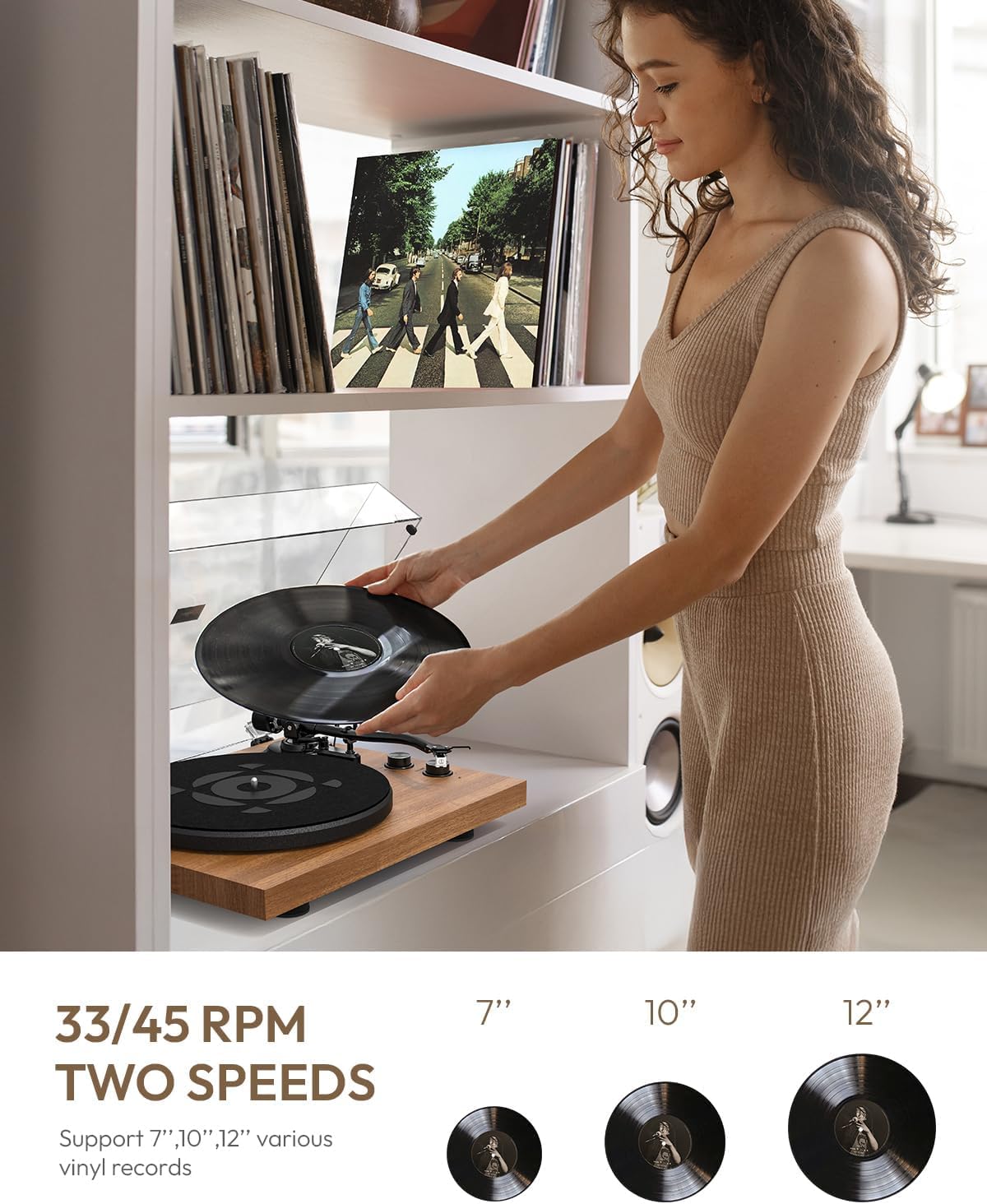
If you’ve ever looked at a record player and wondered why you seemingly need four separate boxes — the turntable itself, a phono preamp (a small amplifier that boosts the turntable’s weak signal to a usable level), a stereo amplifier, and a pair of speakers — you’re not alone. That chain of separates is the traditional audiophile setup, and it exists because each link can be upgraded independently. But it’s also expensive, takes up space, and requires you to understand how the pieces fit together before you’ve even dropped a needle. All-in-one turntables flip that logic: the preamp, amplifier, and speakers are either built directly into the platter unit or bundled as a matched system designed to work together out of the box. Plug in, press play, done. This guide looks honestly at three well-reviewed options — the QLEARSOUL SoulBox S1, the QLEARSOUL ONE-S, and the Audio-Technica AT-LP60X — so you can decide whether the simplicity trade-off makes sense for your specific situation, or whether you’re better off starting with separates from day one.
What You’re Actually Trading When You Go All-in-One
Let’s name the trade-off plainly, because it matters more at the intermediate stage than it does for a first-time buyer who just wants something that plays records.
Signal chain compression. In a separates setup, you choose a phono preamp with a specific RIAA equalization quality, pair it with an amplifier that has headroom to spare, and connect speakers tuned to your room. In an all-in-one, those decisions are made for you — permanently. The components are optimized to work together at a given price point, which means the ceiling is set at the factory. Sound On Sound, in their coverage of phono stages and RIAA equalization (“Understanding Phono Stages,” 2023), makes clear why preamp component quality cascades into everything downstream — and in an integrated system at this price tier, preamp quality is adequate rather than excellent. Analog Planet’s entry-level turntable roundup has noted that listeners tend to become aware of this ceiling around the point when their ears develop meaningful reference points for what good vinyl playback actually sounds like.
Upgrade path versus upgrade trap. This is the more important practitioner frame. An all-in-one that genuinely sounds good now can become a frustration in 18 months if you’ve caught the vinyl bug and want to move up. Some units make that transition easy — line-level outputs, standard RCA jacks, bypass switches on the built-in preamp. Others are essentially sealed systems where adding external speakers or amplification later is harder than it should be. We flag the specific case below.
The decision frame before you read another word: If you already own a stereo receiver with a phono input, or a standalone phono preamp, skip all-in-one units entirely. You’re paying for components you don’t need. The right move is a dedicated deck run through your existing system. The all-in-one category is specifically optimized for people who want zero infrastructure — a bedroom setup, a gift, a listening corner in a space that has no other audio gear — not for someone who already has a signal chain in place.
The Three Units, Compared
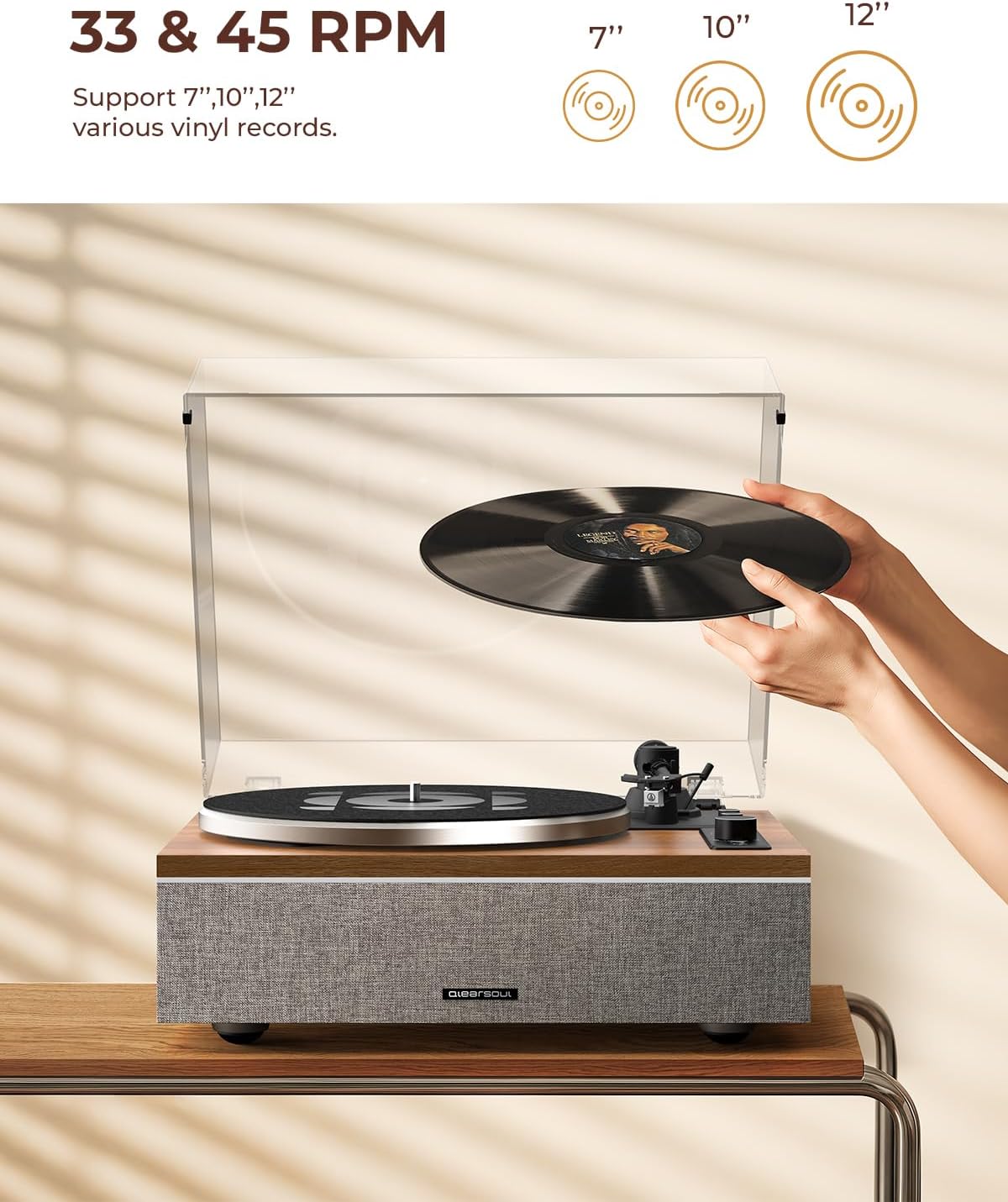
QLEARSOUL SoulBox S1 — The Living-Room Case
Owners of the SoulBox S1 consistently return to two things in their assessments: the sound and the cabinet. The walnut finish is not an afterthought — long-form reviewers describe it as genuinely furniture-grade, something that earns a spot on a credenza without apology. Owner feedback aggregated across retail platforms shows a pattern of surprised satisfaction: the phrase “sounds way better than I expected for the price” recurs independently across review cohorts. Apartment Therapy’s buyer guides for small-space audio (“The Best Record Players for Small Spaces,” 2025) identify this kind of cross-cohort surprise effect as a reliable signal for value-per-dollar performance in the integrated speaker category.
What the SoulBox S1 doesn’t do well: it is a closed system in the design sense. The value proposition is the all-in-one bundle, and it delivers that bundle. If your plan involves eventually routing the signal to a separate amplifier or bookshelf speakers, verify the line-out options before committing. The unit is designed for buyers who want the self-contained experience indefinitely, not as a bridge to separates.
Best for: Someone building a dedicated vinyl corner in a living space where the aesthetic and self-contained simplicity are both features, not compromises. The visual cohesion of the cabinet makes it a credible display piece, not just an appliance.
QLEARSOUL
$169.98
In stock on Amazon
Check price on AmazonQLEARSOUL ONE-S — The Bluetooth-First Option
The ONE-S earns consistent marks for build quality and Bluetooth flexibility. Bluetooth here means the turntable transmits wirelessly to compatible Bluetooth speakers — useful if you already own a wireless speaker you want to use without running cables. Reviewers highlight this as the primary differentiator from the SoulBox S1.
Here is the flag you need to see before buying: detailed reviewer documentation — including at least one assessment that cited a hardware teardown as supporting evidence — has raised an explicit warning that the ONE-S is not designed to be connected to a separate sound system at a later stage. The internal output architecture reportedly limits what you can do with external amplification. This is a rare, specific, technically grounded complaint, not a vague “it sounds cheap” dismissal. It matters because the Bluetooth feature can read like an upgrade path (“I’ll use it wirelessly now, then wire it to my receiver later”) when in practice the output limitations may prevent that second step from working as expected.
The Vinyl Factory’s beginner turntable guide consistently advises readers to ask one question before buying any integrated system: “Can I bypass the built-in preamp and run a clean line-level signal to an external amplifier?” For the ONE-S, based on available reviewer documentation, the answer is more complicated than a clean yes.
Best for: Someone who specifically wants Bluetooth wireless flexibility and plans to stay within the all-in-one ecosystem indefinitely — not someone treating Bluetooth as a bridge to a future separates upgrade.
Audio-Technica
$179.00
In stock on Amazon
Check price on AmazonAudio-Technica AT-LP60X — The Set-and-Forget Standard
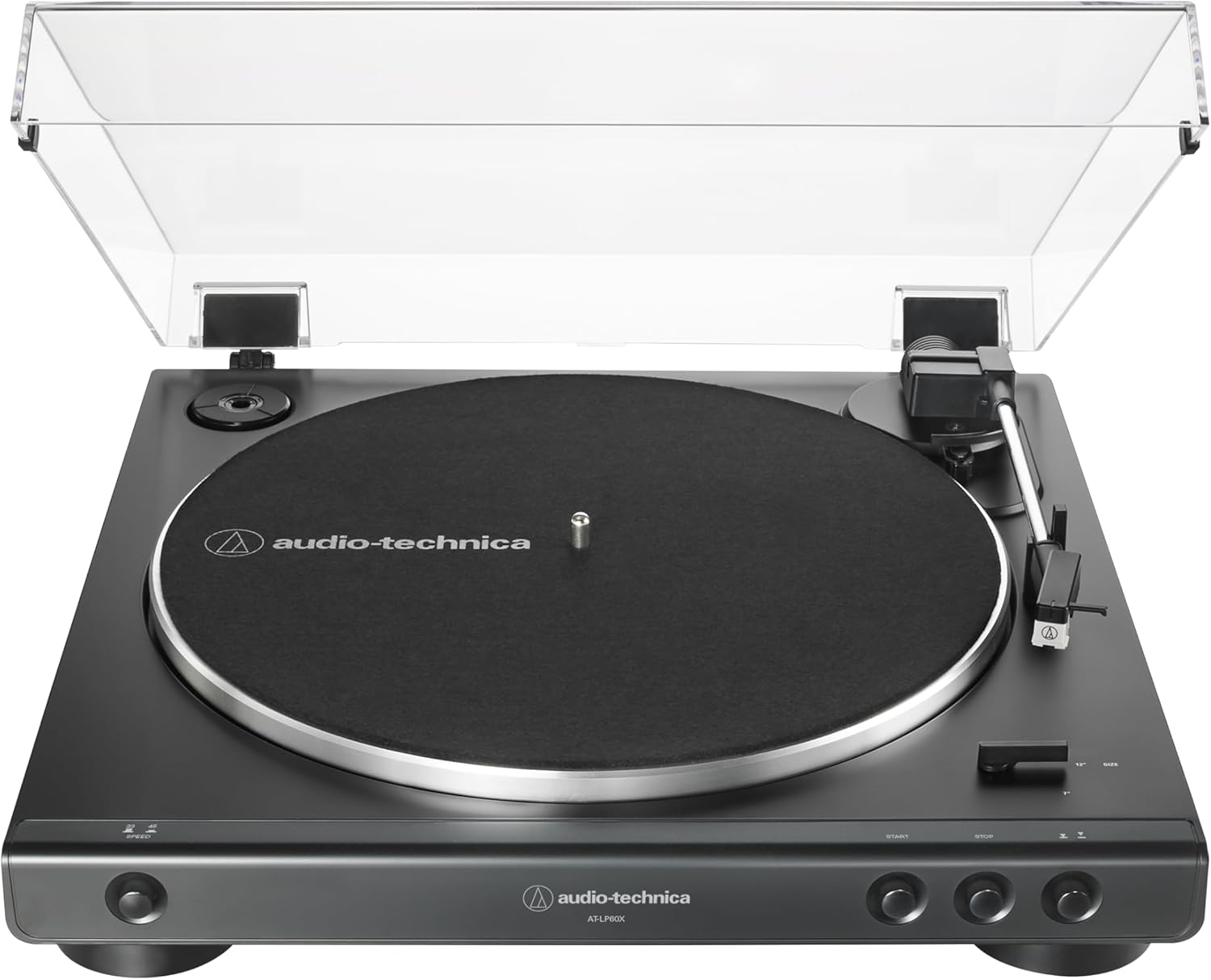
The AT-LP60X is the most widely reviewed unit in this category, which means the pattern of owner feedback is unusually clear. The praise is consistent: Bluetooth pairing works reliably, the fully automatic operation — the tonearm moves, drops, lifts, and returns without you touching it — is genuinely valued by people who want zero fuss, and the built-in phono preamp means you can plug directly into powered speakers or a receiver without worrying about signal levels. Wirecutter, published by The New York Times, has positioned the AT-LP60X as a default recommendation for someone who wants to play records without a strong opinion about setup complexity — a reasonable editorial call given the automatic operation and Bluetooth functionality.
The gotcha — and it appears independently across multiple reviewer cohorts, which makes it credible rather than anecdotal — is the automatic mechanism limitation with non-standard pressings. The LP60X uses a tonearm mechanism with a physical stopper calibrated for standard 7-inch and 12-inch records. Novelty records, picture discs pressed to non-standard diameters, or records with label areas that extend unusually close to the groove can physically prevent the stopper from engaging correctly, sometimes preventing play entirely. If you collect picture discs, shaped records, or any novelty pressings that appear in crate-digging, this is a real constraint. For someone playing standard pressings from a want list, it is a non-issue.
Best for: The LP60X is the right call for someone who wants proven reliability, doesn’t collect novelty pressings, and wants automatic operation with no learning curve whatsoever.
Audio-Technica
$179.00
In stock on Amazon
Check price on AmazonSide-by-Side Snapshot
| Unit | Auto/Manual | Bluetooth | Phono Preamp Built In | External Output Notes |
|---|---|---|---|---|
| QLEARSOUL SoulBox S1 | Manual | No | Yes | Standard |
| QLEARSOUL ONE-S | Manual | Yes | Yes | Limited per reviewer documentation |
| Audio-Technica AT-LP60X | Fully Automatic | Yes | Yes | Standard RCA |
The Sound Ceiling — and When You’ll Hit It
Every experienced reviewer in this category eventually lands on the same honest observation: these systems sound better than the price suggests, and then you hit a ceiling. Stereophile’s coverage of entry-level analog (“Entry-Level Analog: What the Price Buys,” 2024) frames this clearly — at the price tier where all-in-one units compete, the engineering compromises that keep the system affordable tend to concentrate in the preamp stage and the speaker drivers, which are the two components that most directly shape what the listener perceives as “the sound.” The difference between an adequate preamp and a good one becomes audible once you’ve heard the same pressing on a separates system with a purpose-built phono stage.
For someone with 6–24 months of serious vinyl listening, this ceiling tends to arrive around the point where you start buying original pressings rather than modern reissues. Original pressings from labels known for wide dynamic range reward better playback chains. Running a late-1970s original pressing through a budget integrated system isn’t wrong, but you are leaving resolution on the table that was pressed into the groove.
The practical implication: treat an all-in-one as a Phase 1 purchase, not a forever purchase. If you’re buying for someone else, or for a specific context — a themed event, a guest room, a display setup — the value math is excellent. If you’re already at the crate-digging stage and developing a reference ear, the smarter spend is a standalone deck with a dedicated phono preamp and powered monitors.
Frequently Asked Questions
Can the QLEARSOUL ONE-S connect to external speakers or an amplifier later? Based on reviewer documentation — including at least one review that cited a hardware teardown as evidence — the ONE-S has output limitations that can make connecting to a separate sound system more complicated than a standard line-out would suggest. If external amplification is part of your plan at any point, verify the output specification before purchasing and read detailed reviewer assessments carefully before committing.
Does the AT-LP60X work with Bluetooth speakers right out of the box? Yes, in the standard use case. The AT-LP60X includes a Bluetooth transmitter that pairs with compatible Bluetooth speakers without additional hardware. Multiple independent reviewers confirm the pairing process is straightforward. The caveat is Bluetooth latency — wireless audio introduces a small delay that is imperceptible when listening to music but relevant if you are watching video simultaneously.
What does “built-in phono preamp” mean and why does it matter for beginners? A turntable generates a very weak audio signal — called a phono-level signal — that needs amplification before it reaches speakers or an amplifier. A phono preamp does that amplification while also applying a standardized equalization curve (RIAA) that corrects for how records are mastered. Without a phono preamp somewhere in the chain, you get very quiet, thin sound. “Built-in” means it is already inside the turntable, so you can plug directly into powered speakers or a standard auxiliary input without buying a separate box. Sound On Sound’s phono stage coverage (“Understanding Phono Stages,” 2023) identifies this as the single most important feature to confirm before connecting any turntable to a system you have not used with vinyl before.
Will an all-in-one turntable damage my vinyl records compared to a separate setup? The primary record-wear concern is tracking force — the downward pressure the stylus exerts on the groove. This is set at the factory on all-in-one units and is typically within safe ranges for standard records. The Vinyl Factory’s beginner turntable guide notes that the larger risk with budget all-in-ones is stylus quality: a worn or low-quality stylus does more groove damage than a properly maintained better stylus. Replacing the stylus on an AT-LP60X is a documented and inexpensive maintenance step. None of the three units reviewed here are flagged by credible reviewers as record-damaging under normal use with standard pressings.
What is the automatic mechanism limitation on the AT-LP60X? Automatic turntables use a mechanical sensor or physical stopper to detect when a record ends and return the tonearm. This mechanism is calibrated for standard record diameters. Mini-LPs, certain picture discs with non-standard diameters, and novelty shaped records can confuse or physically block this mechanism. On the AT-LP60X specifically, multiple reviewers have documented that the automatic stopper physically prevents play on affected formats. If your collection includes non-standard pressings, either test before committing or choose a manual turntable where you control tonearm movement directly.
Which of these is worth buying if I already own a decent stereo receiver? None of them, honestly. If your receiver has a phono input — many do, labeled “PHONO” — you already have the preamp stage covered. If it does not, a standalone phono preamp in the $40–$80 range unlocks a much wider selection of dedicated turntable decks. In either case, the money spent on a built-in speaker system in an all-in-one is money not spent on a better cartridge or stylus. The AT-LP60X does have standard RCA outputs that let you bypass the built-in speakers and run into a receiver, which is worth knowing — but at that point you are buying a substantial set of features you will not use. If you have a receiver, look at a dedicated deck in the $200–$400 range and run it through what you already own.