August 8, 2026 • Roxanne Flair • 10 min reading time • Prices verified June 4, 2026
Adjustable-Speed Disco Ball Motors: Why RPM Control Changes Everything
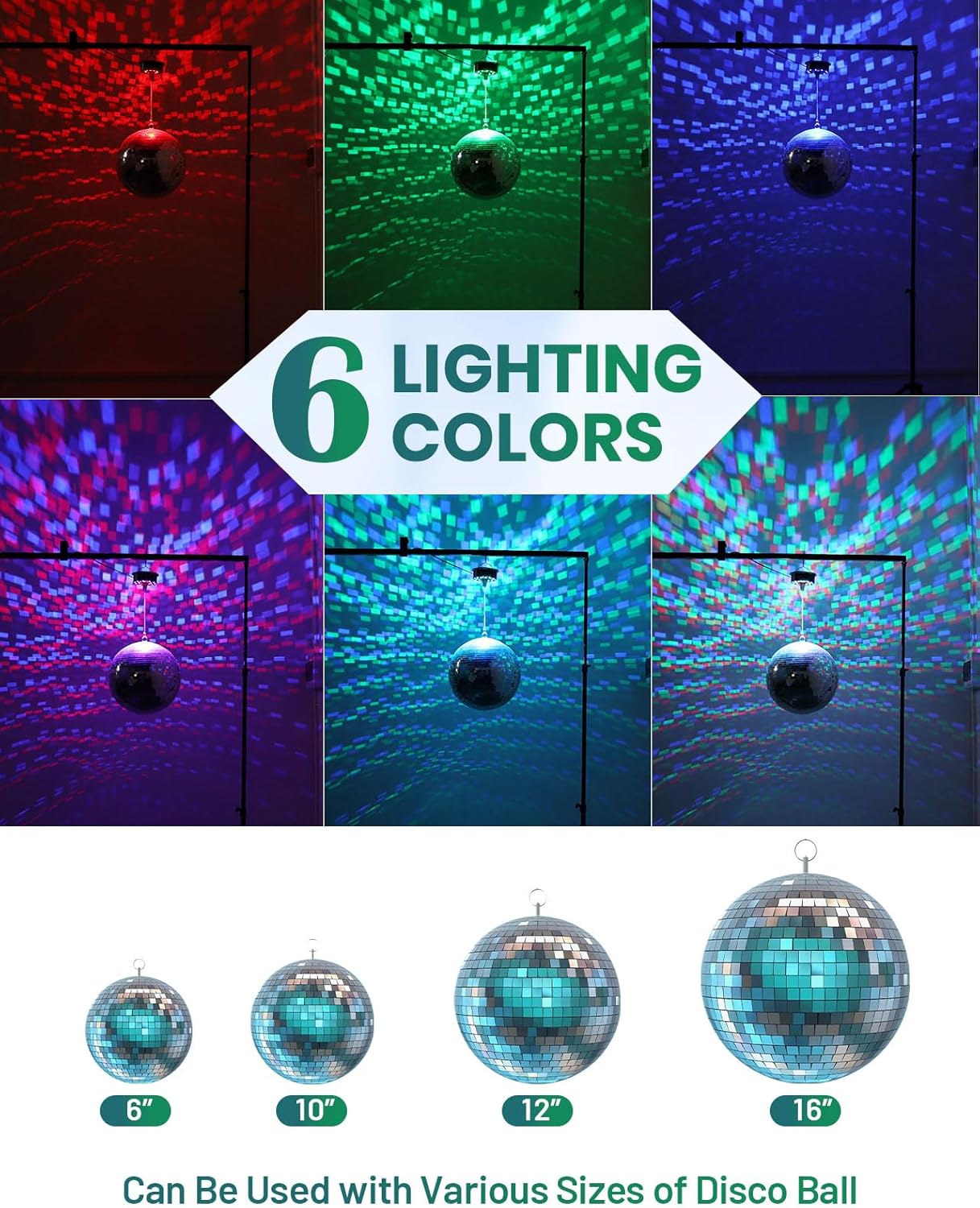
If you’ve ever hung a mirror ball — that spinning sphere covered in tiny square mirrors — in a room and flipped it on, you already know the magic: every light source in the room fractures into dozens of slow-moving dots that crawl across the walls and ceiling. The motor is the unsung piece of this setup. It’s the small electric unit that clamps to your ceiling hook or rigging point and rotates the ball. Most people buy whatever motor is cheapest without thinking about speed, and then discover mid-party that the thing is spinning so fast the reflected dots are strobing across the room like a broken flashlight. That’s the problem this guide solves. We’re going to break down what motor speed (measured in RPM — revolutions per minute, meaning how many full rotations the ball completes in sixty seconds) actually means in practice, which speeds suit which settings, and where adjustable-speed motors earn their price premium over fixed-speed options.
This is aimed at buyers who already understand the basics but are standing in front of a real purchase decision: a home install, a recurring mobile gig, or a permanent venue setup where getting it wrong has a cost.
| EDITOR'S PICKMeagoo Disco Ball with Motor an… | Mid-tier1.5 RPM Speed Disco Ball Motor… | Budget pickSlow Rotating Disco Ball Motor… | |
|---|---|---|---|
| Speed | 6 RPM | 1.5 RPM | — |
| Power source | Battery | — | Battery |
| Ball size range | 8" (included) | 4"–16" | — |
| Light included | ✓ | — | — |
| Light colors | 4 | — | — |
| LED count | 18 | — | — |
| Price | $38.99 | $16.14 | $9.49 |
| See on Amazon → | See on Amazon → | See on Amazon → |
The 6 RPM Problem Nobody Warns You About
Here’s the single most useful data point we can hand you before you buy anything: 6 RPM is faster than it looks on a spec sheet.
One owner report that circulates consistently across product review threads quantifies this precisely — at roughly 11 feet of wall distance from a mirror ball driven by even a modest 10-watt LED pin spot, the reflected light dots move uncomfortably fast at 6 RPM. The effect tips from “disco sparkle” into something closer to a visual irritant. For a three-hour wedding reception or a home living room install where you want ambiance rather than energy, that’s a real problem.
Sound On Sound’s coverage of live event lighting fundamentals reinforces the underlying principle: perceived motion speed for reflected light depends not just on rotation rate but on the distance the light travels before it hits a surface. A small room compresses that distance and amplifies the apparent speed. A 12-foot ceiling in a living room will make any given RPM feel faster than the same motor running in a ballroom with 22-foot ceilings.
This is why the fixed-speed 6 RPM motors that dominate the entry market — perfectly adequate for some applications — generate so many “too fast” complaints from home buyers. The reviewers aren’t wrong. The motors are doing exactly what they’re rated to do. The spec sheet just doesn’t translate that into real-room experience.
RPM by Use Case: A Decision Frame
Before comparing specific motors, build the decision around your actual use case. Here’s how the math shakes out:
By the Numbers
| Setting | Recommended RPM Range | Why |
|---|---|---|
| Wedding ceremony / slow ambiance | 1–2 RPM | Dots move imperceptibly slow; calming, romantic |
| Home living room / bedroom install | 1.5–3 RPM | Sparkle without visual fatigue over 2–3 hours |
| Active dance floor, club night | 4–6 RPM | Energy and movement; short exposure windows |
| Film set / photography backdrop | Variable (remote control) | Director controls mood shot-to-shot |
The 1.5 RPM slow motor category exists precisely because buyers at every price tier eventually discover that 6 RPM doesn’t suit their space. Owners who land on a 1.5 RPM fixed motor after starting with a faster one tend to be vocal about the relief — the recurring phrase across aggregated reviews is some version of “this is what I was actually looking for.” It solves a problem that most product listings don’t warn you exists.
DJ Mag’s mobile DJ gear coverage notes that for paid events, the lighting environment is part of the experience your client is hiring you to deliver — and a mirror ball spinning at the wrong speed for a wedding cocktail hour is the kind of detail that gets noticed, even by guests who couldn’t name what was wrong.
The Case for Adjustable-Speed Motors
If your use case is variable — you DJ weddings and club nights, you have a permanent home install you want to dial in seasonally, or you’re rigging for film or photography work — an adjustable-speed motor with remote control is the only version worth buying.
The buyers who develop genuine loyalty to adjustable-speed motors skew toward unusual or professional use cases: film set operators who need to cut from a slow romantic scene to a high-energy dance sequence without climbing a ladder, golf simulator lounge owners running a permanent ambient install, and mobile DJs who want one motor that works across venue types. Apartment Therapy’s home disco setup coverage identifies this as the “set it and forget it” buyer’s best insurance — you may not know your ideal speed until the ball is spinning in your actual room, and the ability to adjust from a remote rather than a stepladder is a meaningful quality-of-life feature.
The tradeoff is cost and complexity. Adjustable motors cost roughly 2–3× what a fixed-speed motor runs at the same build quality tier. For a one-time party install where the ball comes down after the event, that premium rarely makes sense. For anything permanent or recurring, it pays back quickly.
Ball Weight and Ceiling Height: The Interaction Most Buyers Miss
Two variables that spec sheets rarely connect: ball diameter and ceiling height interact with RPM to produce the apparent speed your guests experience.
A larger, heavier ball — say a 16-inch mirror ball versus an 8-inch — amplifies the distance each reflected dot travels per rotation. At the same RPM, the 16-inch ball generates faster-moving dots at the wall surface than the 8-inch. This means if you’re upgrading from a small ball to a larger one without adjusting motor speed, the effect will feel more aggressive even though the motor specification is identical.
Ceiling height works in the same direction: lower ceilings compress the reflection geometry and make dots move faster across surfaces. A 1.5 RPM motor in a 9-foot basement ceiling can produce faster apparent motion than a 3 RPM motor in a lofted 18-foot ballroom.
The practical decision rule here: if your ceiling is under 10 feet or your ball is 12 inches or larger, start your speed assumption one tier lower than you think you need. Owners of 16-inch balls in standard 8-foot living rooms consistently report that even 3 RPM reads as “fast” in practice.
On the motor capacity question — can a standard mirror ball motor handle a 12-inch or 16-inch ball without stalling? — most quality motors rated for balls up to 20 lbs will spin a 16-inch ball without issue. The failure mode owners report is not stall under normal load but gradual bearing wear when consistently overloaded. Check the manufacturer’s rated weight capacity and build in a margin; running a motor at 90% of its rated weight spec shortens bearing life noticeably according to owner reports across long-run reviews.
Battery Power: The Reliability Question
Battery-operated disco ball motors are genuinely useful for setups where running a power cable isn’t practical — outdoor events, golf simulators, photography backdrops, or anywhere the ceiling hook is far from an outlet. But there’s a documented reliability pattern worth knowing before you commit.
One owner report that surfaces repeatedly in battery motor reviews describes intermittent shutoffs requiring a battery reset to restart. This is not a defective-unit anomaly — it’s a consistent enough pattern across multiple reviewers to treat as a category characteristic rather than bad luck. The likely cause, based on owner speculation in those reviews, is voltage sag as batteries drain, triggering an undervoltage protection circuit.
The practical implications: for a one-night party where you’re starting with fresh batteries and the motor runs two to three hours, this risk is low. For a permanent install or an event where you can’t monitor the motor, it’s a real concern. Our honest read of the aggregated owner data is that battery motors are a convenience tool, not a reliability tool. If you can run mains power, do it.
Cable Length: The 6.5ft vs. 16ft Question
A detail that generates more buyer confusion than it should: many motor models are sold in both a short cable (typically around 6.5 feet) and a long cable (typically around 16 feet) version, and buyers don’t always know which they’re ordering.
The cable here is the drop cable — the length of cord between the ceiling mounting point and the motor itself, which determines how far down the ball hangs from the ceiling. This is not the power cord.
The practical difference: in a room with 8–10 foot ceilings, the short cable puts the ball at roughly eye level or slightly above, which maximizes the ceiling coverage of the reflected light. The long cable version is for high-ceiling venues — ballrooms, event spaces, warehouses — where you want the ball positioned lower so the reflected dots land on the dance floor area rather than only the ceiling. Rolling Stone’s 2024 coverage of the disco revival notes that the “disco ceiling” effect — that wash of moving light across a crowd — requires the ball to be positioned so light sources can reach it from below; too high a hang with too short a cable in a high-ceiling room defeats this.
If you’re buying for a home with standard ceilings, the short cable version is almost always correct. If you’re buying for a venue or event space with ceilings above 12 feet, price out the long cable version.
Frequently Asked Questions
Is 6 RPM too fast for a home living room or bedroom disco ball setup? For most rooms, yes. Owner reports consistently describe 6 RPM as producing light dots that move uncomfortably fast at typical living room distances, especially with a bright LED pin spot. 1.5–3 RPM is the range most home users land on after experimenting.
What RPM speed is best for a wedding ceremony versus an active dance floor? Wedding ceremony: 1–2 RPM maximum. You want barely perceptible, atmospheric movement. Active dance floor: 4–6 RPM is appropriate and matches the energy. If you’re covering both in one night, an adjustable-speed motor with remote is the only practical solution.
Can a disco ball motor handle a 12-inch or 16-inch ball without stalling? Yes, provided the motor is rated for the weight. Most quality motors handle balls up to 20 lbs without stalling. Confirm the manufacturer’s weight rating and leave yourself a margin — running consistently at or near the rated limit accelerates bearing wear according to long-run owner reports.
Does battery power affect how reliably a disco ball motor spins? Yes. Battery-operated motors carry a documented risk of intermittent shutoffs as battery voltage drops, requiring a manual reset. This is a real category-level pattern, not isolated bad units. For permanent installs or unmonitored events, mains power is more reliable.
What is the difference between the 6.5ft and 16ft cable versions of the same motor? The cable length is the drop from ceiling to motor — it determines how low the ball hangs, not how far the power cord reaches. Short cables (6.5ft) suit standard 8–10 foot residential ceilings. Long cables (16ft) are for high-ceiling venues where you need the ball positioned lower to properly scatter light across the room.
How do I know which motor speed is right for my room size? Start with ceiling height and ball diameter. Ceilings under 10 feet and balls 12 inches or larger both push toward slower speeds. As a starting framework: 1.5–2 RPM for small rooms or ambient installs; 3–4 RPM for mid-size rooms with active use; 6 RPM only for large spaces or short-duration high-energy events. When in doubt, buy adjustable.